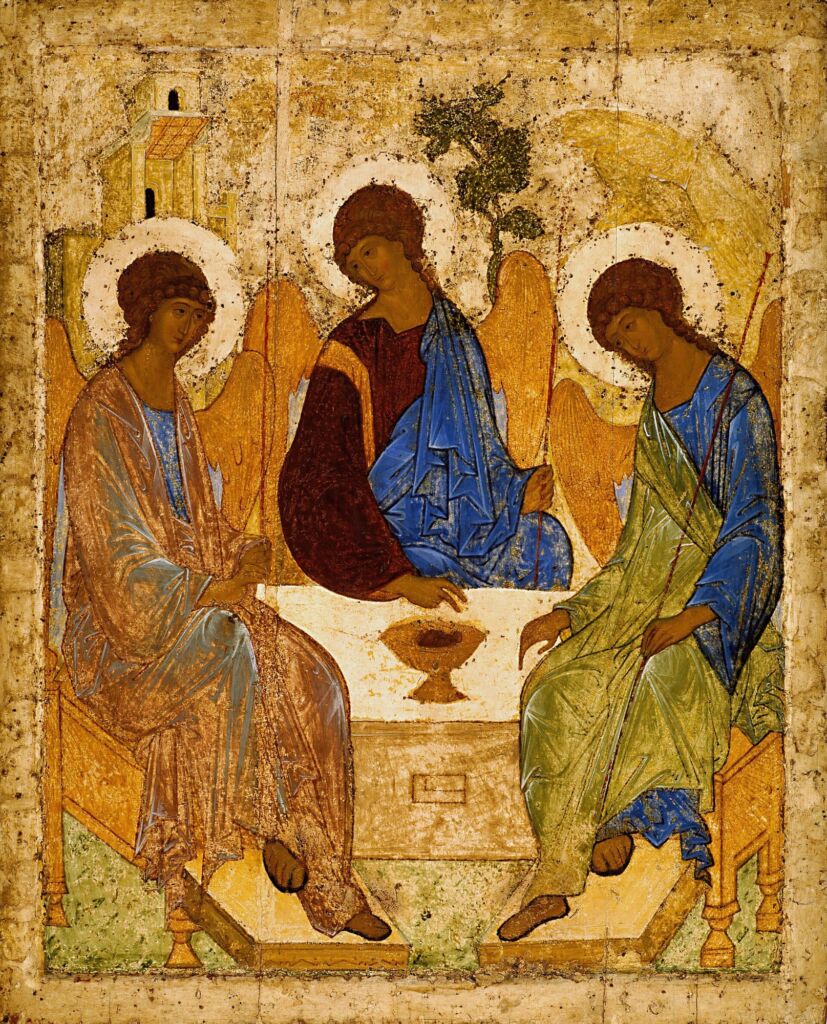
Andrei Rublev, Trinity, 1411 or 1425–1427
Andrei Rublev
Andrei Rublev · 1360, Unknown — 1430, Moscow
Biography
In the spring of 1405 a chronicler listed the masters painting the Church of the Annunciation at the grand prince's court in the Moscow Kremlin: Theophanes the Greek, the elder Prokhor of Gorodets and “the monk Andrei Rublev.” This is the first reliable mention of the man whose name has become synonymous with the medieval Russian icon. He came last on the list, as the junior of the three. Everything before that entry is guesswork.
His year of birth is unknown; it is most often put at around 1360, though earlier estimates exist. The sources do not say where he was born or who taught him. Later tradition links him with the Trinity Monastery founded by St Sergius of Radonezh north of Moscow (today the Trinity Lavra of St Sergius) and with Sergius's disciples, and he apparently took his vows at the Andronikov Monastery of the Savior in Moscow. His work beside Theophanes in 1405 is the most that can be said about his training.
In 1408 the chronicle names him again: with Daniil Chorny he was painting the Dormition Cathedral in Vladimir. Their Last Judgment frescoes survive in part, and they are the only surviving work by Rublev dated by a document. A huge iconostasis was painted for the same cathedral at the time; its icons are now divided between the State Tretyakov Gallery and the State Russian Museum. Rublev went on working with Daniil. Around 1425–1427 Abbot Nikon of Radonezh asked them to paint the new stone Trinity Cathedral built over the relics of Sergius. The frescoes have not survived; the iconostasis has.
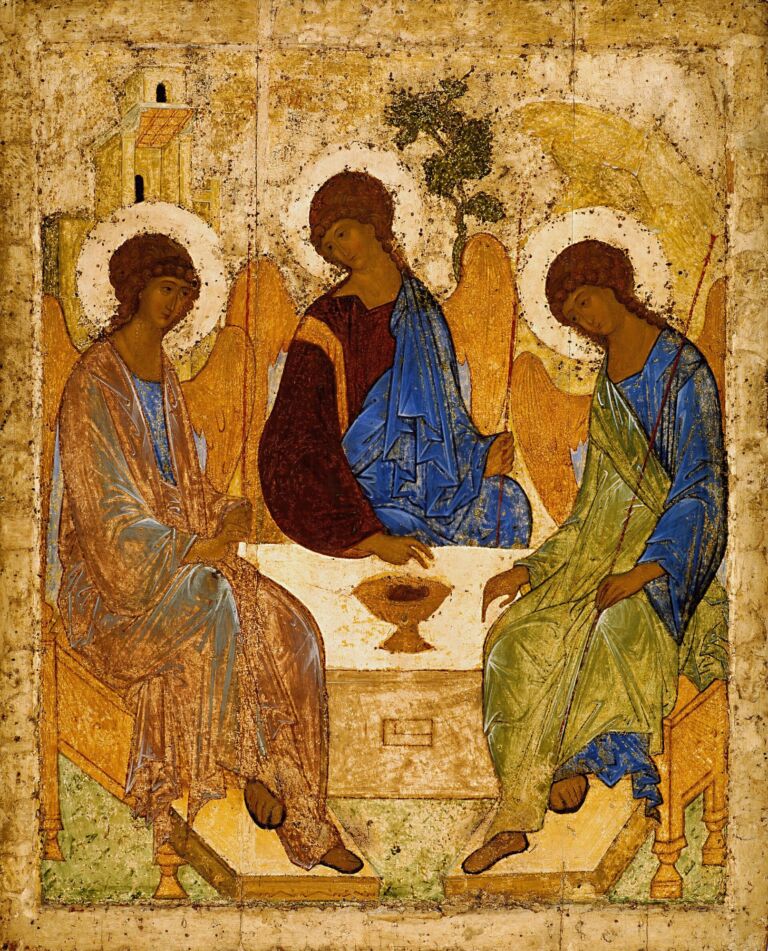
The Trinity is also associated with that cathedral. Its dating varies: around 1411, or 1425–1427, together with the iconostasis. For centuries it was hidden under a metal cover (oklad) and later overpainting. Restorers first uncovered it in 1904–1905 and completed the work in 1918–1919, and the icon came as a revelation. From 1929 it was kept in the State Tretyakov Gallery, and in 2023 it was handed over to the Russian Orthodox Church. Since June 2024 the Trinity has been back in the Trinity Cathedral of the Lavra. Museum professionals have repeatedly voiced concern about its condition: in 2025 Tretyakov specialists noted changes in the icon's condition, and in September 2026 it was taken down from the iconostasis for three weeks because of problems with its climate-controlled case.
The other great discovery is the Zvenigorod Deesis: three icons from a Deesis tier (Christ flanked by interceding saints), including the Savior, found in Zvenigorod in 1918. Their attribution to Rublev is not supported by documents, and in 2017 Tretyakov experts questioned whether the Savior was painted by the same hand as the other two icons. Rublev turned away from the tense, sharp manner of Theophanes. His line is soft, his silhouettes flowing, his color clear and light, like the famous blue of the Trinity. His icons do not frighten; they reconcile.
His last work is thought to be the murals of the Cathedral of the Savior at the Andronikov Monastery. He died there, in 1428 or 1430 according to different sources; the dates given are October 17, 1428, and January 29, 1430. His grave has not survived.
His fame did not begin in the 20th century. As early as 1551 the Stoglav (Hundred Chapters) Council told icon painters to work “from ancient models,” as Andrei Rublev had painted, a rare case in the Middle Ages of a master's name becoming a standard. Andrei Tarkovsky's film Andrei Rublev (1966) made him a hero for the modern age, although almost the entire plot is invented. In 1988 the Russian Orthodox Church canonized him, numbering him among its venerable monastic saints. Today Rublev can be seen at the State Tretyakov Gallery, in the Dormition Cathedral in Vladimir, at the Trinity Lavra of St Sergius and in the former Andronikov Monastery, where the Museum of Ancient Russian Culture and Art has borne his name since 1985.
Major works
Click a painting to see the details.
-
 01
Trinity
1411 or 1425–1427 · Trinity Cathedral, Trinity Lavra of St Sergius, Sergiev Posad
Related artists
 Theophanes the Greek
1405 · senior master; joint murals