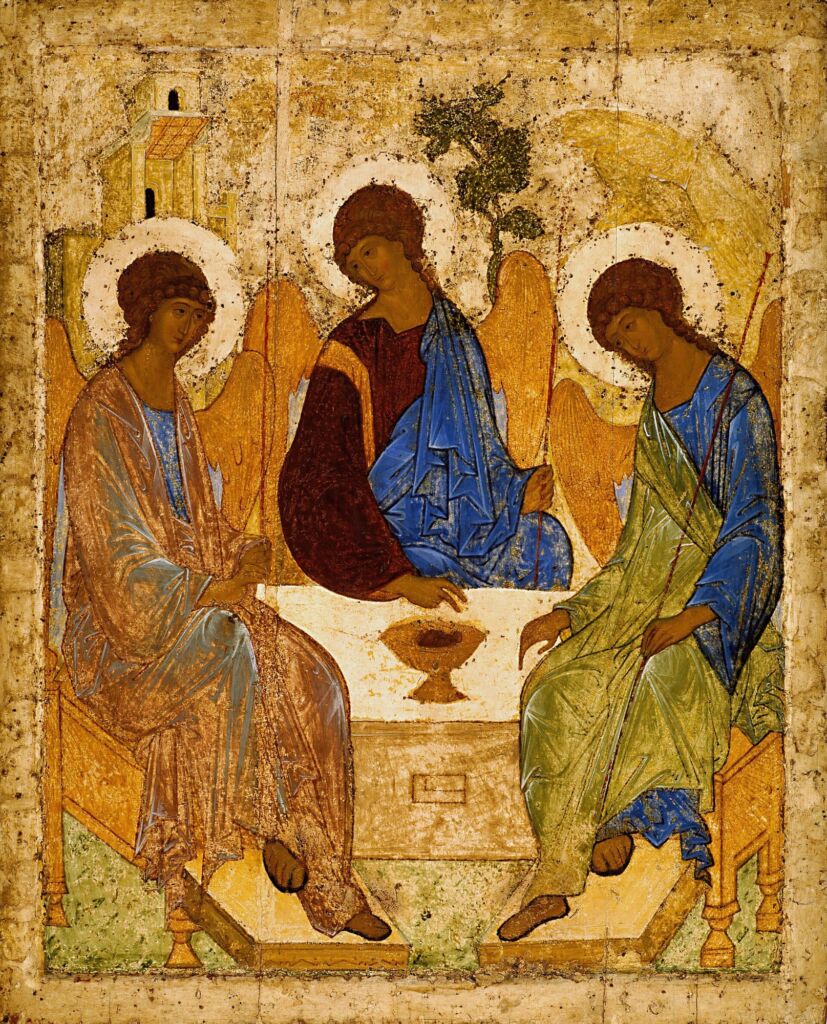
Andrei Rublev, Trinity, 1411 or 1425–1427
Russian icon painting
10th–17th centuries · Rus
About the movement
In 1904 the collector Ilya Ostroukhov succeeded in having restorers begin removing the later layers from the Trinity at the Trinity Lavra of St Sergius, the great monastery outside Moscow. The icon had been repainted at least five times, and beneath the darkened drying oil and the overpainting of the 17th to 19th centuries nobody could see the real Andrei Rublev any longer. The cleaning, carried out by a team under the icon painter Vasily Guryanov, marked the start of the rediscovery of the medieval Russian icon, an art that for almost two centuries had been dismissed as the business of craftsmen and the Old Believers, the traditionalists who broke with the official Church in the 17th century.
Icon painting reached Rus after its conversion to Christianity in 988, together with Greek masters and models. The most famous of the imported images is Our Lady of Vladimir, painted in Constantinople, which traveled from Kyiv to Vladimir and then to Moscow. For the first few centuries Russian artists learned from Byzantium, but local schools gradually took shape: Novgorod, with its ringing vermilion, Pskov, Tver and Moscow. The icon made no attempt to imitate nature. Reverse perspective, gold grounds and stylized light were meant to show not the earthly world but a transfigured one.
In the 1370s the Byzantine painter Theophanes the Greek came to Novgorod, and in 1378 he painted the frescoes of the Church of the Transfiguration on Ilyina Street, the only ones of his that survive beyond dispute. He later worked in Moscow, and in 1405, with the elder Prokhor of Gorodets and Andrei Rublev, decorated the Cathedral of the Annunciation in the Kremlin. Our Lady of the Don (late 14th century) is attributed to the circle of Theophanes. Rublev turned the icon toward stillness and contemplation, and the summit of that path was the Trinity. Its date is disputed: some scholars place it in 1408–1412 (1411 is often given), others in the mid-1420s, when the stone Trinity Cathedral was built. Little is known about Rublev himself. A monk of the Andronikov Monastery in Moscow, he died around 1430, and in 1988 a Local Council of the Russian Orthodox Church canonized him.
The next high point came with Dionisius. In 1500 his workshop produced the Crucifixion for the Pavlo-Obnorsky Monastery, and in 1502 he and his sons painted the Cathedral of the Nativity of the Virgin at the Ferapontov Monastery; the luminous, elongated figures of these frescoes are regarded as the culmination of the classical period. In the 17th century the painters of the Kremlin Armory, led by Simon Ushakov, began to introduce volume and modeling in light and shade, and the reign of Peter the Great finally shifted the center of Russian art to secular painting.
The real discovery of the old icon came in the 20th century. In the autumn of 1911 Henri Matisse visited Moscow; Ostroukhov showed him his icon collection and gave him two pieces, which Matisse, in a letter to his wife, called "a royal gift." In 1913 Moscow held a large exhibition of early Russian art with newly cleaned icons, and the critic Pavel Muratov predicted that Europe would soon want such an exhibition too. In 1918 the Trinity went to the restoration workshops headed by Igor Grabar, where it was uncovered down to the original paint layer, and in 1929 it entered the State Tretyakov Gallery.
Today the fate of the most important icons is changing again. In 2023 the Trinity was handed over to the Russian Orthodox Church and is now displayed at the Trinity Lavra of St Sergius. On April 3, 2026, the Tretyakov Gallery transferred Our Lady of Vladimir and Our Lady of the Don to the Church for free use, and they were moved to the Cathedral of Christ the Saviour. All three icons are still listed in the gallery's collection; the handover of the Trinity had already drawn criticism from specialists, who feared for the fragile panel outside a museum. The icon's legacy, meanwhile, has long since spread beyond the church: from Kuzma Petrov-Vodkin to Kazimir Malevich, the Russian avant-garde learned flatness, color and the rejection of illusion from it.
Artists
Major works
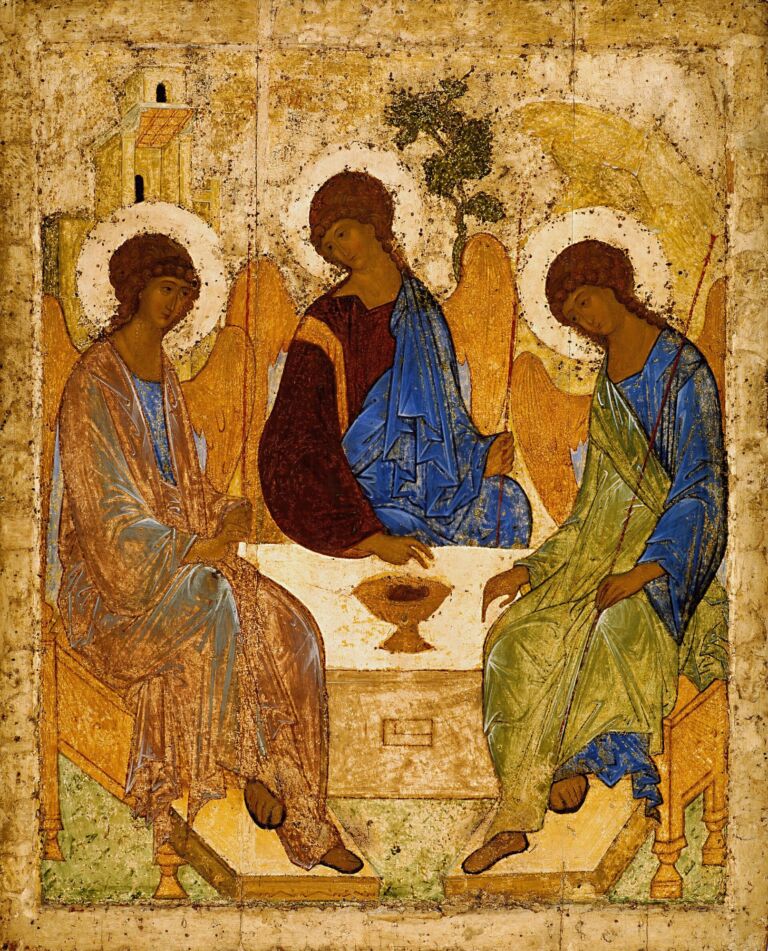 TrinityAndrei Rublev · 1411 or 1425–1427