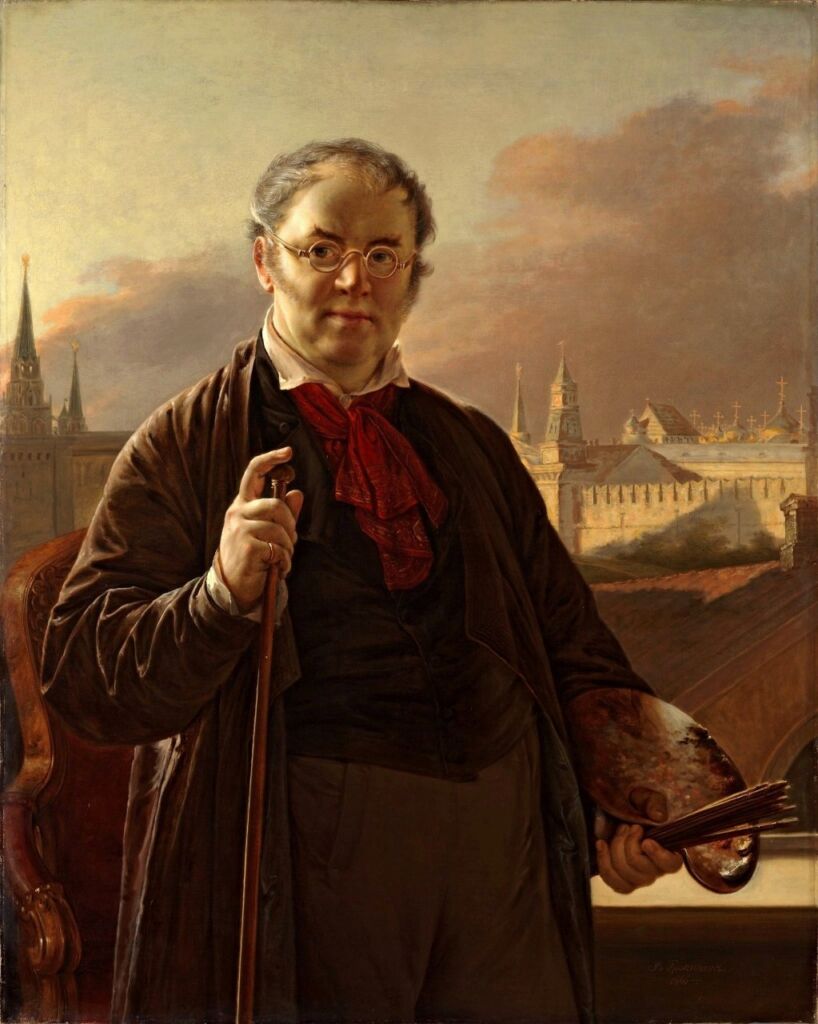
Vasily Tropinin
Vasily Andreyevich Tropinin · 1776, Karpovo village — 1857, Moscow
Biography
In 1823 an artist already past forty was granted his freedom. Until then Vasily Tropinin had been a serf: born in the village of Karpovo near Novgorod, he passed to Count Irakly Morkov as part of the count’s wife’s dowry and was listed in his household now as a pastry cook, now as a footman. His year of birth is traditionally given as 1776, but, according to the State Russian Museum, the inscription on his gravestone and parish confession records point to 1780.
Morkov sent him to St Petersburg to train as a pastry cook, but the young man secretly attended drawing classes at the Academy of Arts. In 1799 his master allowed him to study there as an auditor under Stepan Shchukin. Success came quickly: in 1804 his picture Boy Grieving over a Dead Bird caught the eye of the empress. Then Morkov recalled him to Kukavka, his estate in Ukraine. Tropinin spent about twenty years there, copying paintings and portraying the count’s family, the peasants and the countryside. From these years come A Girl from Podolia (1804–1807) and the family portrait of the Counts Morkov (1813). Almost all of his early works perished in 1812, when the Morkovs’ Moscow house burned down.
Freedom brought immediate recognition. In 1823 he presented The Lacemaker, An Old Beggar and a portrait of the artist Skotnikov to the Academy Council and was named a candidate academician, receiving the full title in 1824. The Lacemaker had a remarkable history: it was bought by the writer Pavel Svinyin; after his collection was sold in 1834 it passed to the collector Pryanishnikov as The Pretty Russian Lacemaker, then to the Rumyantsev Museum, and in 1925 to the State Tretyakov Gallery. The artist’s own replica of 1824 is in Nizhny Novgorod.
In 1827, at the house of Sergei Sobolevsky, he was introduced to Alexander Pushkin. The poet disliked sitting for portraits but made an exception for Tropinin. The portrait of Pushkin in a dressing gown is now in the All-Russian Pushkin Museum: in 1937 the Tretyakov sent it to Leningrad for the anniversary exhibition, and it stayed. From the same years come The Gold Embroiderer (1826) and The Guitarist, whose sitter, it turned out, was Vladimir Morkov, who merely shared a surname with the artist’s former master.
Muscovites nicknamed him the “dressing-gown portraitist.” Tropinin posed his sitters at home, without ceremonial sashes and columns, and this set him apart from the St Petersburg tradition of portraiture. A special place belongs to the Portrait of the Artist’s Son (c. 1818): the boy Arseny is painted as if alive, unposed. Tropinin’s wife, Anna Katina, as State Russian Museum researchers have established, sat for several late works once thought to be portraits of various old women.
He became Moscow’s leading portraitist. In 1833 he worked with the Public Art Class, which grew into the Moscow School of Painting, Sculpture and Architecture. In 1843 the Moscow Art Society elected him an honorary member. His sitters included the historian Nikolai Karamzin, the statesman Mikhail Speransky and the actor Karatygin.
Tropinin died in Moscow in May 1857 and was buried in the Vagankovo Cemetery. In 1969 a museum bearing his name opened in the Zamoskvorechye district.
The main collections are the State Tretyakov Gallery, the Tropinin Museum and the State Russian Museum. In 2026 the Marble Palace in St Petersburg showed about a hundred of his works, the first monographic exhibition in Russia in half a century. Alla Manilova, director of the State Russian Museum, called him “a genius of the Russian portrait.”
Major works
Click a painting to see the details.
-
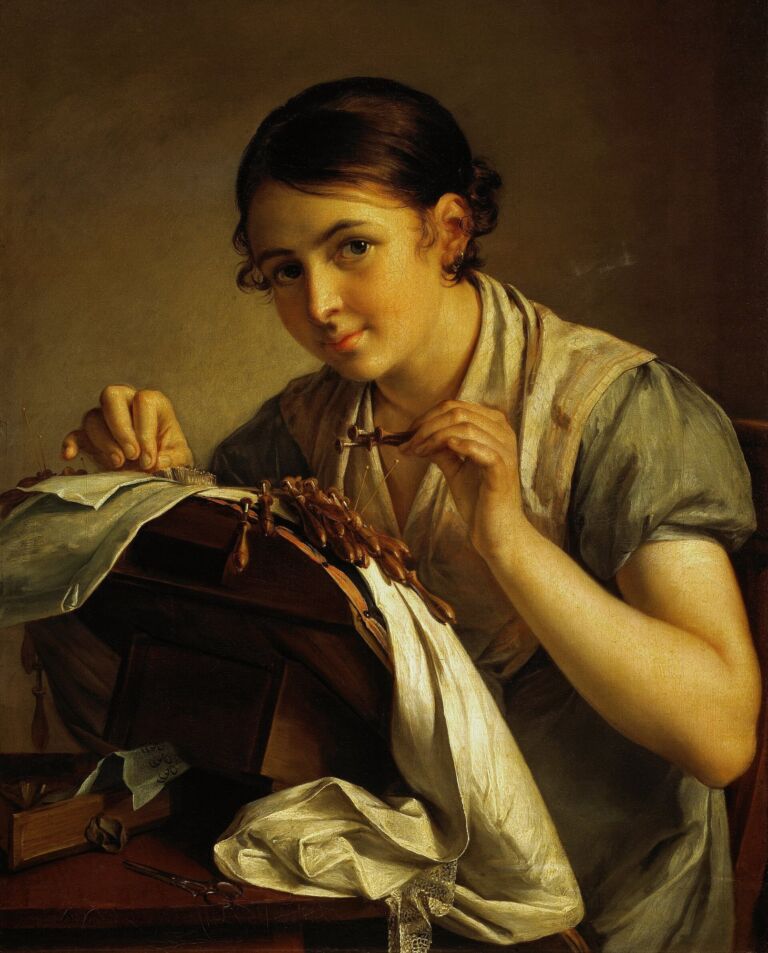 01
The Lacemaker
1823 · State Tretyakov Gallery, Moscow