Art movement
Abstract art
1910s–1960s · Europe, Russia and the United States
About the movement
On a watercolor in the Centre Pompidou, often called the "first abstraction," Wassily Kandinsky wrote the date 1910. Most scholars believe the sheet was made around 1913 and that the earlier date was added after the fact, in a dispute over who came first. The dispute says a lot: nonobjective painting was born almost simultaneously in several cities. Kandinsky was working in Munich, František Kupka and Robert Delaunay in Paris, Mikhail Larionov and Kazimir Malevich in Moscow, Piet Mondrian in the Netherlands. The Swedish painter Hilma af Klint had been making abstract cycles as early as 1906–1915, but she left instructions that they not be shown for twenty years after her death; the wider public saw them only in 1986, at the exhibition "The Spiritual in Art" in Los Angeles.
Abstract art is not a style but an umbrella over dozens of movements. They share one thing: a picture no longer has to depict anything visible. Color, line, plane and rhythm acquire rights that once belonged to subject matter. The justifications varied. In Concerning the Spiritual in Art, published in December 1911, Kandinsky compared painting to music and spoke of "inner necessity." Malevich sought the "zero of form," Mondrian a universal harmony of right angles and primary colors. Some came to abstraction through Theosophy and mysticism, others through the Cubist breakdown of the object.
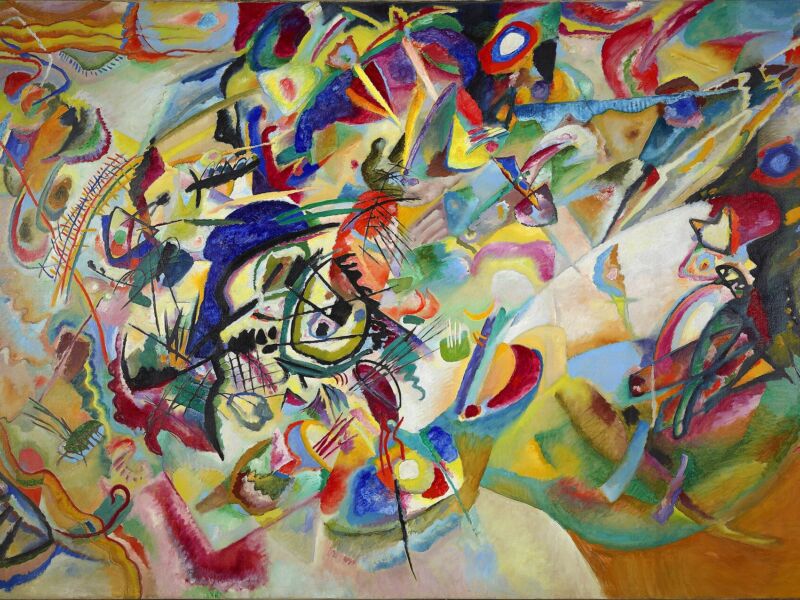
The milestones are easy to set out year by year. Kupka showed Amorpha, Fugue in Two Colors at the Salon d'Automne of 1912, and that same year Guillaume Apollinaire coined the word "Orphism" for Delaunay's painting. Kandinsky painted Composition VII (1913, now in the State Tretyakov Gallery) and later, after returning to Moscow, Moscow I (1916). In 1913 Larionov published his pamphlet Rayonism. In December 1915, at the exhibition "0,10" in Petrograd, Malevich hung his Black Square in the "red corner," the place where icons hang in a Russian home, and announced Suprematism. From 1917 Mondrian and the journal De Stijl developed Neoplasticism.
Contemporaries met nonobjective canvases with irritation or bewilderment, seeing in them wallpaper patterns, a joke or a symptom of illness. The critic Alexandre Benois read the Black Square as an insolent substitute for the icon. Alfred Barr tried to bring order to the story. In 1936 he opened the exhibition "Cubism and Abstract Art" at the Museum of Modern Art in New York and put a genealogical chart on the dust jacket of the catalog: arrows from Cézanne, Gauguin, Japanese prints and Neo-Impressionism led to two outcomes, "geometrical" and "non-geometrical" abstract art. The chart has often been criticized as simplistic, but it is the version that made it into the textbooks.
The Russian strand is arguably the central one. Kandinsky was a Muscovite, Malevich created Suprematism and Larionov Rayonism. At the exhibition "5×5=25" in 1921, Alexander Rodchenko showed three monochrome canvases, red, yellow and blue, and declared them the end of painting. The Constructivists carried nonobjective art into design, printing and architecture. From the 1930s official Soviet aesthetics branded abstraction as "formalism," and its legacy spent decades in museum storerooms. It was revived by the unofficial artists of the Khrushchev Thaw, and in 1962, at an exhibition in the Manege in Moscow, Nikita Khrushchev publicly berated young abstract painters.
After 1945 the center shifted to New York. The Abstract Expressionism of Jackson Pollock and Willem de Kooning, the color field painting of Mark Rothko, born in Dvinsk, and Barnett Newman, and later Op art and Minimalism: each has its own page in this encyclopedia. In Europe, Tachisme and Art Informel developed in parallel. By the 1960s abstraction had gone from scandal to the language of museums and corporate lobbies. Pop art and Conceptual art rebelled against that victory, but the question first asked around 1910, whether a painting can depict nothing at all, has been considered settled ever since.
Stories