Art movement
American Realism
1900s–1940s · USA
About the movement
In February 1908 Macbeth's, a small New York gallery, opened an exhibition of eight painters who had been shut out of, or coolly received by, the National Academy of Design. It was put together by Robert Henri, and ever since the participants have been known simply as The Eight: Henri, John Sloan, William Glackens, George Luks and Everett Shinn, along with Arthur B. Davies, Maurice Prendergast and Ernest Lawson. "American Realism" is the usual label for several waves of painting in the first half of the 20th century, and this show was the first of them. The roots go deeper, to Winslow Homer and Thomas Eakins, who were already painting America without European gloss in the 19th century.
Henri's friends Sloan, Glackens, Luks and Shinn had started out as newspaper illustrators in Philadelphia and were used to a reporter's quick eye. They painted what the Academy considered unworthy of canvas: Lower East Side tenements, saloons, ferries, street kids. Dark, broad, unpolished. Henri told his students that life mattered more than good taste, and he taught in New York for years; dozens of artists passed through his classes, from Bellows to Stuart Davis. He himself had studied at the Pennsylvania Academy under Thomas Anshutz, a pupil of Eakins, so the tie to the 19th century was almost a family one. The nickname "Ashcan School" came later, and not at first as a compliment. According to the Metropolitan Museum of Art, it was prompted by a 1915 drawing by George Bellows; in 1916 the cartoonist Art Young put the phrase into circulation in a review, and in 1934 Holger Cahill and Alfred Barr fixed it in a MoMA catalog.
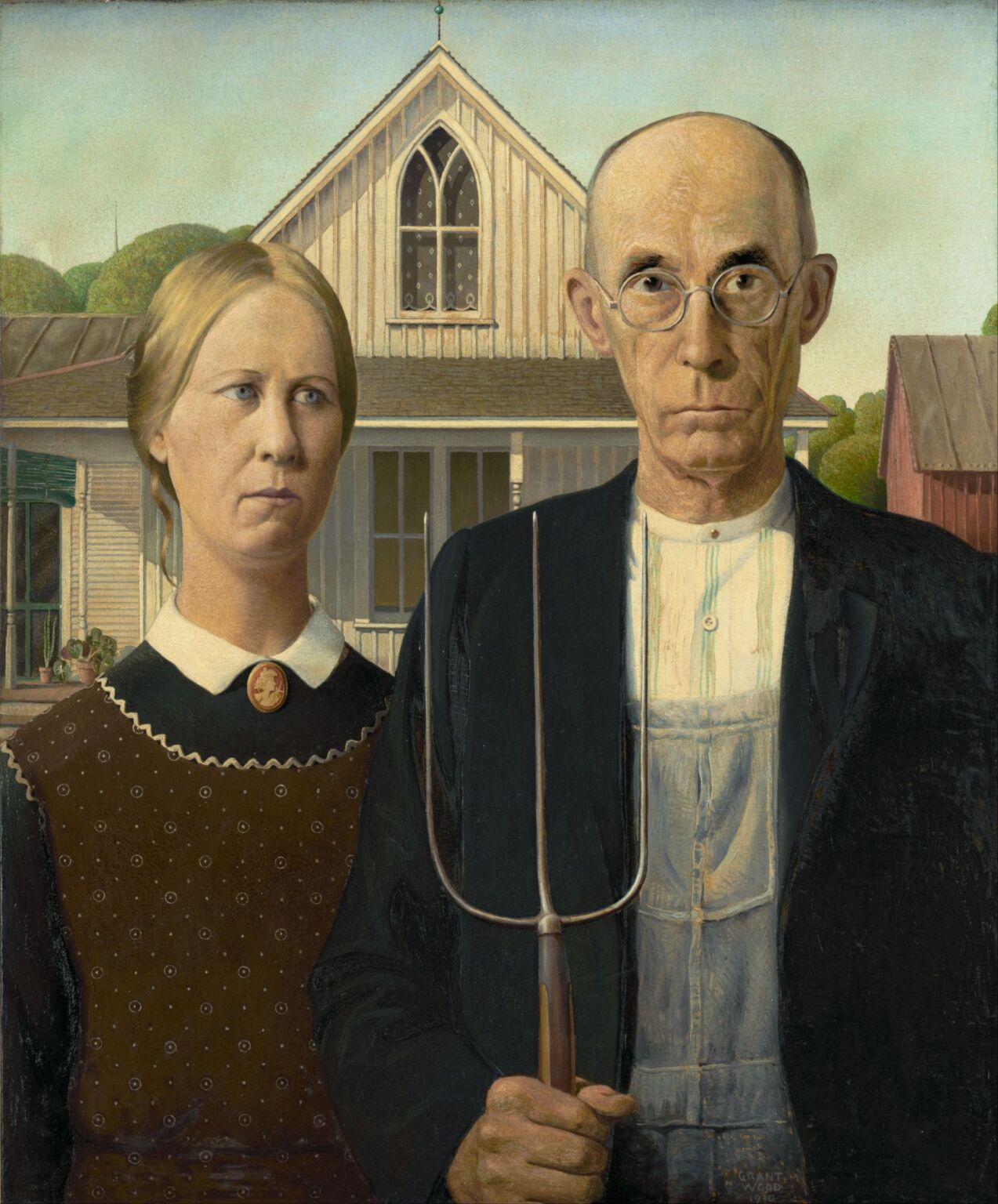
Bellows, Henri's favorite student, was not one of The Eight; he belonged to the second generation. His Stag at Sharkey's (1909, Cleveland Museum of Art) shows an illicit bout at a private, men-only club, since public prizefights were banned in New York at the time. Edward Hopper also studied with Henri. He developed another side of realism, the silence and emptiness of the big city. His Nighthawks (1942) is in the Art Institute of Chicago, as is Grant Wood's American Gothic (1930).
The turning point came in 1913. The Armory Show, organized in part by people from Henri's circle, brought Matisse, Picasso and Duchamp to New York, and the realists, rebels only yesterday, suddenly looked old-fashioned. Hopper, as it happens, sold his first painting there, Sailing. Bellows and Sloan exhibited at the Armory Show as well, but next to Duchamp's Nude Descending a Staircase their city scenes looked less like a challenge than the norm. Twenty years later the pendulum swung back. During the Great Depression the Regionalists (Wood, Thomas Hart Benton and John Steuart Curry) held up the Midwest against Parisian fashion. In December 1934 Time put Benton's self-portrait on its cover, presenting Regionalism as the new American art.
There is a Russian thread, too. Raphael Soyer, one of the leading painters of New York's Social Realism in the 1930s, was born in 1899 in Borisoglebsk and emigrated to the United States with his family as a teenager, in 1912; his twin brother, Moses, and younger brother, Isaac, also became artists. Ben Shahn, who painted the Sacco and Vanzetti trial, was born in Kovno (now Kaunas), then part of the Russian Empire. For them realism was a way to speak about poverty and injustice, not rural idylls.
After World War II leadership passed to Abstract Expressionism, and Regionalism was quickly written off as a provincial past. But the line did not break. Hopper kept working into the 1960s, Andrew Wyeth painted Christina's World (1948, MoMA), and the Photorealists of the 1970s once again made art out of diners, shop windows and cars, the things Robert Henri's students had been the first to see.
Stories