Biedermeier
1815–1848 · Germany, Austria
About the movement
Starting in 1855, the Munich humor magazine Fliegende Blätter published poems by a Swabian village schoolmaster named Gottlieb Biedermaier. The schoolmaster did not exist. He was invented by the physician Adolf Kussmaul and the writer Ludwig Eichrodt, who combined the fashionable word Biederkeit ("respectability, guilelessness") with the most ordinary of surnames. The parody was based on real verses, naive and touching, by a village teacher named Samuel Friedrich Sauter, whom Kussmaul had met during his years as a country doctor. The character became a byword for the complacent philistine, and around the turn of the 20th century his name, in the form "Biedermeier," came to stand for the whole period between the Congress of Vienna in 1815 and the revolutions of 1848.
It really was a quiet era. Metternich's system of censorship and police surveillance pushed politics out of public life, and the burgher made himself a world the size of a living room. Biedermeier had no manifesto and no leader; it was a shared taste, not a school. It worked against two things at once: academic history painting, with its gods and generals, and Romantic anguish. What people valued was clear daylight, meticulous finish, the unflattering portrait, the view of one's hometown, the family celebration. The same taste produced furniture in pale cherry and pear wood, with simple lines and a minimum of bronze mounts, which collectors later turned into perhaps the defining symbol of the style.
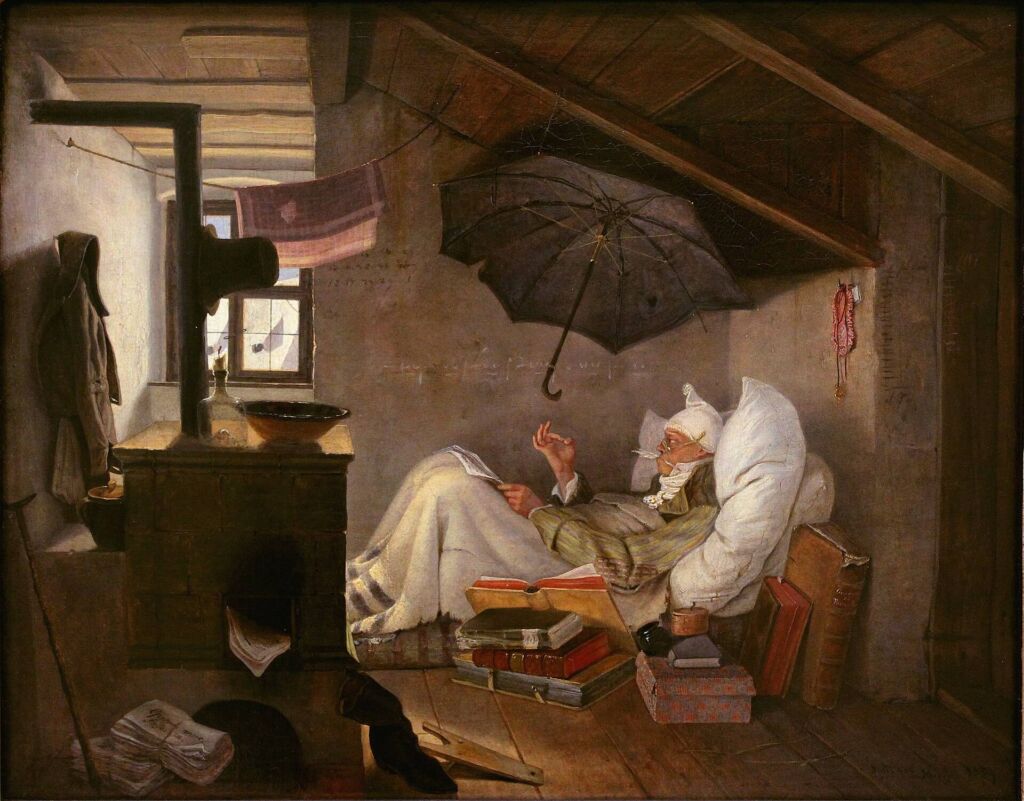
There were three centers. In Vienna, Ferdinand Georg Waldmüller painted his piercingly bright landscapes and village scenes, Friedrich von Amerling painted portraits, and the watercolorist Rudolf von Alt spent decades drawing the city's streets and squares. In Berlin, Franz Krüger painted Parade on the Opernplatz in Berlin (1824–1830, Alte Nationalgalerie), dozens of recognizable townspeople in a crowd around a marching regiment, and Eduard Gaertner created a panorama of Berlin from the roof of the Friedrichswerder Church (1834). In Munich there was Carl Spitzweg: The Poor Poet (1839, Neue Pinakothek), The Love Letter (around 1845–1846), The Bookworm (around 1850). Spitzweg shows that the Biedermeier mood outlived 1848.
The most famous picture of the era did not please everyone at first. The Poor Poet was first shown at the Munich Kunstverein, the city's art association, in 1839, and critics accused Spitzweg of irony: in a versifier who feeds the stove with his own manuscripts they saw a mockery of the lofty image of poetry and of academic art in general. The painting stayed in the family for a long time; it was the artist's nephew Eugen Spitzweg who gave it to the Neue Pinakothek in 1887. The word "Biedermeier" itself long had a contemptuous ring, as a label for small-minded bourgeois narrowness. The reappraisal came only around 1900.
Biedermeier also has a direct Russian thread. Krüger worked for the Russian court for many years: Parade on the Opernplatz in Berlin was commissioned in 1824 by the future Emperor Nicholas I, who appears in it leading a cuirassier regiment past King Frederick William III of Prussia. It hung for a long time in the Winter Palace in St Petersburg, until shortly before the First World War the tsar gave it to the Kaiser. Between 1832 and 1851 Krüger often visited St Petersburg and painted Nicholas with his suite. Some Russian painters of the time are a parallel rather than a relative: the intimate portraits of Vasily Tropinin, the peasant scenes and interiors of Alexei Venetsianov's school, the early Pavel Fedotov. They share with the Germans the same interest in private life, but they grew from their own soil.
The Revolution of 1848 closed the era, but not its taste. Its calm views and interiors prepared the way for German realism in the second half of the century, and around 1900 the simplicity of Biedermeier furniture and objects came back into fashion. Viennese architects and designers in the circle of the Secession saw in it an honest, unornamented form, which the eclecticism of their own day lacked. And so a mocking nickname, dreamed up by two witty friends, became the respectable name of a style.