Classicism
17th century · France, Rome
About the movement
In 1624 Nicolas Poussin, a Norman not quite thirty years old, arrived in Rome, and apart from two unhappy years at the Paris court (1640–1642) he lived there until his death in 1665. Therein lies the central paradox of Classicism: the official style of the French monarchy was worked out by a painter who hardly ever lived in France. Its language came to him from ancient reliefs, Raphael's frescoes and the Bolognese Carracci, and Paris turned that language into state doctrine. The word "Classicism" itself was coined later, in the 19th century; contemporaries spoke of "rules" and "good taste."
The essence of the method is subordination. A picture is built like a tragedy by Corneille: an elevated subject from ancient history, myth or the Bible, a few protagonists, carefully calibrated gestures, and every figure in its place. Drawing matters more than color, the idea more than the effect. Classicism was a response both to the surge of the Baroque, with its diagonals, and to the "low" truthfulness of Caravaggio's followers. "My nature leads me to seek and love well-ordered things," Poussin confessed in a letter of 1642.
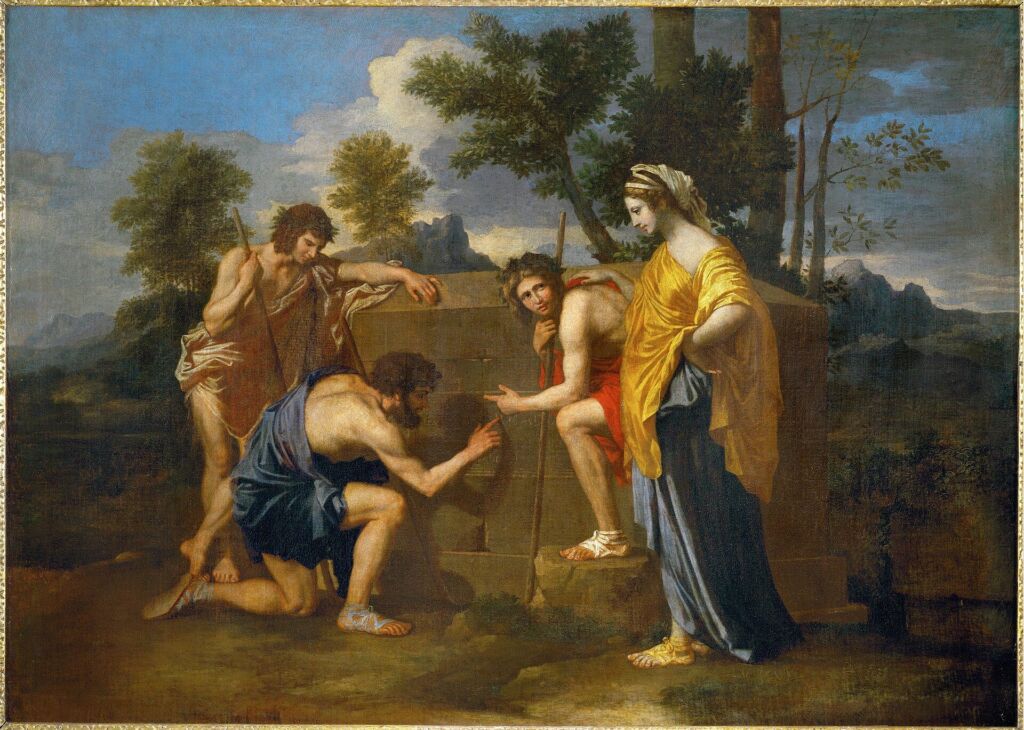
His Arcadian Shepherds (around 1638, Louvre), with its Latin inscription about death, present even in Arcadia, became for later generations the model of "thinking" painting, a picture to be read and not only looked at. Working alongside Poussin in Rome was Claude Lorrain, a native of Lorraine, the creator of the ideal landscape. He painted Seaport with the Embarkation of the Queen of Sheba (1648) for the Duc de Bouillon; it is now in the National Gallery in London, and J. M. W. Turner left the museum two of his own paintings on condition that they hang beside two canvases by Claude. In Paris itself, Classicism was carried forward by Eustache Le Sueur and Philippe de Champaigne.
The movement became an institution in 1648, when the Royal Academy of Painting and Sculpture was founded in Paris. Under Colbert and Charles Le Brun, First Painter to the King from 1664, it became a ministry of taste. At the Academy's "conferences" Poussin's paintings were analyzed as models, and the historiographer André Félibien codified the hierarchy of genres, with history painting at the top and still life at the bottom. The consensus did not last long. From 1671 the Academy was split between the "Poussinistes," who put drawing above all, and the "Rubénistes," who defended color. Their leader, the critic Roger de Piles, was himself admitted to the Academy in 1699, and in 1717 Watteau became a member, which is usually seen as the final victory of the colorists.
Russia acquired works by the movement's finest masters through collecting. The State Hermitage Museum holds Poussin's Tancred and Erminia and Landscape with Polyphemus (1649), as well as four landscapes by Claude known as the Times of Day: Morning, Noon, Evening and Night. The Pushkin State Museum of Fine Arts has Poussin's Rinaldo and Armida and The Continence of Scipio. Russia's own Classicism took shape a century later, together with the Imperial Academy of Arts in St Petersburg, founded in 1757. Its features are seen in Dmitry Levitsky's allegorical portrait Portrait of Catherine II the Legislatress in the Temple of the Goddess of Justice (1783), though Levitsky was above all a portraitist and is not ranked with Poussin.
The hierarchy of genres established under Louis XIV survived into the Salons of the 19th century. In the 1780s Jacques-Louis David returned to Poussin's severity and became the leading master of Neoclassicism. The Romantics, the Realists and the Impressionists later rebelled against the same academic system, while Paul Cézanne, by contrast, looked to Poussin for the foundation of a painting built by reason. So the argument between order and feeling outlived both the king and his Academy.