Cubism
1907–1914 (later forms into the 1920s) · France
About the movement
The word came not from an artist but from a scoffer. On November 14, 1908, the critic Louis Vauxcelles wrote in the newspaper Gil Blas about Georges Braque's exhibition at Daniel-Henry Kahnweiler's gallery, saying that Braque reduced everything (places, figures, houses) to geometric schemes, "to cubes." A little earlier, according to Vauxcelles himself, Henri Matisse, who sat on the jury of the Salon d'Automne, had described Braque's landscapes as made of "little cubes." By the spring of 1909 Vauxcelles was writing of "cubic oddities," and the label stuck for good.
Cubism had two roots. The first was Paul Cézanne, who died in 1906 and was given retrospectives in Paris in 1907; as early as 1904 he had advised treating nature "by means of the cylinder, the sphere, the cone." The second was African and Iberian sculpture, which Pablo Picasso studied while working on Les Demoiselles d'Avignon (1907, MoMA). In the summer of 1908, at L'Estaque, Braque painted landscapes in which the houses are turned into facets. Together they abandoned the single viewpoint on which European painting had rested since the Renaissance: an object is shown from several sides at once, and depth gives way to a complex flat surface.
From here the story splits in two. In the Analytic phase, roughly 1909–1912, Picasso and Braque, working almost side by side, broke form into small facets in grays and ochers. In May 1912 Picasso glued a piece of oilcloth into Still Life with Chair Caning (Musée Picasso, Paris), and collage was born; that September Braque made the first papier collé. The Synthetic phase (1912–1914) assembled the picture from large planes, pasted papers and lettering. Kahnweiler paid both men, and their allies Juan Gris and Fernand Léger, for exclusive rights to their work.
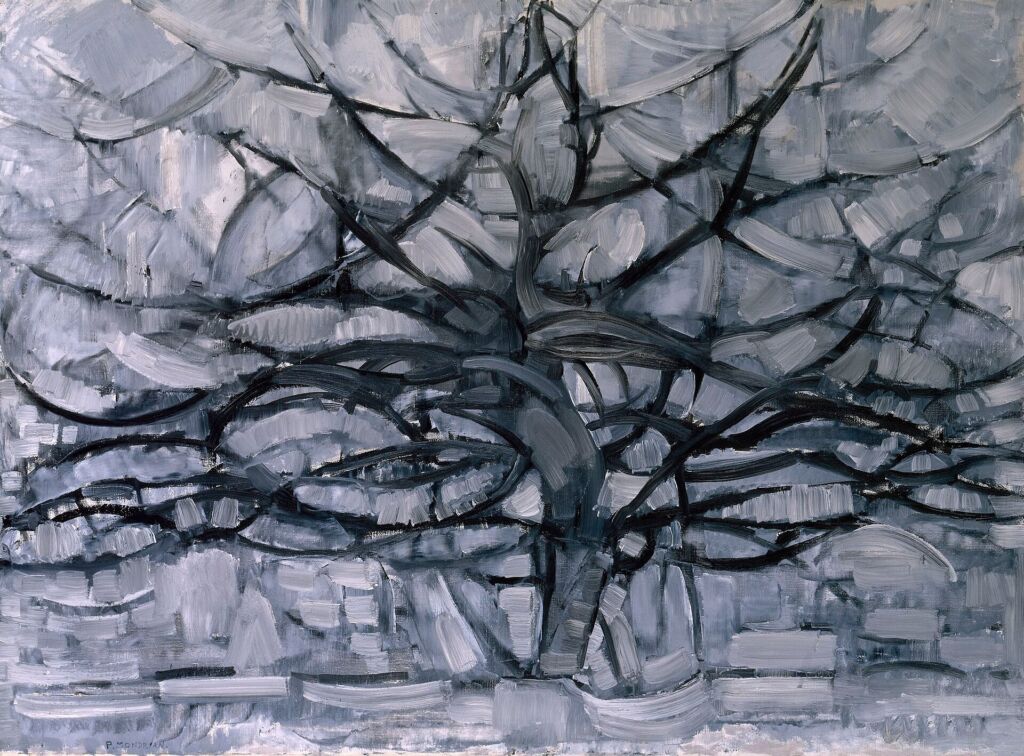
The public came to know Cubism not through Picasso and Braque, who rarely showed at the Salons, but through Room 41 at the Salon des Indépendants in the spring of 1911. On view were Jean Metzinger, Albert Gleizes, Léger, Henri Le Fauconnier and Robert Delaunay, and the press made a scandal of it. In 1912 Gleizes and Metzinger published the first treatise, On Cubism; that autumn the large Section d'Or exhibition took place at the Galerie La Boétie, and in 1913 Guillaume Apollinaire brought out his book The Cubist Painters. Delaunay was already steering Cubism toward color: Apollinaire assigned his Champs de Mars: The Red Tower (1911–1923, Art Institute of Chicago) to Orphism. Piet Mondrian, who saw the Cubists in 1911, made his way to abstraction through Cubist trees, from The Gray Tree (1911, Kunstmuseum Den Haag) to his Paris compositions of 1912–1914.
Cubism's Russian connection is direct. Sergei Shchukin bought about fifty works by Picasso, beginning with Woman with a Fan; after nationalization his collection was divided between the Hermitage and the Pushkin Museum, and the Hermitage holds, among others, Friendship (1908). Ivan Morozov bought Girl on a Ball (1905, Pushkin State Museum of Fine Arts), a work from before Cubism. Muscovites saw the new painting earlier than many Parisians, and in 1912–1913 Lyubov Popova and Nadezhda Udaltsova studied with Metzinger and Le Fauconnier at the Académie de La Palette. The treatise by Gleizes and Metzinger appeared in Russian as early as 1913. Out of this experience grew Kazimir Malevich's Cubo-Futurism and Vladimir Tatlin's counter-reliefs.
The war of 1914 scattered the group. Braque went to the front, and Kahnweiler's stock, as the property of a German national, was confiscated and sold off at auction after the war. But by then Cubism had become a common language. Futurism, Orphism, Suprematism, Mondrian's Neo-Plasticism and Constructivism all passed through it, and the very idea that a painting is a constructed flat surface rather than a window onto the world shaped almost all 20th-century painting.