Fauvism
1905–1908 · France
About the movement
In the middle of Room VII at the 1905 Salon d'Automne in Paris stood a bust in the manner of the Florentine Renaissance by Albert Marque. All around it hung canvases by Henri Matisse, André Derain, Maurice de Vlaminck and their friends, full of green faces and orange shadows. On October 17 the critic Louis Vauxcelles wrote in the daily Gil Blas of "Donatello among the wild beasts." The word fauves, "wild beasts," stuck to the painters at once.
Matisse and Derain had spent the previous summer in Collioure, a fishing town near the Spanish border. There they gave up for good on the idea that color had to be true to life; Matisse came back with Open Window, Collioure (1905, National Gallery of Art, Washington). They learned from Van Gogh and Gauguin and from Signac's pointillism, but broke the dot up into a broad brushstroke. Color no longer described an object; it built space and expressed feeling on its own. What they were fighting is clear enough: the gray "truth" of the Salon, and even the Impressionists' devotion to nature.
At the same 1905 Salon Matisse showed Woman with a Hat (now in the San Francisco Museum of Modern Art). It was bought by Gertrude and Leo Stein, Americans who soon became leading patrons of the new art. In the spring of 1906 Matisse's Le Bonheur de vivre (now in the Barnes Foundation) was the centerpiece of the Salon des Indépendants. Derain, commissioned by the dealer Ambroise Vollard, painted London: the Thames, its bridges, Westminster. Albert Marquet, Kees van Dongen, Raoul Dufy, Othon Friesz, Charles Camoin and Henri Manguin were also part of the circle, and in 1906 the young Georges Braque painted Fauvist landscapes at L'Estaque.
The public laughed and the critics were outraged. Vlaminck, a former bicycle racer and café violinist, happily played up to the image and called himself "a tender barbarian, full of violence." But the scandal worked in the painters' favor: people talked about them and bought their work. Fauvism was short-lived, three exhibitions between 1905 and 1908, and by 1908 its members had gone their separate ways: Braque into Cubism alongside Picasso, Derain toward a severe, almost classical form, Vlaminck toward dark, dramatic landscapes.
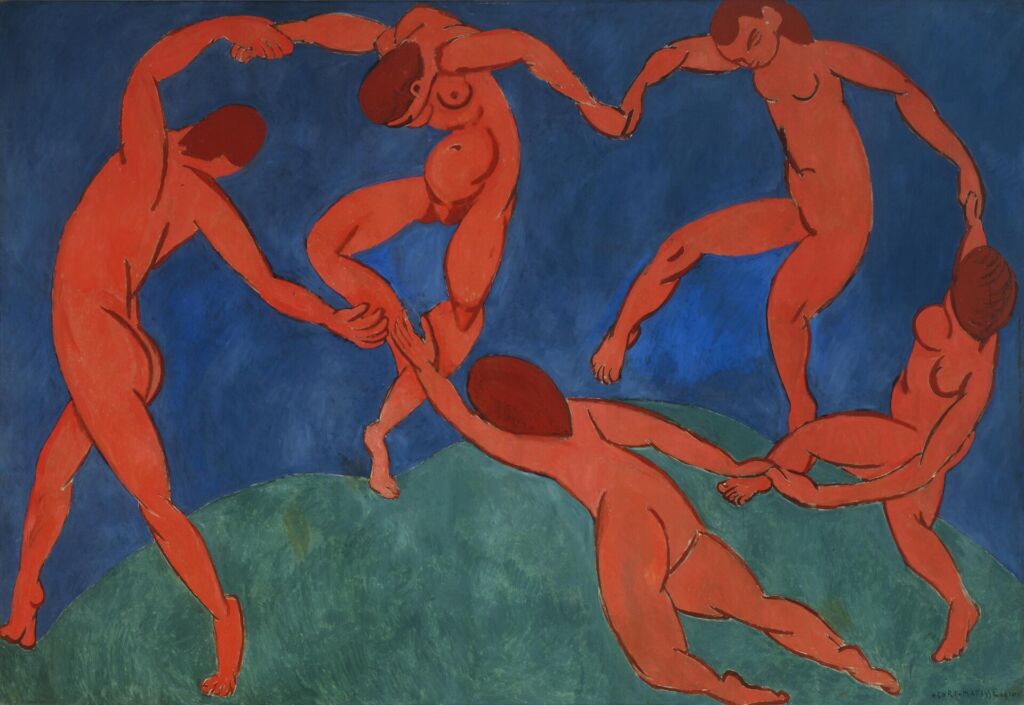
Matisse went further than the rest, and his path led through Moscow. He first painted a large canvas for Sergei Shchukin's dining room in shades of blue, then repainted the background red. The result was The Dessert: Harmony in Red (The Red Room), now in the State Hermitage Museum, which dates it to 1908. In December of that year Matisse published "Notes of a Painter," in which he wrote that what he was after above all was expression. In March 1909 Shchukin wrote to commission two large panels for his mansion, Dance and Music. When they were shown at the Salon d'Automne of 1910, the uproar was such that the collector briefly had second thoughts, but he took them to Moscow all the same. Strictly speaking, this is no longer Fauvism but what grew out of it: a few colors, vast flat areas, rhythm. Ivan Morozov, the other great Moscow collector, also bought Matisse, though he preferred calmer pictures. Both panels are now in the Hermitage; in October 1911 Matisse came to Moscow himself to see how they were hung.
Fauvism was the first major avant-garde movement of the 20th century. It proved that color could stand on its own, a lesson taken up by the German Expressionists and by the Russian artists who saw the Shchukin and Morozov rooms before the Revolution.