Gothic art
Mid-12th to early 16th century · Europe
About the movement
The name was invented by its enemies. Italian writers of the 16th century, above all Giorgio Vasari, considered the architecture of pointed arches barbaric and traced it back to the Goths, the destroyers of Rome; hence "Gothic," meaning crude and alien. The builders themselves used a far more modest term, opus francigenum, "French work." The starting point is usually given as 1144, when Abbot Suger consecrated the new choir of the abbey church of Saint-Denis outside Paris: slender supports, rib vaults and huge windows let in colored light, which Suger understood as an image of the divine.
Gothic transformed the building first, and through it, painting. Once the wall had dissolved into windows, it was no longer a place for large frescoes, and stained glass became the leading form of painting in the north. Chartres Cathedral, rebuilt after the fire of 1194, and the Sainte-Chapelle, consecrated in 1248 as a reliquary for Louis IX's Crown of Thorns, are above all walls of glass. The second field was the book: the Psalter of Saint Louis (around 1270) and other Paris manuscripts set the fashion for an elegant, elongated figure, a flowing line and jewel-like color. The heavy solemnity of the Romanesque gave way to the curve, the gesture, an almost worldly grace.
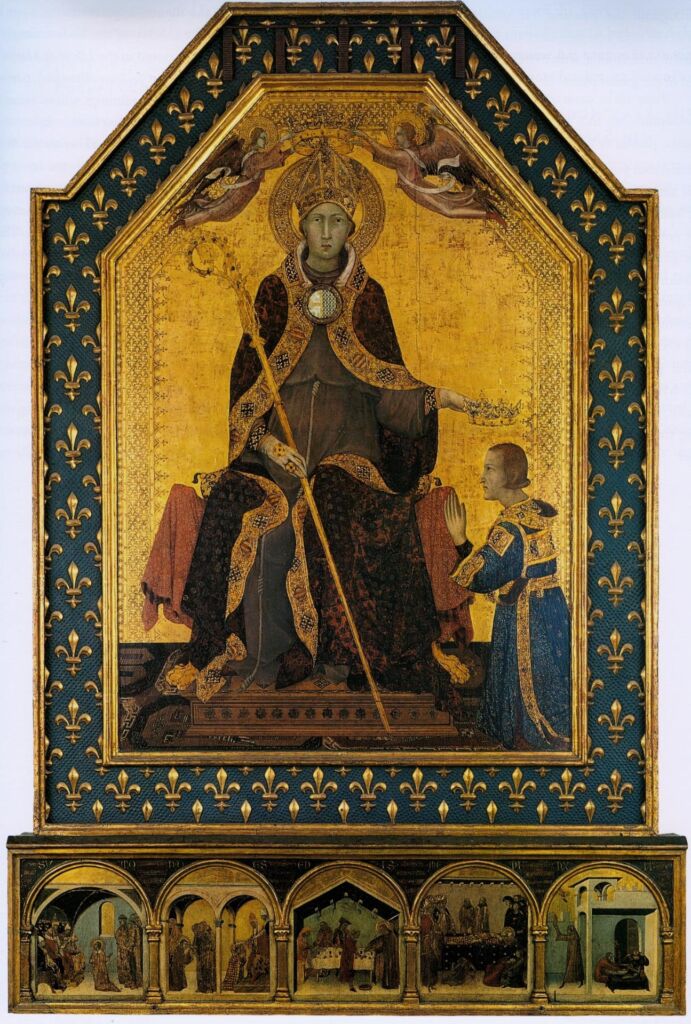
In Italy, Gothic met the Byzantine tradition and produced an especially refined school of painting in Siena. Simone Martini painted the Maestà in the council hall of the city's Palazzo Pubblico (1315, reworked in 1321); the altarpiece Saint Louis of Toulouse (around 1317, Museo di Capodimonte, Naples), a political image that affirmed the claims of King Robert of Anjou; and the Annunciation with Saints Ansanus and Margaret (1333, Uffizi), painted together with his brother-in-law Lippo Memmi. Late in life Martini worked at the papal court in Avignon, and through Avignon the Sienese manner spread across the north.
Around 1400 the court workshops of Paris, Prague, Burgundy, Milan and London came to speak almost the same language, which is known as International Gothic. The Wilton Diptych (around 1395–1399) was painted for the private devotions of King Richard II of England; since 1929 it has been in the National Gallery, London. The Limbourg brothers worked on the Très Riches Heures du Duc de Berry from about 1411, but in 1416 both they and their patron died; the manuscript is in the Musée Condé at Chantilly. Gentile da Fabriano completed his Adoration of the Magi (1423, Uffizi) for the Florentine banker Palla Strozzi, and Pisanello worked alongside him.
Gothic's reputation swung sharply over the centuries. The Renaissance saw it as a dark past, Neoclassicism as a violation of proportion. The turning point came with Romanticism: in his essay "On German Architecture" (1772), the young Goethe praised Strasbourg Cathedral and called Gothic a national style, not a barbaric one. In the 19th century Eugène Viollet-le-Duc restored Notre-Dame and Saint-Denis, and the Gothic Revival spread through architecture from London to St Petersburg.
Russia had no Gothic of its own, but it had a love of Gothic. In the second half of the 18th century a Russian "pseudo-Gothic" emerged: the Chesme Church in St Petersburg and the Tsaritsyno palace ensemble near Moscow by Vasily Bazhenov and Matvei Kazakov. There is a genuine Gothic work, too: the State Hermitage Museum holds Simone Martini's Madonna from the Annunciation Scene, from the collection of Count Grigory Stroganov, one half of a diptych whose other half, The Angel of the Annunciation, is in the National Gallery of Art in Washington.
In the 15th century Gothic was displaced by the Renaissance in Italy and by the new painting of Jan van Eyck in the Netherlands. In the north, however, its accent (brittle folds, elongated figures, a love of detail) persisted into the early 16th century, and in the 19th century it returned as deliberate stylization.