Japonisme
1860s–1900s · Europe and the United States
About the movement
There is a story repeated in almost every book on Japonisme. Around 1856, the engraver Félix Bracquemond saw a volume of Hokusai's Manga in the workshop of the printer Auguste Delâtre, supposedly used as packing material in a crate of porcelain. Historians have long treated the tale with caution; it reads more like a legend of discovery than a documented fact. But it gets the essence right. Once Japan opened its ports to Western trade in the 1850s, ukiyo-e prints, fans, screens, lacquerware and ceramics began to reach Europe. The Japanese collection of the British envoy Rutherford Alcock at the London International Exhibition of 1862 and the Japanese section of the Paris Exposition of 1867 made them fashionable, and in 1872 the critic and collector Philippe Burty gave the fashion a name: "Japonisme."
What struck artists was not the exoticism but the way the image was put together. Japanese prints had no modeling in light and shade and no single-point perspective; color lay in flat patches, figures were cut off by the edge of the frame, and the viewpoint rose high above the scene or dropped almost to the ground. For a generation at odds with academic painting, this was proof that a picture could be built differently and still hold together. Japanese art arrived as a ready-made argument against the Salon. As early as 1867, defending Édouard Manet, Émile Zola compared his simplified manner to Japanese color prints.
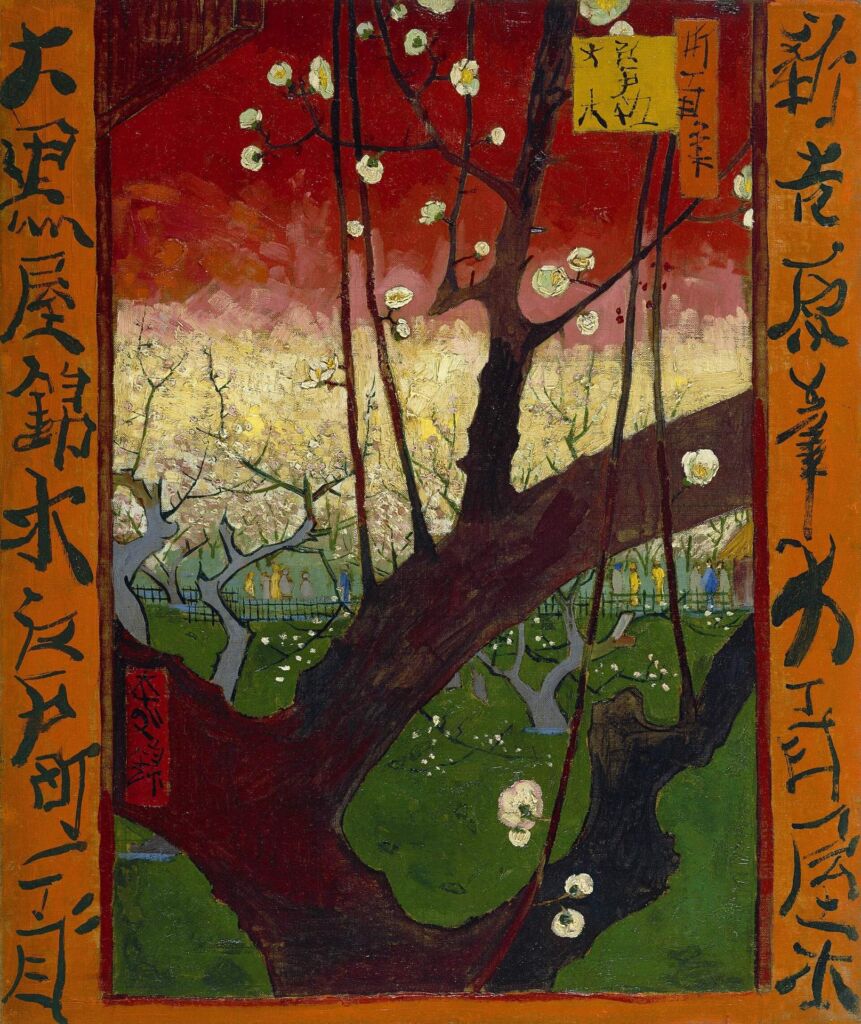
James McNeill Whistler used that argument earlier and more consistently than anyone. He collected blue-and-white porcelain, brought kimonos and fans into his paintings, and in 1876–1877 transformed the dining room of the London shipowner Frederick Leyland into the Peacock Room, now in the Freer Gallery of Art in Washington. Claude Monet showed La Japonaise (1876, Museum of Fine Arts, Boston) at the second Impressionist exhibition. In Paris in 1887, Vincent van Gogh copied Hiroshige in oil, producing Flowering Plum Orchard (after Hiroshige), now in the Van Gogh Museum in Amsterdam. Degas and Toulouse-Lautrec learned cropped composition from the Japanese, and after an exhibition of ukiyo-e at the École des Beaux-Arts in the spring of 1890, Mary Cassatt made a series of ten color etchings, shown in 1891.
That 1890 exhibition was organized by Siegfried Bing, a dealer whose Paris shop handled thousands of Japanese objects. From 1888 to 1891 he published the journal Le Japon artistique in three languages, and in 1895 he opened the gallery Maison de l'Art Nouveau, which gave its name to an entire style. Not everyone was pleased. Many critics saw Japonisme as a drawing-room craze for knickknacks, and the Goncourt brothers jealously argued over who had been first to discover Japan for Paris.
The wave reached Russia later, but with a hero of its own. Sergei Kitaev, a naval officer who had served in the Far East, assembled a huge collection of Japanese prints and paintings and exhibited it at the Imperial Academy of Arts in St Petersburg in December 1896 and at the Historical Museum in Moscow in February 1897. Anna Ostroumova-Lebedeva, then a student at the Academy, recalled being enchanted by the show, and Japanese prints went on to shape her color woodcuts. Other Russian artists and collectors also acquired Japanese prints, among them Pyotr Shchukin and Ilya Ostroukhov. Around 1916–1917 Kitaev's collection went to the Rumyantsev Museum, and after that museum closed, to what is now the Pushkin State Museum of Fine Arts.
By the 1900s Japonisme had dissolved into what it had helped to create. The flat color and expressive contours of the Nabis, Toulouse-Lautrec's posters, the line of Art Nouveau and the prints of the World of Art group are all its heirs. European painting was moving toward flatness even without Japan, but the Japanese print showed it a shortcut.