Mannerism
Around 1520–1600 · Italy, Europe
About the movement
Raphael died in 1520 and Leonardo a year earlier, while Michelangelo was still alive and seemed to have said everything already. Young Florentine painters could either repeat the great masters or outdo them in refinement. They chose the latter. For Giorgio Vasari, author of the Lives (1550; second edition 1568), the word maniera was praise: it meant the graceful, assured style an artist attains by studying the best models. It became a term of abuse in the 17th century, when the theorist Giovanni Pietro Bellori accused imitators of painting "from manner" rather than from nature.
The Mannerists deliberately undid what the High Renaissance had built. Space loses its stability, figures stretch and twist into the "serpentine line," and color turns cool and unexpected. This is art for connoisseurs who prized difficulty, quotation and wit rather than plain verisimilitude. Historians still argue whether to see it as a crisis of the age, after the Sack of Rome in 1527 and the start of the Reformation, or as a purely artistic game.
The Florentines came first. Rosso Fiorentino painted a Deposition for Volterra (1521), and Pontormo a Deposition for the Capponi Chapel in the church of Santa Felicita (1525–1528), a scene with neither ground nor horizon. In the Madonna with the Long Neck (1534–1540, Uffizi), Parmigianino pushed proportion to the limit and never finished the picture. Agnolo Bronzino became portraitist to the Medici court. Giulio Romano, a pupil of Raphael, decorated the Palazzo Te in Mantua for the Gonzaga (1524–1534); in its Chamber of the Giants the very walls come crashing down. The Venetian Tintoretto, in The Miracle of Saint Mark (1548, Gallerie dell'Accademia, Venice), combined Mannerist foreshortening with Venetian color.
Contemporaries did not call themselves Mannerists or see themselves as rebels. Vasari, himself a painter of this circle, regarded the art of his time, crowned by Michelangelo, as the summit of progress. But by the end of the century the tone had changed. The Council of Trent demanded clarity and piety from religious painting, and elaborate allegories became suspect. The Carracci in Bologna and Caravaggio in Rome brought nature back into painting, and in the eyes of the 17th century Mannerism turned into an age of decline between Raphael and the Baroque.
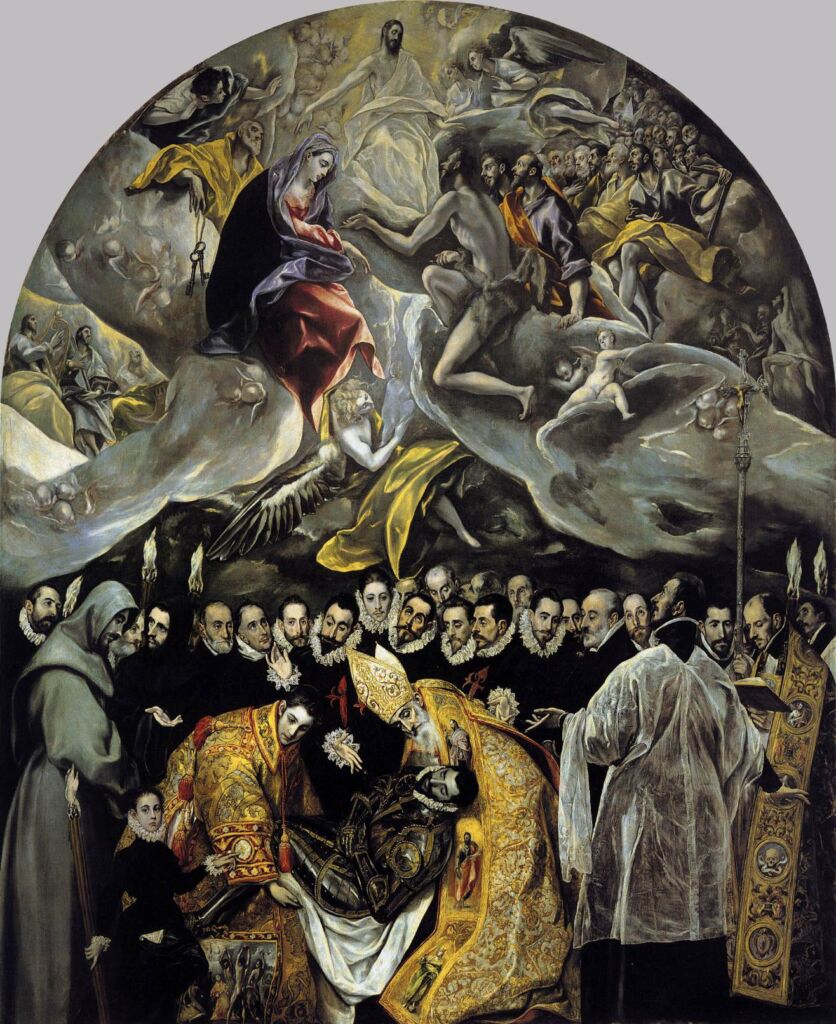
The style traveled with the Italians. Rosso in 1530 and Francesco Primaticcio in 1532 went to the court of Francis I and created the School of Fontainebleau. The Prague court of Rudolf II gathered Bartholomeus Spranger and Giuseppe Arcimboldo, with his heads made of vegetables and flowers. The most original heir was the Greek Domenikos Theotokopoulos, El Greco: trained in Venice and Rome, he painted The Burial of the Count of Orgaz (1586–1588) in Toledo for the church of Santo Tomé, where it still hangs. In the State Hermitage Museum, Mannerism is represented by Pontormo's Madonna and Child with Saint Joseph and Saint John the Baptist (1520s), which came from the collection of Countess Mordvinova.
Rehabilitation came in the 20th century. After the First World War the art historians Max Dvořák and Walter Friedlaender saw in Mannerism not decline but a style in its own right, akin to their own era, and El Greco suddenly became a "contemporary" of the Expressionists. Since then the concept has expanded to the point of controversy: some apply it only to Italian painting of the 1520s to 1590s, others to a pan-European court style, and still others to art's perennial taste for refinement after every "classical" period.