Les Nabis
1888–1899 · France
About the movement
In the autumn of 1888 Paul Sérusier brought back to Paris from Brittany the lid of a cigar box on which he had painted a landscape in the Bois d'Amour near Pont-Aven. He painted it with Paul Gauguin dictating, and, as Maurice Denis later recalled, the advice went roughly like this: the trees are yellow, so put down yellow; the shadow is bluish, so use pure ultramarine. Sérusier showed the little panel to his friends at the Académie Julian, and they named it The Talisman. Today it is in the Musée d'Orsay. Around it formed a group that took the name Nabis, from the Hebrew navi, "prophet." The name is usually credited to the poet and Hebrew scholar Henri Cazalis, although Denis linked it to Sérusier himself.
The Nabis wanted not to depict the world but to construct a picture as an object in its own right. Following Gauguin and Japanese prints, they gave up illusionistic depth: flat patches of color ringed with outline, the pattern of a fabric on equal terms with a face. In August 1890 the nineteen-year-old Maurice Denis gave the movement its formula in the journal Art et Critique: a picture, before it is a war horse or a nude woman, is a flat surface covered with colors arranged in a certain order. The sentence would later be called one of the first manifestos of modernism.
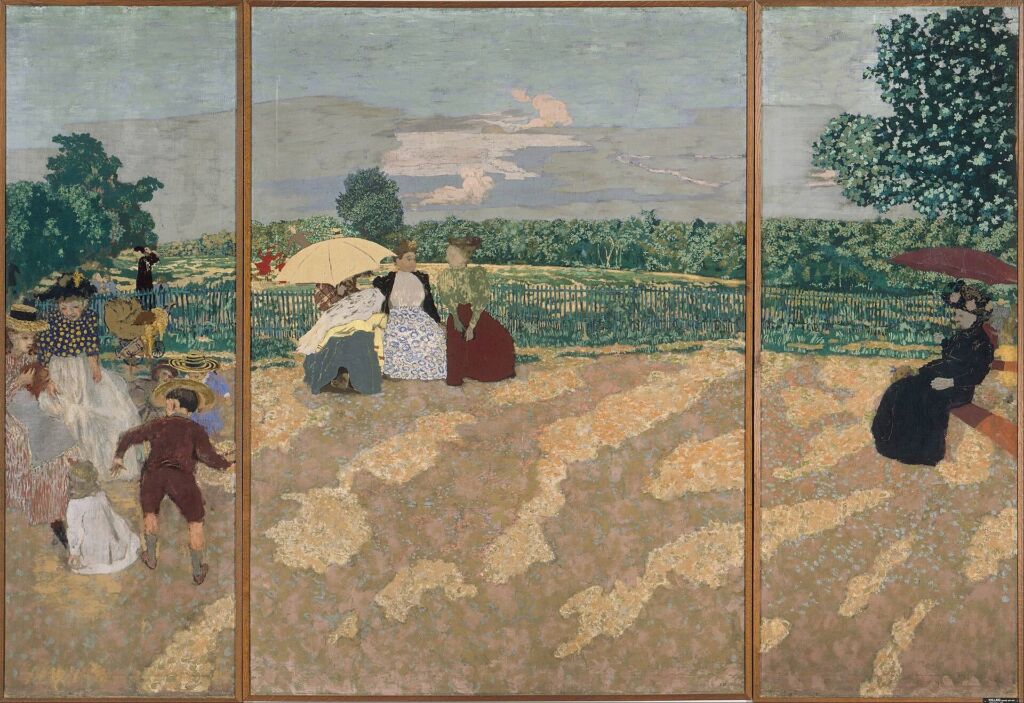
The group included Pierre Bonnard, Édouard Vuillard, Maurice Denis, Paul Ranson, Ker-Xavier Roussel and Henri-Gabriel Ibels, and later the Swiss Félix Vallotton, the Dutchman Jan Verkade, the Hungarian József Rippl-Rónai and the sculptor Aristide Maillol. Two wings emerged within it. Denis and Sérusier leaned toward religious Symbolism, Bonnard and Vuillard toward private life. Vuillard painted cramped rooms in which his mother, a dressmaker, and his sister dissolve into the wallpaper: In Bed (1891, Musée d'Orsay) and Interior, Mother and Sister of the Artist (1893, Museum of Modern Art, New York). His Public Gardens (1894) was conceived as a series of panels for Alexandre Natanson's dining room.
The Nabis hardly ever showed in official venues. They held their first joint exhibition in 1891, and their real home was La Revue Blanche, the magazine of the Natanson brothers, for which Bonnard, Vuillard and Vallotton drew covers, posters and illustrations. The same circle worked for the Symbolist theaters, above all the Théâtre de l'Œuvre. In 1896, for the premiere of Alfred Jarry's Ubu Roi, one of the loudest theatrical scandals of the decade, the sets were painted by Sérusier and Bonnard, assisted by Vuillard, Ranson and Toulouse-Lautrec. The last joint exhibition took place in 1899 at Durand-Ruel's gallery, after which the group quietly drifted apart.
Outside France, the Nabis left their most notable mark in Moscow. The Moscow collector Ivan Morozov commissioned from Maurice Denis a series of panels, The Story of Psyche, after Apuleius, for the music room of his mansion on Prechistenka Street; Denis worked on it in 1908–1909, and the cycle is now in the Hermitage. In 1910 Morozov commissioned from Bonnard the triptych The Mediterranean for the staircase of the same house: the artist worked from photographs of the interior, and the canvases, more than four meters high, were fitted between the columns. Two large panels were added later, among them Early Spring in the Country (1912), now in the Pushkin State Museum of Fine Arts. The Hermitage also holds Bonnard's city views Morning in Paris and Evening in Paris (1911).
As a group the Nabis lasted about ten years, but their lessons spread widely. Bonnard and Vuillard spent another half-century developing an intimate kind of painting that critics called Intimism. Denis became France's leading theorist of religious art. The Fauves took up the Nabis' flat decorative color, and the idea of the picture as a flat surface laid out in colors led European art toward abstraction.