Naïve art
From the late 19th century · France and beyond
About the movement
In November 1908, in Pablo Picasso's studio in the famous Bateau-Lavoir in Montmartre, a banquet was held in honor of the 64-year-old Henri Rousseau. Some guests later remembered it as a sincere tribute, others as a practical joke. That ambiguity sums up the fate of naïve art as a whole: the professional avant-garde laughed at the self-taught and learned from them at the same time.
Naïve art is not a school or a group but a way of working. The term describes painting by people without academic training who do not imitate the academy and are not ashamed of it. They have their own perspective, their own anatomy, their own sense of scale: what matters is shown large, details are rendered with almost artisanal care, and color rings out at full strength. A Russian encyclopedia links Rousseau's manner to popular urban culture, to shop signs, cheap prints and fairground posters; he often took his figures from magazine illustrations and postcards.
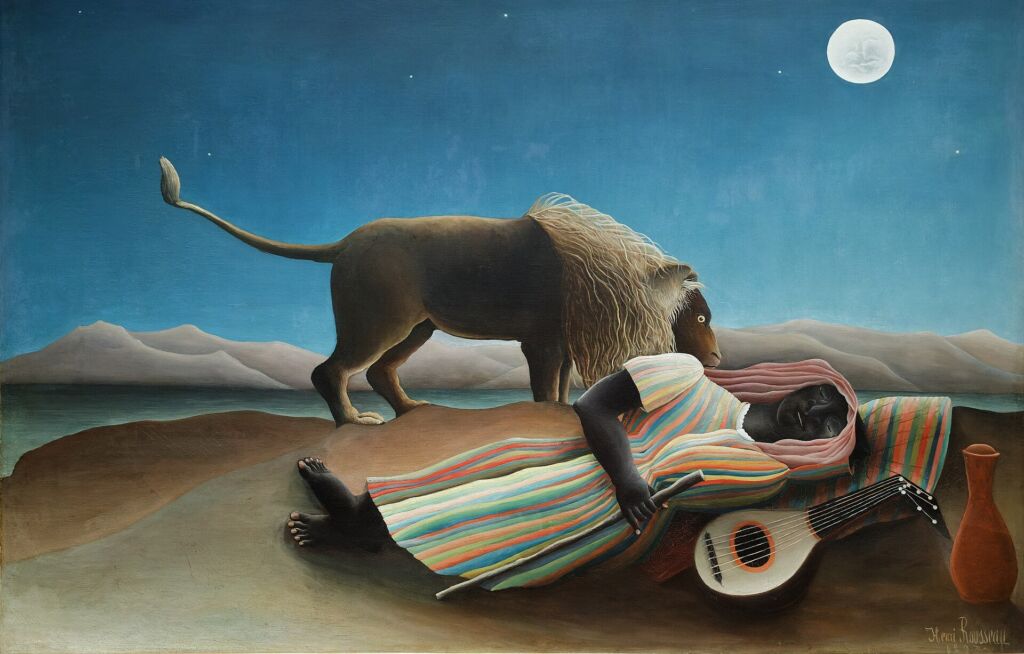
From 1871 to 1893 Rousseau worked for the Paris municipal toll service, hence his nickname "Le Douanier," the customs officer. He began painting around 1880, and from 1886 he exhibited at the Salon des Indépendants, which had no jury. For years critics ridiculed him. In 1897 he showed The Sleeping Gypsy there and offered it, unsuccessfully, to the town hall of his native Laval; the painting then vanished from view for almost thirty years, ending up with a Paris coal merchant. In early 1924 it came into the hands of the critic Louis Vauxcelles, then passed through Daniel-Henry Kahnweiler and the American collector John Quinn, and in 1939 Mrs. Simon Guggenheim gave it to the Museum of Modern Art in New York.
Recognition came within the artist's lifetime, and it came from poets and painters. Picasso, Apollinaire and Robert Delaunay valued in Rousseau what they themselves lacked: directness without irony. Wassily Kandinsky and Franz Marc reproduced his works in the Blue Rider almanac (1912) alongside children's drawings and folk images. In 1912, after Rousseau's death, the Bernheim-Jeune gallery held a retrospective of his work. Around the same time the German critic and collector Wilhelm Uhde, one of his earliest admirers, became the leading champion of self-taught artists. In 1928 he mounted the exhibition "Painters of the Sacred Heart" in Paris, showing alongside Rousseau Séraphine Louis, his former housekeeper from Senlis, as well as Camille Bombois, Louis Vivin and André Bauchant.
Naïve art has a strong Russian thread. Sergei Shchukin bought Rousseau, which is why his paintings can be seen today in Moscow and St Petersburg, among them In a Tropical Forest: Struggle between Tiger and Bull (1908, State Hermitage Museum) and Jaguar Attacking a Horse (1910, Pushkin State Museum of Fine Arts). In 1912 in Tiflis (now Tbilisi), Mikhail Le-Dantyu and the brothers Ilya and Kirill Zdanevich discovered the self-taught Georgian painter Niko Pirosmani, who painted signs and pictures for taverns. By the spring of 1913 his works were hanging in Moscow at the "Target" exhibition beside paintings by Mikhail Larionov and Natalia Goncharova, for whom folk and naïve painting was a program.
In 1938 MoMA in New York staged the exhibition "Masters of Popular Painting," securing the self-taught a place in the history of modernism. Later, whole national schools emerged, the best known of which formed in the 1930s in the Croatian village of Hlebine. People still argue about replacing the word "naïve" itself: some find it condescending, but no one has yet come up with anything better.