Neoclassicism
Around 1760–1830 · Europe
About the movement
It all started with a spade. In 1738 excavations began at Herculaneum, buried by Vesuvius, and in 1748 at Pompeii, and for the first time Europe saw antiquity not as fragments of marble but in the details of daily life: frescoes, furniture, lamps. In 1755 the Saxon librarian Johann Joachim Winckelmann arrived in Rome, having just published his Thoughts on the Imitation of Greek Works in Painting and Sculpture. His formula, "noble simplicity and quiet grandeur," became the watchword of a generation tired of Rococo curlicues.
The new art set itself against caprice and sensuality, in favor of clear outline, restrained color and subjects that taught a lesson. In 1761 Winckelmann's friend Anton Raphael Mengs completed his ceiling fresco Parnassus at the Villa Albani in Rome, which was hailed at once as a model of the new style. Against this background François Boucher's elegant pastorals suddenly looked frivolous, and Denis Diderot, in his reviews of the Paris Salons, openly accused him of falseness. Rome became a workshop for all of Europe: the Swiss painter Angelica Kauffman worked there, as did the Venetian Antonio Canova, who turned marble sculpture into a cool, flawlessly smooth dream of ancient Greece.
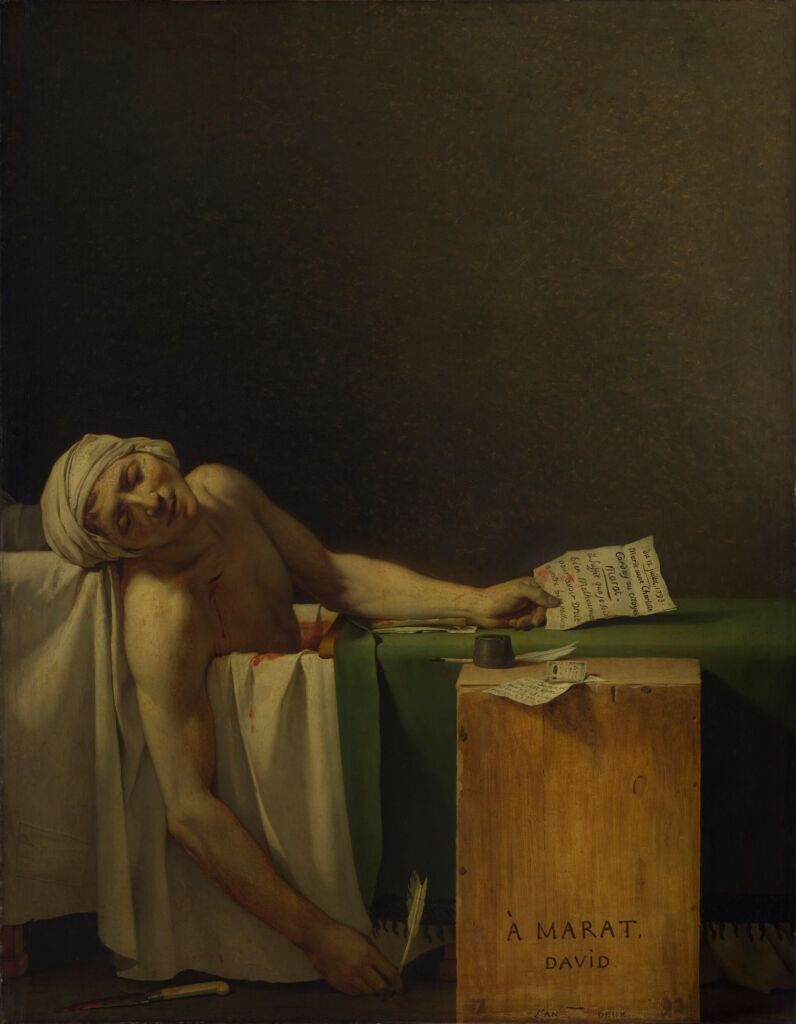
The movement's strongest voice was Jacques-Louis David. He painted The Oath of the Horatii (1784–1785, Louvre) on a royal commission from Louis XVI, and at the Salon of 1785 it caused a sensation. Eight years later the same artist, now a deputy in the revolutionary National Convention, painted The Death of Marat (1793, Royal Museums of Fine Arts of Belgium, Brussels), a secular icon of the Revolution. He voted for the execution of Louis XVI, the very king who had commissioned the Horatii, and after the fall of Robespierre in 1794 he was himself imprisoned. Under Napoleon, David became First Painter of the Empire and produced the enormous Coronation (1805–1807, Louvre).
His studio trained Antoine-Jean Gros, Anne-Louis Girodet, François Gérard and Jean-Auguste-Dominique Ingres. Ingres won the Prix de Rome in 1801 and spent almost two decades in Italy. He pushed the cult of line to its limit, but in a paradoxical way: La Grande Odalisque (1814, Louvre), with her impossibly long back, baffled contemporaries as much as anything by the Romantics. For decades Ingres defended the classical tradition, and the Salon of 1824, where his Vow of Louis XIII hung near Eugène Delacroix's Massacre at Chios, became an open clash between the two camps. He did not finish The Turkish Bath until 1862, when Neoclassicism had long since passed into history.
In Russia the movement was known simply as Classicism, and it shaped the look of St Petersburg. Giacomo Quarenghi, invited by Catherine the Great, built for the court, and Andrei Voronikhin designed the Kazan Cathedral (1801–1811) and the Mining Institute (1806–1808). The Imperial Academy of Arts trained painters by the same rules of the antique model. The sculptor Ivan Martos and painters of the academic school translated the classical ideal into Russian subjects, from tombstones to the Monument to Minin and Pozharsky on Red Square in Moscow. The State Hermitage Museum holds one of Canova's major works, The Three Graces, commissioned by the Empress Josephine; her grandson Maximilian, Duke of Leuchtenberg, brought the sculpture to St Petersburg.
By the 1830s Neoclassicism had hardened into an academic norm, against which first the Romantics and then the Realists rebelled. But its language outlived its era: the colonnades of 19th- and 20th-century government buildings, academic drawing from plaster casts, even the "return to order" after the First World War are all the legacy of Winckelmann and David.