Orphism
1912–1914 · France (Paris)
About the movement
In 1912, when Cubism seemed the last word in Paris, Guillaume Apollinaire noticed that it already had heirs who were arguing with it. The poet called them Orphists, after Orpheus, the singer whose music could move stones. A year later, in his book The Cubist Painters (1913), he singled out "Orphic Cubism" as a separate current: painting in which color and rhythm matter more than the object, and the picture sounds like music. The name stuck, though the artists it was applied to seldom called themselves Orphists.
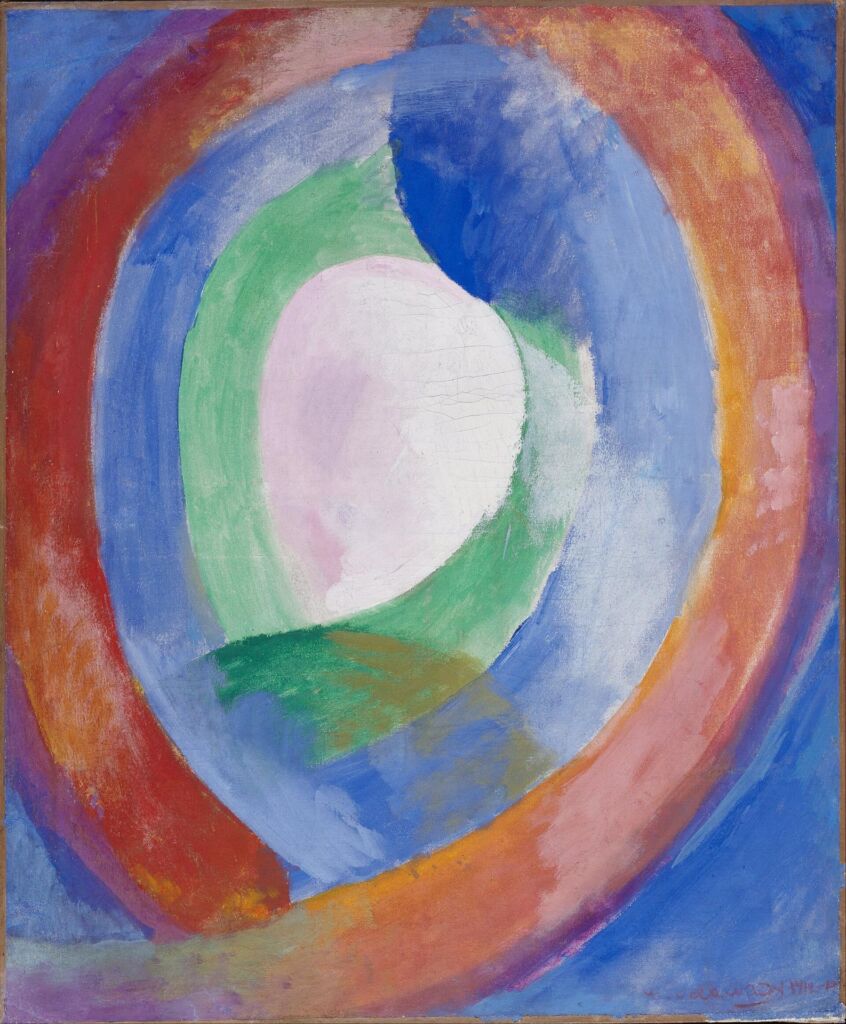
The Cubists took form apart and kept their color muted, gray and brown, almost monochrome. The Orphists brought color back and made it their main building material. Robert Delaunay drew on the chemist Michel-Eugène Chevreul, who as early as 1839 had described the law of simultaneous contrast: neighboring colors alter one another, and the eye sees movement where there is none. Hence the movement's other name, Simultanism. For Delaunay, contrasting planes of color were not decoration but a way of conveying the light and energy of the modern city.
Delaunay's own path shows clearly in three works. Champs de Mars: The Red Tower (1911–1923, Art Institute of Chicago) is still a Cubist explosion of the Eiffel Tower. Simultaneous Windows on the City (1912, Hamburger Kunsthalle) is already an almost nonobjective fabric of transparent colored facets. Circular Forms, Moon No. 1 (1913) consists of pure disks of color, with nothing of the object left at all. Working alongside him was his wife, Sonia Delaunay, whose Electric Prisms (1914, Centre Pompidou) grew out of watching the new electric lights of the Paris boulevards. Apollinaire also counted František Kupka among the Orphists; Kupka's Amorpha, Fugue in Two Colors (1912, National Gallery Prague), shown at the Salon d'Automne of 1912, was one of the first fully abstract paintings exhibited in Paris. Francis Picabia, Marcel Duchamp and Fernand Léger are usually placed in the movement's orbit.
Orphism found its warmest welcome not in Paris but in Germany. Delaunay took part in the first Blue Rider exhibition in Munich in December 1911; in 1912 August Macke and Franz Marc visited his studio, and in January 1913 a solo show of his work opened at the Der Sturm gallery in Berlin. Paul Klee translated his essay "On Light" into German, and Apollinaire wrote the poem "Windows" for the exhibition.
The Russian connection is direct. Sonia Delaunay, née Sarah Stern, was born in 1885 in Hradyzk in the Poltava region of present-day Ukraine (by another account, in Odessa), grew up in St Petersburg in the family of her uncle Henri Terk, and left for Paris in 1905. She considered her first abstract work to be a blanket she sewed in 1911 for her son "in the manner of Russian peasants." In 1913, with Blaise Cendrars, she made The Prose of the Trans-Siberian, a book two meters long that unfolds like a scroll, in which verses about a journey across Russia are interwoven with rhythms of color. And Aristarkh Lentulov, who studied at the Académie de La Palette in Paris in 1911, carried the lessons of simultaneous color back to Moscow: his Saint Basil's Cathedral (1913) has a distinctly Orphist ring.
As a shared movement Orphism did not survive 1914: Apollinaire went to the front, and the Delaunays left for Spain and Portugal. But the idea of color as an independent force lived on. In 1913 the Americans Morgan Russell and Stanton Macdonald-Wright announced their own Synchromism, close to what Delaunay was attempting. Sonia Delaunay carried simultaneous color into textiles, fashion and the theater: in 1918 she designed the costumes for Diaghilev's ballet Cléopâtre, and in 1937 the couple painted murals for pavilions at the World's Fair in Paris.