Proto-Renaissance
Late 13th–14th century · Italy
About the movement
"In painting Cimabue thought that he / Should hold the field, now Giotto has the cry": so, in Canto XI of the Purgatorio (lines 94–95, here in Henry Wadsworth Longfellow's translation), Dante reflects on the vanity of earthly fame. The lines are often cited as the first testimony to a new era: a contemporary could already see that a change of generations had taken place in Italian art and that the new had eclipsed the old. Historians would later call this period, from the late 13th century through the 14th, the Proto-Renaissance.
The starting point was the "Greek manner," the Byzantine tradition of gold backgrounds, flat figures and fixed formulas. Italian artists did not abandon religious subjects, but they began to ask new questions of them: where does a figure stand, how much does it weigh, what does it feel? The term itself was coined much later. No one in the 14th century thought of himself as a "forerunner"; artists simply competed for commissions from cities and religious orders. Sculptors were the first to feel the change. In his pulpit for the Baptistery in Pisa (1260), Nicola Pisano drew on Roman sarcophagi, and his son Giovanni gave stone drama and movement.
In painting, the path was opened by the Florentine Cimabue, who softened Byzantine severity. In Rome, Pietro Cavallini painted a Last Judgment (around 1293) in the church of Santa Cecilia in Trastevere, with weighty, almost sculptural apostles, before Giotto had made his name in Florence. For this reason some scholars regard Rome as no less important a center of change than Florence. The Upper Church of San Francesco in Assisi holds a special place: its cycle of the life of Saint Francis has become a field of scholarly dispute. The Italian tradition, going back to Vasari, regards it as the work of the young Giotto, while many German and English-speaking scholars have doubted this since the early 20th century.
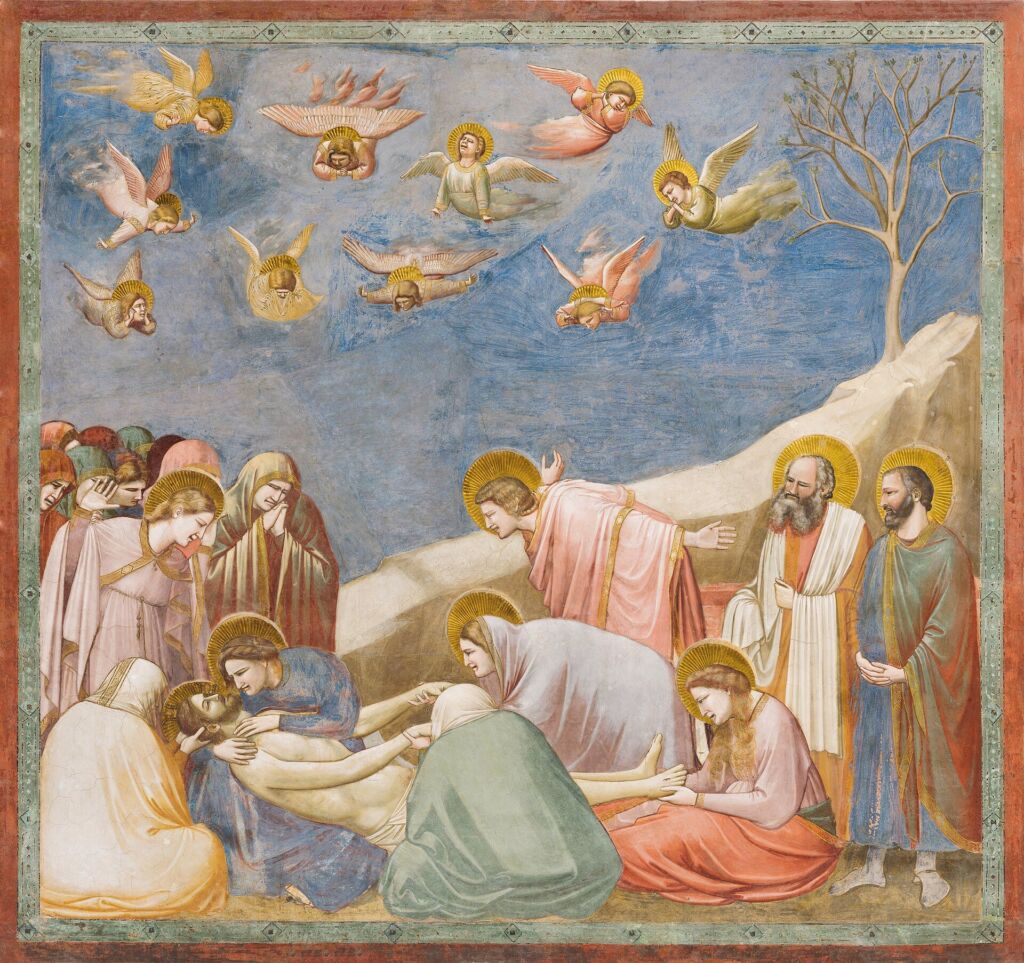
The undisputed Giotto is the Scrovegni Chapel in Padua. It was built by the banker Enrico Scrovegni, son of a moneylender whom Dante placed in the Inferno; the chapel was consecrated on March 25, 1305, and the frescoes were painted roughly between 1303 and 1305. By restorers' estimates, the work took some forty assistants and more than six hundred working days. Here too is the Lamentation, a scene in which grief is conveyed by people's postures and even their backs, not just their faces. Nearby, on the lowest register, Giotto painted allegories of the Virtues and Vices in grisaille, like stone statues: for the first time, painting challenged sculpture on its own ground. In his last years Giotto worked on the campanile of Florence Cathedral, begun in 1334; he died in 1337.
Siena went its own way, which is treated as a separate Sienese School. Duccio di Buoninsegna painted the Maestà (1308–1311, Museo dell'Opera del Duomo, Siena), a huge altarpiece carried into the cathedral in a solemn procession in 1311. The Sienese kept the gold and the graceful line but filled them with narrative: on the back of the Maestà, dozens of small scenes of the Passion read almost like a book. Their work was continued by Simone Martini, with his Annunciation (1333, Uffizi), and by the brothers Pietro and Ambrogio Lorenzetti. Ambrogio's frescoes of Good and Bad Government in the Palazzo Pubblico (1338–1339) became one of the first large secular cycles in Europe.
In the view of a number of scholars, the plague of 1348, which killed a great many people in Florence and Siena, held this movement back for a long time; the Lorenzetti brothers are named among its likely victims. The next decisive step came only in the early 15th century, with Masaccio, Brunelleschi and Donatello. But they took Giotto as their starting point: in his Lives (1550), Vasari wrote that it was Giotto who restored nature to painting, and for later generations of Florentines he remained the point from which everything was measured.