Art movement
Rococo
Around 1720 to the 1770s · France, Europe
About the movement
When Louis XIV died in 1715, the court left Versailles for a time, and the center of fashionable life moved to Paris, to aristocratic town houses with small salons, boudoirs and private cabinets. These rooms called for a different art: not grand allegories meant to last for centuries, but light painting, mirrors, carved frames and porcelain. That is how Rococo was born. The word itself came later, and as a sneer: according to the critic Étienne-Jean Delécluze, it was coined around 1797 by Pierre-Maurice Quays, a pupil of Jacques-Louis David, who combined the French rocaille, a fanciful ornament of shells and pebbles, with the Italian barocco.
Rococo gave up grandeur for pleasure. Instead of symmetry, a curving line; instead of a hero, a pair of lovers; instead of dark varnish, silvery, pink and blue tones. The Englishman William Hogarth, in his treatise The Analysis of Beauty (1753), went so far as to declare the serpentine line the line of beauty. Most important of all, the patron changed: pictures were now painted not for the church or the king but for private individuals and their homes.
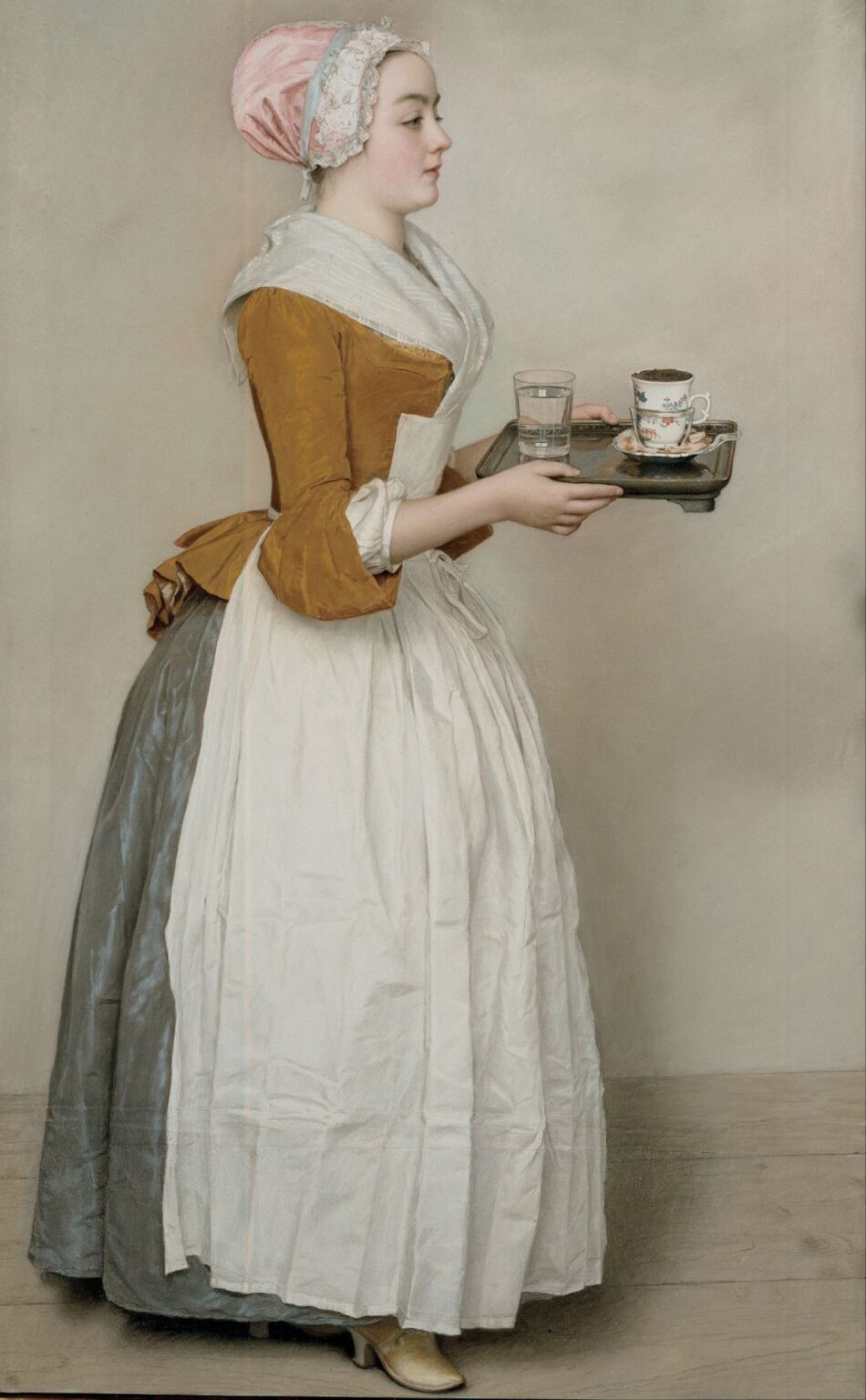
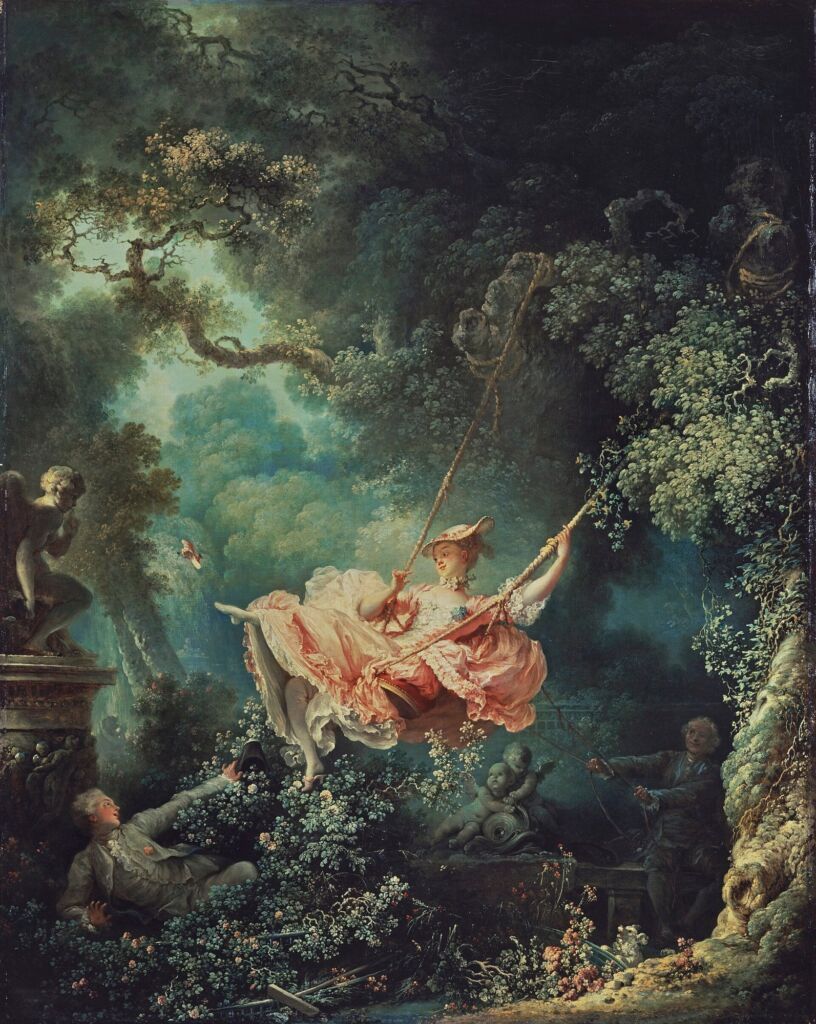
It began with Antoine Watteau. In 1717 the Academy admitted him as a member on the strength of Pilgrimage to Cythera (Louvre) and, finding no place for the picture in the hierarchy of genres, registered it as a fête galante, a "gallant party." A new category was born. François Boucher, a favorite of Madame de Pompadour and from 1765 First Painter to the King, painted goddesses and shepherdesses; his Triumph of Venus (1740) soon left for Sweden and is now in the Nationalmuseum in Stockholm. Jean-Honoré Fragonard brought the genre to a sly climax in The Swing (around 1767–1768, Wallace Collection, London). Jean-Baptiste-Siméon Chardin worked alongside them but on other themes: Saying Grace (around 1740, Louvre) carries the same intimacy into the home of the Third Estate, the commoners. In England Thomas Gainsborough painted Mr and Mrs Andrews (around 1750), while Hogarth answered Rococo with satire: his series Marriage A-la-Mode (around 1743) tells the story of a marriage of convenience. Both are in the National Gallery, London.
Contemporaries were already divided. Reviewing the Salon of 1761, Denis Diderot said of Boucher: "This man has everything except truth." Even earlier, in 1754, the engraver Charles-Nicolas Cochin had mocked, in the Mercure de France, the goldsmiths and decorators who bent every line. In the German lands, by contrast, the style flourished to the full: the Amalienburg pavilion near Munich, the pilgrimage church of Wies, and the Würzburg Residence, where in 1750–1753 Giovanni Battista Tiepolo painted the Imperial Hall and the ceiling over the staircase.
Rococo reached Russia under Empress Elizabeth. Francesco Bartolomeo Rastrelli built the Winter Palace and the Catherine Palace at Tsarskoye Selo, with gilded stucco in the spirit of late Baroque and Rococo. The Italian Pietro Rotari, invited in 1756, painted heads of young women; after his death they were used to decorate the Cabinet of Fashions and Graces in the Great Palace at Peterhof. Catherine II assembled the finest French art of the period for the Hermitage: in 1772, with Diderot acting as intermediary, she bought the Crozat collection, with paintings by Watteau and Chardin. Russian portraitists took softness and intimacy from Rococo. Fyodor Rokotov painted half-smiles veiled in haze, and Dmitry Levitsky painted the pupils of the Smolny Institute for noble girls, among them the Portrait of Ekaterina Nelidova (1773, State Russian Museum).
By the 1770s taste had changed. The excavations at Herculaneum and Pompeii, Enlightenment ideas and the call for simplicity made Rococo a symbol of the pampered old order, and Neoclassicism took its place. Its rehabilitation began in the 19th century, when the brothers Edmond and Jules de Goncourt set about collecting and writing about the 18th century. Today Watteau is seen as a forerunner of the Romantics, and Fragonard as a painter from whom the Impressionists learned.
Stories