Sienese school
Late 13th to 15th century · Siena, Italy
About the movement
On June 9, 1311, the shops of Siena closed and the whole city poured into the streets. To the ringing of bells, with trumpets and candles, Duccio di Buoninsegna's enormous Maestà was carried from his workshop to the high altar of the cathedral. The painter had received the commission in 1308 from the cathedral's overseer, Jacopo de' Marescotti; the double-sided altarpiece, with the Virgin among saints on the front and scenes of the Passion on the back, became the pride of the republic. And so Siena acquired a school of painting of its own, a rival to Florence.
In the 13th and 14th centuries Siena was a rich republic of bankers and merchants that competed with Florence in everything. Its painting grew out of the Byzantine icon, which was well known there, and out of French Gothic, which arrived through manuscripts and luxury objects. Following Giotto, the Florentines built up volume, weight and dramatic space. The Sienese took a different path: gold grounds, lilting contours, patterned fabrics, long and tender faces. They cared less for the heft of the body than for the melody of a line and the preciousness of color.
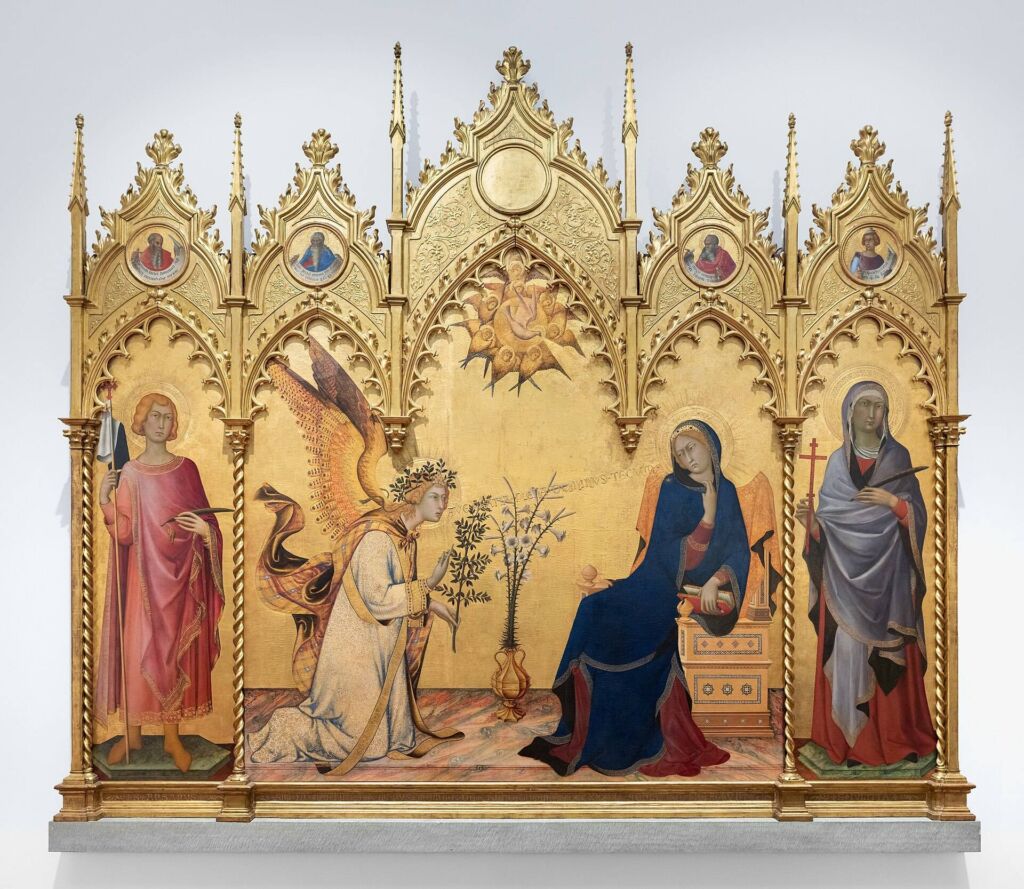
The forerunner is considered to be Guido da Siena, whose Maestà in the Palazzo Pubblico bears the date 1221, a date that scholars have long disputed, placing the work in the 1260s. Duccio himself was famous before the cathedral commission: in 1285 a Florentine confraternity ordered from him the Rucellai Madonna, now in the Uffizi. In 1878 the cathedral Maestà was moved to the Museo dell'Opera del Duomo, though some of its small scenes are now scattered among museums around the world. Simone Martini painted his Maestà as a fresco in the Hall of the Great Council (1315, reworked in 1321) and, with his brother-in-law Lippo Memmi, the Annunciation (1333, Uffizi). Between February 1338 and May 1339 Ambrogio Lorenzetti decorated the Sala dei Nove, the chamber of the city's governing council of Nine, with the Allegory of Good and Bad Government, one of the first large cycles in Italian painting on a civic rather than religious theme, with an almost documentary view of the city and the surrounding fields. His brother Pietro worked in the Lower Church at Assisi.
Sienese art was above all a civic affair: the commune and the cathedral commissioned the Maestà panels, painters belonged to a guild, and the city made jealously sure that its saints and its Virgin looked no worse than Florence's. Its fame traveled farther still. Around 1336 (by other accounts, by 1340) Simone Martini moved to the papal court at Avignon, became friends with Petrarch and painted a portrait of the poet's beloved Laura; Petrarch mentioned it in two sonnets, but the work itself has not survived. Martini died in Avignon in 1344. Even the Guidoriccio da Fogliano in the Palazzo Pubblico, dated 1328, is the subject of a long-running debate, with some scholars doubting that Martini painted it.
The Russian connection is modest but real. The State Hermitage Museum holds Simone Martini's Madonna from the Annunciation Scene, from the Roman collection of Count Grigory Stroganov; its companion, The Angel of the Annunciation, is in Washington. The Sienese masters also caught the attention of Russian travelers in the early 20th century: the writer Pavel Muratov devoted a chapter to Siena in his Images of Italy.
The plague of 1348 was a turning point. After it both Lorenzetti brothers disappear from the records, and it is generally assumed that they died in the epidemic along with a huge share of the city's population. Siena never regained its former wealth, but the school lived on for another century and a half: Sassetta, Giovanni di Paolo, Sano di Pietro and Matteo di Giovanni kept to gold and a fairy-tale tone when Florence had already moved on to Renaissance perspective. For this they were long considered backward, and for this the 20th century came to love them.