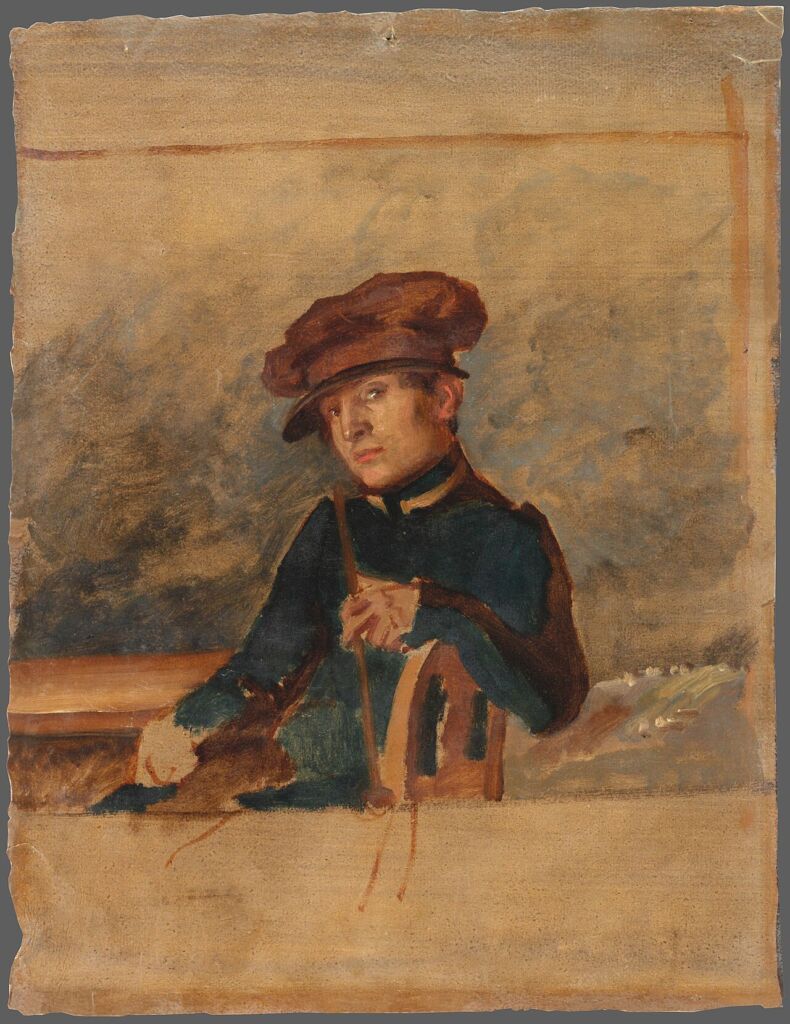
Alexander Ivanov
Alexander Andreyevich Ivanov · 1806, St Petersburg — 1858, St Petersburg
Biography
In 1858, in the White Hall of the Winter Palace, Alexander II inspected a huge canvas that a Russian scholarship painter had spent twenty years working on in Rome. A few weeks later the artist was dead, and on the very day he died word came that the emperor had bought the picture. So ended the life of Alexander Ivanov, a painter barely understood in his lifetime and, after his death, placed at the very center of 19th-century Russian painting.
He was born in St Petersburg on July 28, 1806 (July 16, Old Style), the son of Andrei Ivanovich Ivanov, professor of history painting at the Academy of Arts. The boy was sent to the Academy as a child and was taught above all by his father. Priam Asking Achilles for the Body of Hector (1824) won him the small gold medal, and Joseph Interpreting the Dreams of His Fellow Prisoners (1827) the large one.
In 1830 the Society for the Encouragement of Artists sent him to Italy. Ivanov settled in Rome and never again went home for long. He studied Raphael and the art of antiquity and painted Apollo, Hyacinthus and Cyparissus Making Music and Singing (1831–1834, State Tretyakov Gallery). He sent Christ's Appearance to Mary Magdalene after the Resurrection (1835) to St Petersburg, and in 1836 it earned him the title of academician; the painting is now in the State Russian Museum. In Rome he became close to Gogol and painted his portrait (1841), and Gogol devoted an essay to him, "The Historical Painter Ivanov," in his book Selected Passages from Correspondence with Friends.
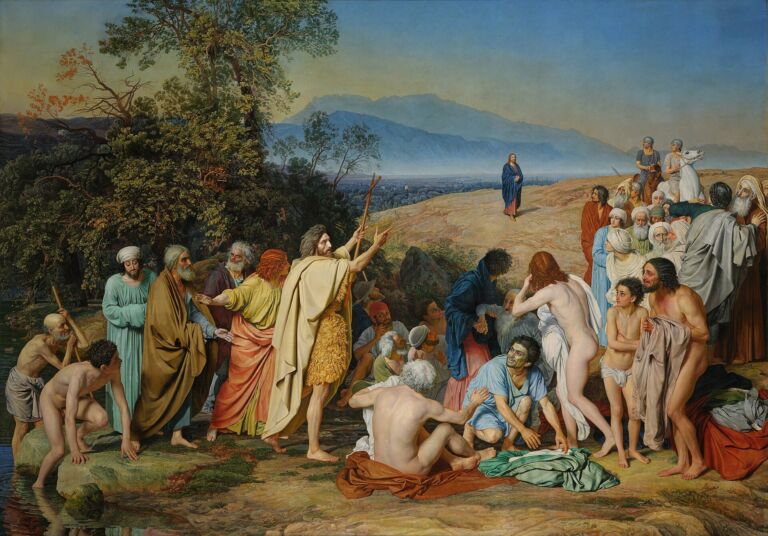
He found his great subject in 1833, in the Gospel of John: John the Baptist preparing the people to meet the Messiah. In May 1837 Ivanov bought a large canvas and rented a studio. Work on The Appearance of Christ to the People (The Appearance of the Messiah) went on, with interruptions, until the mid-1850s; the finished canvas measures 540 × 750 cm. A smaller version (State Russian Museum) was bought in 1858 by the Moscow merchant and collector Kozma Soldatenkov.
Ivanov's preparations seemed endless. By 1840 he had made five main sketches and more than two hundred studies, and some four hundred in all: models, casts of ancient sculpture, and landscapes of the Roman Campagna standing in for Palestine, which he could not reach. From 1846 he worked with a camera lucida. His open-air studies of naked boys by the water and his Italian landscapes now look bolder than the painting itself; in light and color they were ahead of their time.
The St Petersburg premiere was a disappointment. From June 22 (June 10, Old Style), 1858, the painting was on view at the Academy of Arts; the critics, Vasily Tolbin among them, were cool, and, according to the Great Russian Encyclopedia, this undermined the artist's health. He died of cholera on July 15 (July 3, Old Style), 1858. The emperor paid 15,000 silver rubles for the canvas.
Ivanov devoted his last years to the Biblical Sketches, watercolors on subjects from the Old and New Testaments; the series is in the State Tretyakov Gallery. The painting itself went to the Rumyantsev Museum in Moscow in 1862, and in 1932 it was moved to a hall built for it at the Tretyakov, where it still hangs. Ivanov's work is in the State Tretyakov Gallery and the State Russian Museum, and artists still respond to his great canvas, from Erik Bulatov (Painting and Spectators, 2012–2013) to theater projects.
Major works
Click a painting to see the details.
-
 01
The Appearance of Christ to the People (The Appearance of the Messiah)
1837–1857 · State Tretyakov Gallery, Moscow