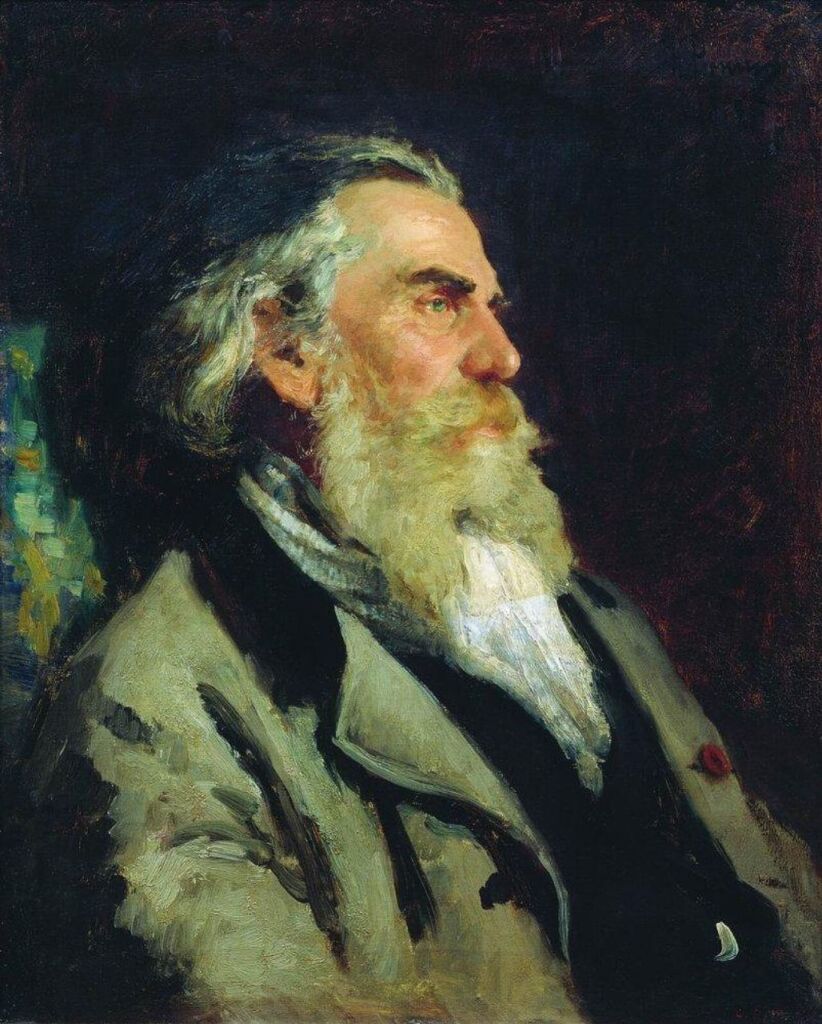
Alexei Bogolyubov
Alexei Petrovich Bogolyubov · 1824, Pomeranye estate — 1896, Paris
Biography
The grandson of Alexander Radishchev, author of the banned A Journey from St Petersburg to Moscow, an eighteenth-century indictment of serfdom, became court painter to the Imperial Russian Navy. His life is full of such pairings: an officer who turned artist, an academic painter among the Peredvizhniki, a Russian who spent his last twenty-odd years in Paris and gave a museum to the provincial city of Saratov.
Alexei Bogolyubov was born on March 28, 1824 (March 16, Old Style), at Pomeranye, an estate in the Novgorod Governorate. His father, Pyotr Gavrilovich, was a retired colonel; his mother, Fyokla Alexandrovna, was Radishchev's daughter. The boy was sent first to the Alexander Cadet Corps for young boys and then to the Naval Cadet Corps, from which he graduated as a midshipman in 1841. He served in the navy for several years and drew constantly on his voyages.
In 1850, at twenty-six, Bogolyubov enrolled at the Academy of Arts as an auditor, a non-degree student, and studied under Maxim Vorobiev and Bogdan Willewalde. He graduated in 1853 with the large gold medal, and in the 1850s he was also given the title of painter to the Main Naval Staff. The medal came with a scholarship to travel abroad: he spent several years in Europe, working in Geneva, in Eugène Isabey's studio in Paris and, for two years, with Andreas Achenbach in Düsseldorf.
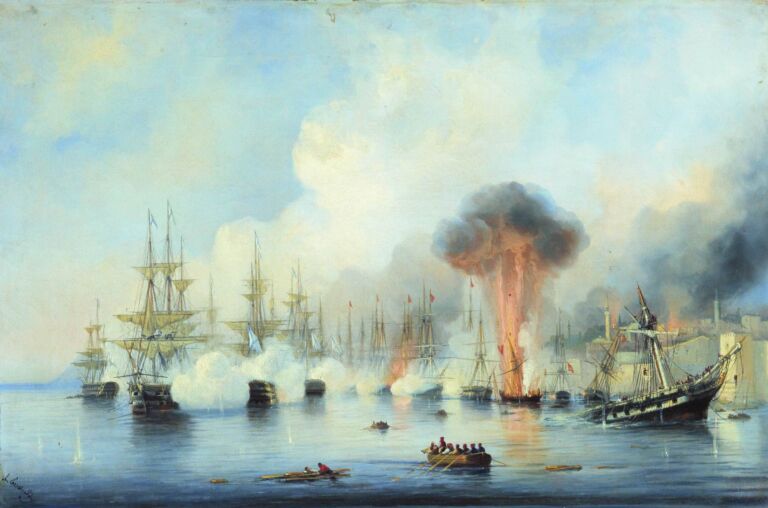
Naval commissions came from three emperors in succession. To complete battle pieces ordered as far back as the reign of Nicholas I, he traveled in 1856 to Sinop, the Turkish port on the Black Sea, to the Danube and to Constantinople to make studies. His large canvas The Battle of Sinop on November 18, 1853, finished in 1860, was shown in the White Hall of the Winter Palace; at the exhibition that same year the public also took note of his Kermesse in Amsterdam. He became an academician in 1858 and a professor in 1860–1861. Later came The Golden Horn, Constantinople (1864) and The Bicentenary of Peter the Great on the Neva (1872).
Bogolyubov worked with the precision of a staff officer. He painted from life, tied his sketches to geographic coordinates and checked the positions of ships against records of the battle. As a result his battle paintings, of which there were about a hundred, look like reconstructions. In his landscapes, by contrast, especially after he came to know the French masters, everything depends on light, air and quick studies.
From 1873 Bogolyubov lived in Paris, and that same year he joined the Society for Traveling Art Exhibitions, the Peredvizhniki. His Paris apartment became a mainstay for young Russian artists studying abroad on Academy scholarships: in 1877 he founded the Mutual Aid Society of Russian Artists. He also used his closeness to the court (he had accompanied the heir to the throne, the future Alexander III, on a journey through Russia) on his colleagues' behalf. In 1885 he lobbied for the lifting of the ban on Repin's Ivan the Terrible and His Son Ivan, and the ban was lifted.
Saratov became the main work of his later years. In 1885 the city's Radishchev Art Museum, named after his grandfather, opened on the basis of Bogolyubov's collection and with his money; attached to it was a drawing school, which has borne his name since 1897. He died in Paris on November 7, 1896, and was buried in St Petersburg in the Malaya Okhta Cemetery. In 1941 his remains were moved to the Alexander Nevsky Lavra, but the site of the grave was later lost.
The finest collections of Bogolyubov's work are in the Radishchev Art Museum in Saratov, the State Tretyakov Gallery, the State Russian Museum and the Central Naval Museum in St Petersburg. The naval museum holds his battle paintings, among them The Battle of Gangut, July 27, 1714 (1876).
Major works
Click a painting to see the details.
-
 01
The Battle of Sinop on November 18, 1853
1860 · Central Naval Museum, St Petersburg -
 02
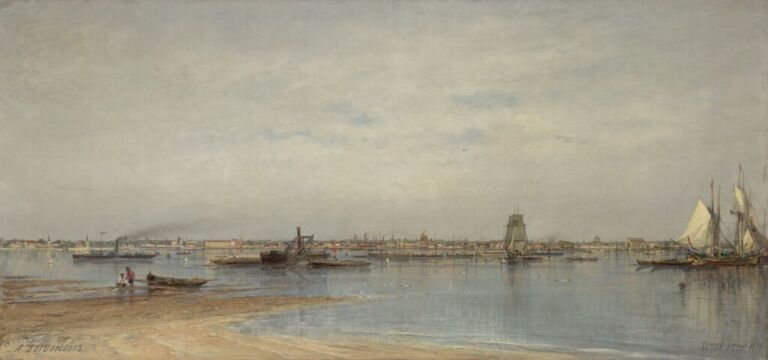
The Mouth of the Neva
1872 · State Tretyakov Gallery, Moscow
Related artists
 Ilya Repin
1885 · Bogolyubov lobbied to lift the ban on his painting