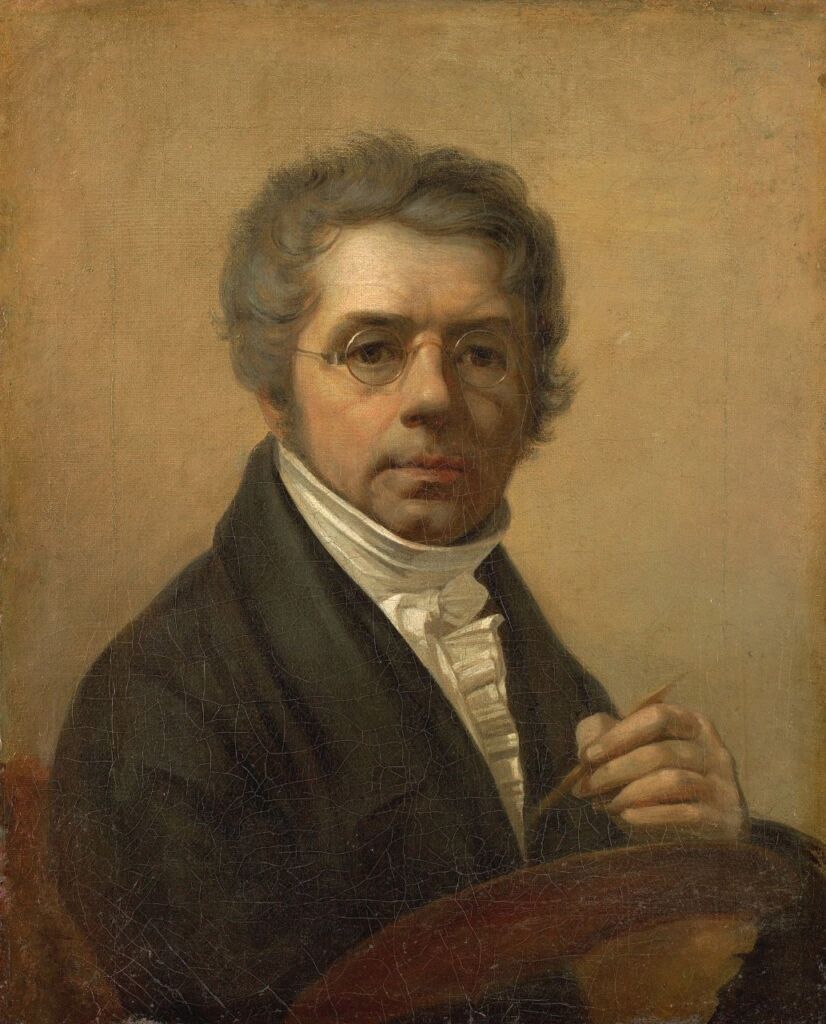
Alexei Venetsianov
Alexei Gavrilovich Venetsianov · 1780, Moscow — 1847, Poddubye
Biography
In 1824 the writer and journal editor Pavel Svinyin wrote that Alexei Venetsianov’s pictures “captivate with their truth.” The praise sounded almost like a discovery: until then the Russian peasant had appeared in painting as little more than an extra. Venetsianov made him the main subject and turned his country estate into an art school.
He was born in Moscow on February 18, 1780 (February 7, Old Style). According to family tradition, his ancestors came from Greece; his father, Gavrila Yuryevich, traded in currants, tulip bulbs and paintings, and his mother was a merchant’s daughter. Venetsianov taught himself to draw. He worked as a land surveyor in the Forestry Department, and from 1807 as a government clerk in St Petersburg. There he copied paintings in the Hermitage and took lessons from Vladimir Borovikovsky.
His first notable venture was satirical. In 1808 Venetsianov launched the Journal of Caricatures, which was soon banned, and in 1812, together with Ivan Terebenev, he drew caricatures of the French and of Russian Francophiles. In 1811 the Academy of Arts first named him a candidate academician for a self-portrait, and then a full academician for a portrait of K. I. Golovachevsky with pupils of the Academy.
In 1819 he left government service and settled with his family at Safonkovo, a small estate he had bought in Tver Governorate. It was here that he painted his major works. In the Ploughed Field. Spring was painted in the first half of the 1820s and opens his series on peasant labor, which also includes Harvesting. Summer and Haymaking. Venetsianov neither signed nor dated his pictures, so scholars disagree about dates: for In the Ploughed Field, both the 1810s and the early 1830s have been proposed. The title also changed over time, and in 1893 the canvas was bought by Pavel Tretyakov. The same village world appears in The Threshing Floor (1821–1823), Zakharka (1825), The Sleeping Shepherd Boy and Peasant Woman with Cornflowers.
Venetsianov had no academic training, and this shaped his manner. He learned from the old masters in the Hermitage and from Borovikovsky, and he painted peasants where they lived and worked, in the fields and cottages of his own estate. Figure and landscape carry equal weight in his pictures, and labor is shown without sentimentality and without social protest. In 1826 the critic Vasily Grigorovich praised his “truthful and pleasing colors” and named as his best works “the interior of a threshing barn,” “the sleeping peasant boy” and “the village morning.”
He was never made a professor of the Academy, since he lacked an academic education. So he taught on his own: more than seventy pupils trained at Safonkovo, many of them from poor families or serfs, and the poet Vasily Zhukovsky helped some of them. Grigory Soroka, one of his pupils, came to a tragic end: a serf belonging to the landowner Milyukov, he took his own life. In 1829 Nicholas I appointed Venetsianov court painter. In the late 1830s he painted Seeing Off a Recruit (Pavlovsk) and The Return of the Soldier (State Russian Museum); his portraits of the historian Nikolai Karamzin and of Nikolai Gogol date from earlier, 1828 and 1834.
On December 16, 1847 (December 4, Old Style), on the road to Tver near the village of Poddubye, his horses bolted and Venetsianov was killed. He was buried in the village of Dubrovskoye, now called Venetsianovo. The main collections are the State Tretyakov Gallery and the State Russian Museum. The importance of the “Venetsianov school” is that genre painting in Russia began not with satire but with respect for people who had gone unnoticed.
Major works
Click a painting to see the details.
-
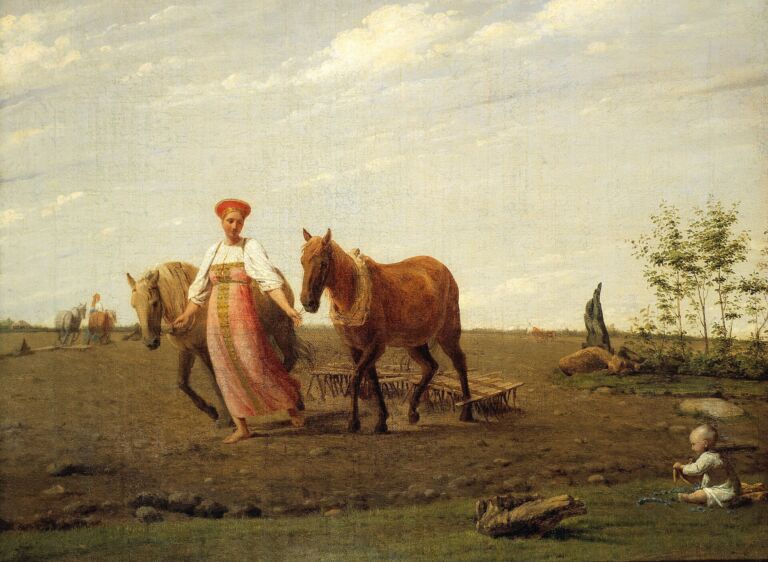 01
In the Ploughed Field. Spring
First half of the 1820s · State Tretyakov Gallery, Moscow
Related artists
 Vladimir Borovikovsky
1800s · teacher