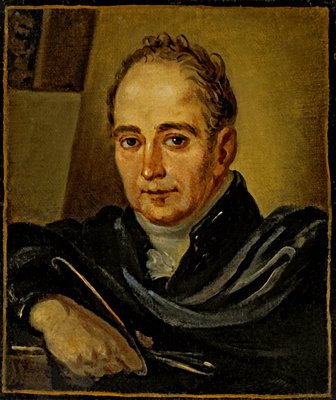
Vladimir Borovikovsky
Vladimir Lukich Borovikovsky · 1757, Mirgorod (now Myrhorod — 1825, St Petersburg
Biography
Two allegories painted for a traveling palace decided his fate. In 1787 Catherine the Great was journeying to Crimea, and the poet Vasily Kapnist commissioned an icon painter he knew in Mirgorod to paint pictures for the empress’s rooms in Kremenchuk. She liked the works, and their author, Vladimir Borovik, soon found himself in St Petersburg.
He was born on August 4, 1757 (July 24, Old Style), in Mirgorod, now Myrhorod in Ukraine, into a Cossack family. His father, Luka Borovik, painted icons, and his sons worked with him decorating local churches. Vladimir served in the Mirgorod Regiment, retired as a lieutenant and lived at home until he was thirty. In the autumn of 1788 he moved to the capital and changed his surname to Borovikovsky.
He was too old for the Academy, so he studied privately, first with Dmitry Levitsky and then with the Austrian Johann Baptist Lampi. For about ten years he lived in the house of the architect Nikolai Lvov, whose circle shaped his taste. In 1795, only seven years after moving to the capital, he was made an academician for his portrait of Grand Duke Konstantin Pavlovich. A year earlier he had painted Catherine II Strolling in Tsarskoye Selo Park: the empress did not buy the picture, but its homely, almost private image became a landmark in Russian portraiture. From 1802 Borovikovsky was a council member of the Academy.
His most famous canvas is the Portrait of Maria Lopukhina (1797). It was commissioned by Stepan Lopukhin, Master of the Hunt at court, to mark his marriage to Maria Tolstaya. She died of consumption in 1803, and the portrait was later acquired by Pavel Tretyakov. It now hangs in the State Tretyakov Gallery, and critics call it the “Russian Mona Lisa.” A year before it, in 1796, he painted his teacher Levitsky, and in 1816 the Serbian leader Karađorđe. Alongside these stand his portraits of Murtaza Quli Khan (1796), Paul I (1800), Prince Kurakin (1801–1802), the Gagarin sisters (1802) and the poet Gavrila Derzhavin (1811).
What made him distinctive? He combined metropolitan training with an icon painter’s meticulousness and devised a formula of his own for Russian Sentimentalism: a sitter against a park background, soft light, pensiveness without gesture. Pose, foliage and fabric all serve a single mood. His roughly five hundred portraits, of which about four hundred survive, form a chronicle of St Petersburg society over thirty years.
He did not teach at the Academy and founded no school, although pupils lived in his house; among them was Alexei Venetsianov. From 1804 to 1811 he worked on icons for the Kazan Cathedral, then under construction. He never married.
He spent his last years in search of spiritual support. Borovikovsky belonged to the Masonic lodge of the Dying Sphinx, but the mystical circles left him largely disappointed. He returned to icon painting; his last work was the iconostasis of the church at the Smolensky Cemetery. Death came suddenly, on April 18, 1825 (April 6, Old Style). Borovikovsky was buried in the Smolensky Cemetery, and in 1931 his remains were moved to the Lazarevskoe Cemetery of the Alexander Nevsky Lavra.
The finest collections are in the State Tretyakov Gallery (Lopukhina, the Gagarin sisters, Portrait of an Unknown Woman in a Yellow Shawl) and the State Russian Museum. Britannica calls him the foremost portraitist of the Sentimentalist era.
Major works
Click a painting to see the details.
-
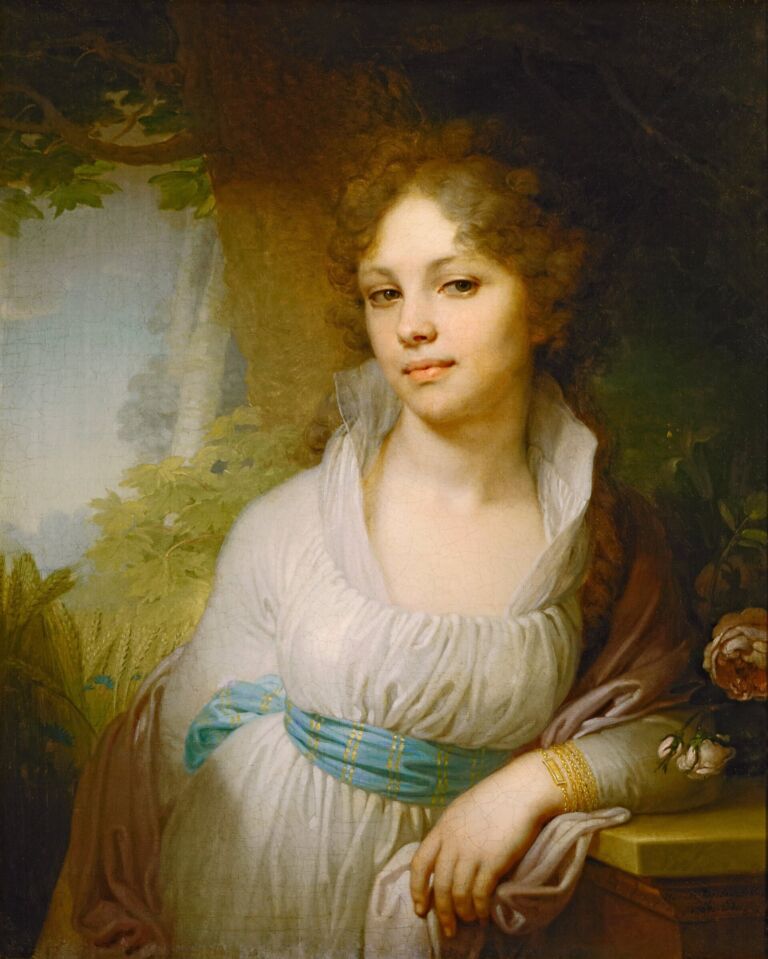 01
Portrait of Maria Lopukhina
1797 · State Tretyakov Gallery, Moscow
Related artists
 Dmitry Levitsky
1790s · teacher
 Alexei Venetsianov
1800s · pupil