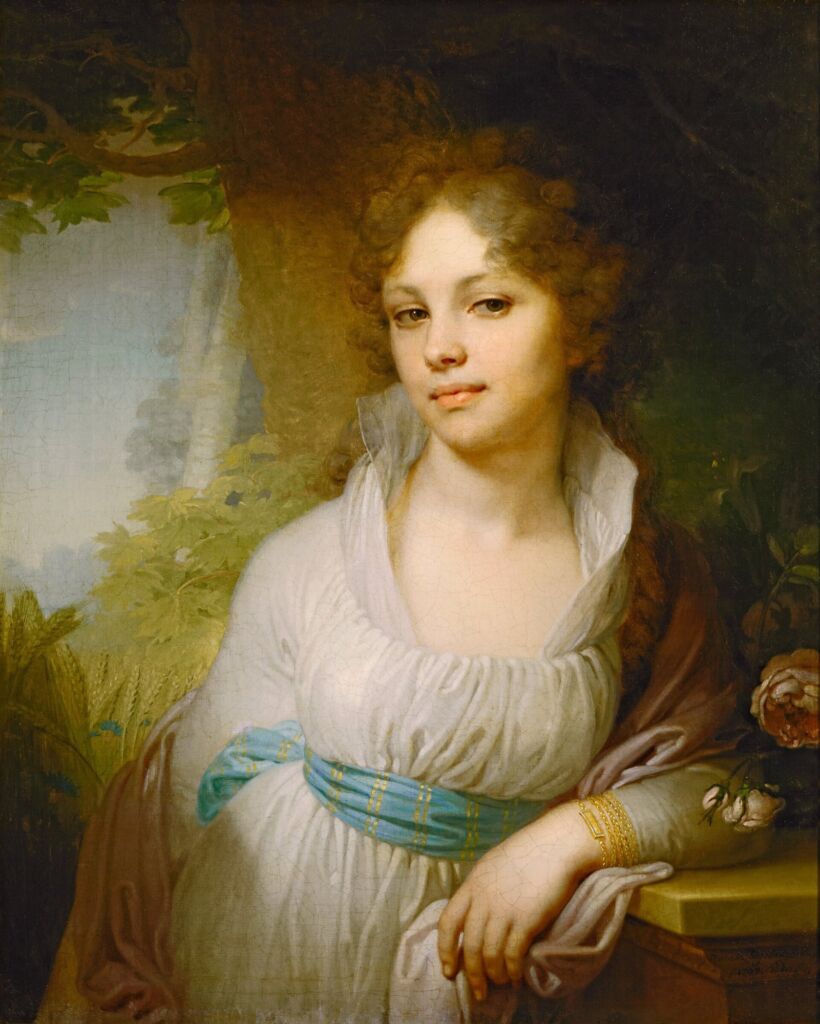
Vladimir Borovikovsky, Portrait of Maria Lopukhina, 1797
Sentimentalism
Second half of the 18th to early 19th century · Europe and Russia
About the movement
The movement was named after a book, not a painting. In 1768 Laurence Sterne published A Sentimental Journey through France and Italy, and the word "sentimental" spread across Europe along with the novels of Samuel Richardson and Jean-Jacques Rousseau's Julie, or the New Heloise (1761). The Age of Enlightenment, with its faith in reason, suddenly discovered that what makes a person good is, above all, the heart. Painting caught the mood almost at once.
Against the courtly heroics and gallantry of the Rococo, Sentimentalism set private life. Its heroes are fathers of families, brides, children and old people, and its main subject is feeling: tenderness, gratitude, remorse, quiet sadness. Nature turned from a backdrop into a companion. The movement had no manifesto and no school; it was more a shared mood that united artists of very different manners and countries.
In France its voice was Jean-Baptiste Greuze. The Village Bride (1761, Louvre) caused a sensation at the Salon, and in 1763 Greuze showed Filial Piety, known as The Paralytic. Denis Diderot, who saw such pictures as moral sermons, opened his review with the words "Now here is truly my painter, this Greuze." The Paralytic is now in the State Hermitage Museum: Catherine the Great bought it on Diderot's advice. In England the same note sounds in the portraits of Thomas Gainsborough, whose sitters stroll in a park or sit under a tree instead of posing against columns, like Mr and Mrs Hallett in The Morning Walk (1785, National Gallery, London). In Germany, Daniel Chodowiecki, the illustrator of The Sorrows of Young Werther, made engravings of scenes from middle-class life.
The public wept before Greuze's pictures, and engravings after them sold by the thousands; the artist himself made sure his works were engraved. But Diderot later cooled toward him, and in 1769 the Academy admitted Greuze on the strength of Septimius Severus Reproaching Caracalla only as a genre painter, denying him the title of history painter. Offended, Greuze stayed away from the Salon for many years. The hierarchy of genres proved stronger than the fashion for feeling.
Russia produced perhaps the strongest images of Sentimentalism. In 1792 Nikolai Karamzin published his story Poor Liza, and the pond by the Simonov Monastery in Moscow, where the heroine drowns herself, became a place of pilgrimage. Vladimir Borovikovsky, a pupil of Dmitry Levitsky, showed the empress as an elderly country lady with her little dog in Catherine II Walking in Tsarskoye Selo Park (1794, State Tretyakov Gallery; a later replica is in the State Russian Museum), and in his Portrait of Maria Lopukhina (1797, State Tretyakov Gallery) he created the emblematic image of the age. Almost ninety years later the poet Yakov Polonsky dedicated a poem to the portrait: "She passed long ago, and those eyes are no more." The movement's prehistory also includes the lyrical portraits of Fyodor Rokotov, above all his Portrait of Alexandra Struiskaya (1772, State Tretyakov Gallery), wife of the poet Nikolai Struisky, which Nikolai Zabolotsky celebrated in 1953 in his poem "Portrait."
The age of sensibility was short-lived. In France it gave way to the austere Neoclassicism of Jacques-Louis David, and by the 1810s Borovikovsky himself had turned to a cool Empire manner. Yet Sentimentalism left its mark. It taught art to value the inner life of the private individual and to see nature as a mirror of the soul. Romanticism inherited those lessons, and 19th-century genre painting, from Russia's Peredvizhniki, or Wanderers, to Victorian painting in England, grew in large part out of Greuze's pictures, in which a family scene began to speak seriously about morals.
Artists
Major works
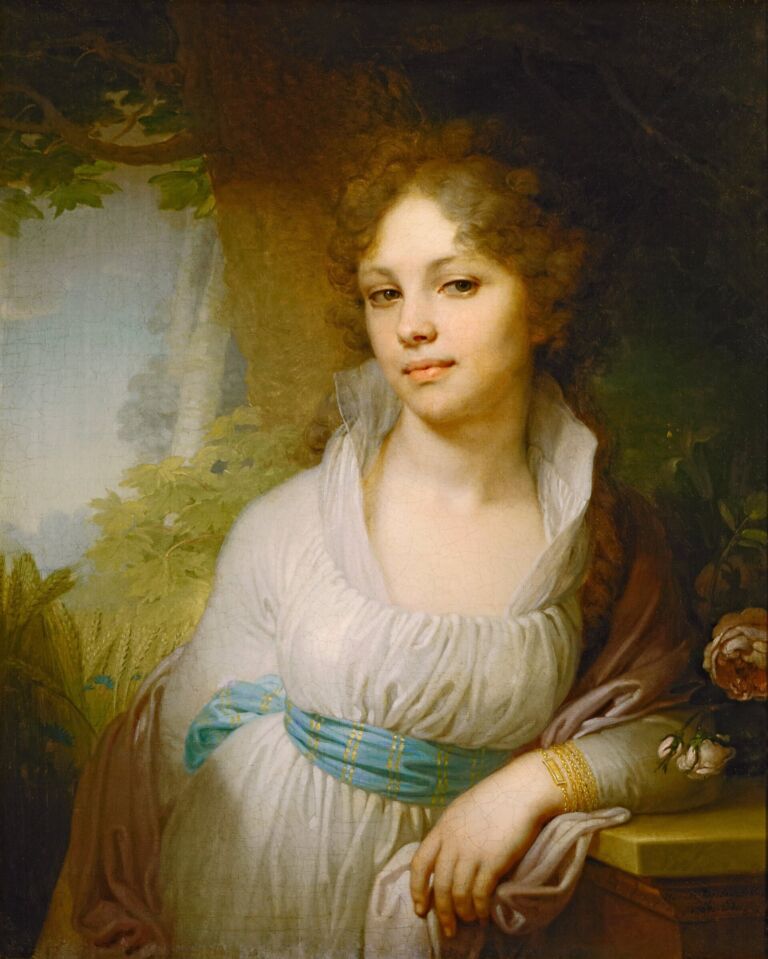 Portrait of Maria LopukhinaVladimir Borovikovsky · 1797