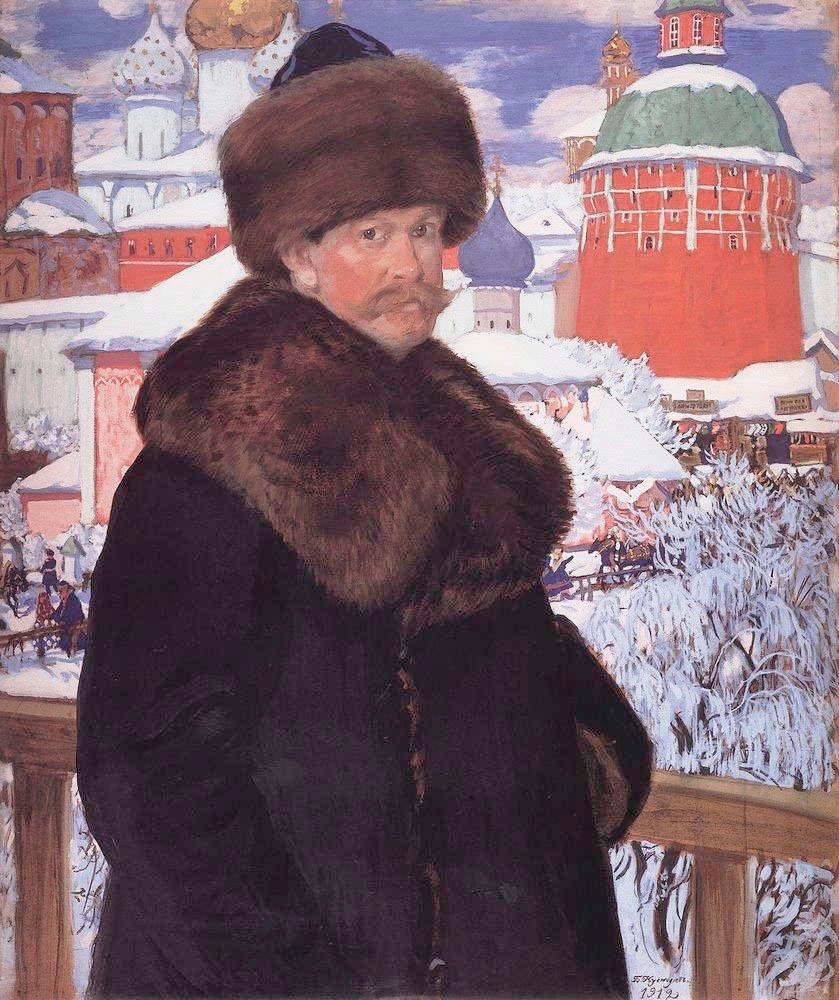
Boris Kustodiev
Boris Mikhailovich Kustodiev · 1878, Astrakhan — 1927, Leningrad
Biography
In March 1916 Stepan Krachkovsky wrote to Kustodiev that Repin was “delighted with your Shrovetide.” That same month the man who had painted it underwent a second operation on his spine and never walked again. The sunniest, noisiest canvases in early twentieth-century Russian art were painted by a man who spent the last ten years of his life in a wheelchair.
Boris Mikhailovich Kustodiev was born on March 7, 1878 (February 23, Old Style), in Astrakhan. His father, a teacher at the local gymnasium, died before the boy was two, and the children were raised by their mother. Kustodiev attended a church school and then a seminary, and took drawing lessons from the Astrakhan painter Pavel Vlasov, with whom he corresponded for the rest of his life. In 1896 he entered the Higher Art School of the Academy of Arts, where he studied under Vasily Savinsky and in Ilya Repin's studio.
Repin soon singled out his student and took him on as an assistant for the huge group portrait Ceremonial Session of the State Council (1901–1903). Kustodiev painted studies for the portraits of the dignitaries and learned to hold a crowded composition in his head. He graduated from the Academy in 1903 with a gold medal and a scholarship to travel abroad, which took him to Paris and Spain. As early as 1909 he was made an academician, and his self-portrait entered the collection of the Uffizi in Florence. From 1907 to 1910 Kustodiev was a member of the Union of Russian Artists, and from 1911 of the revived World of Art.
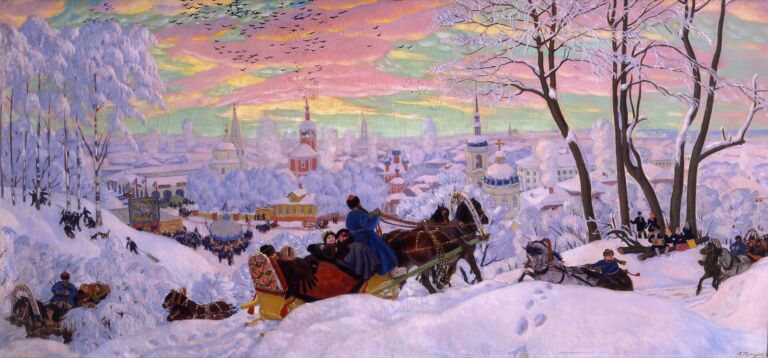
Around 1907 his arms began to hurt. In 1911 doctors in Switzerland diagnosed bone tuberculosis, but a year of treatment did not help; in 1913 surgeons in Berlin suspected a tumor of the spinal cord and operated. The pain eased for a time. It was in these years that “Kustodiev's world” took shape: fairs, merchants' wives, festivities, provincial towns. He painted Shrovetide (1916), a scene of Maslenitsa, the carnival week before Lent, from memories of the festivities of his childhood and student years. After the World of Art exhibition in February 1916 the canvas was bought by the Academy, and since 1923 it has been in the Russian Museum. Merchant's Wife (1915) and The Beauty (1915, State Tretyakov Gallery) caused controversy: some saw them as satire on the merchant class, others as loving admiration.
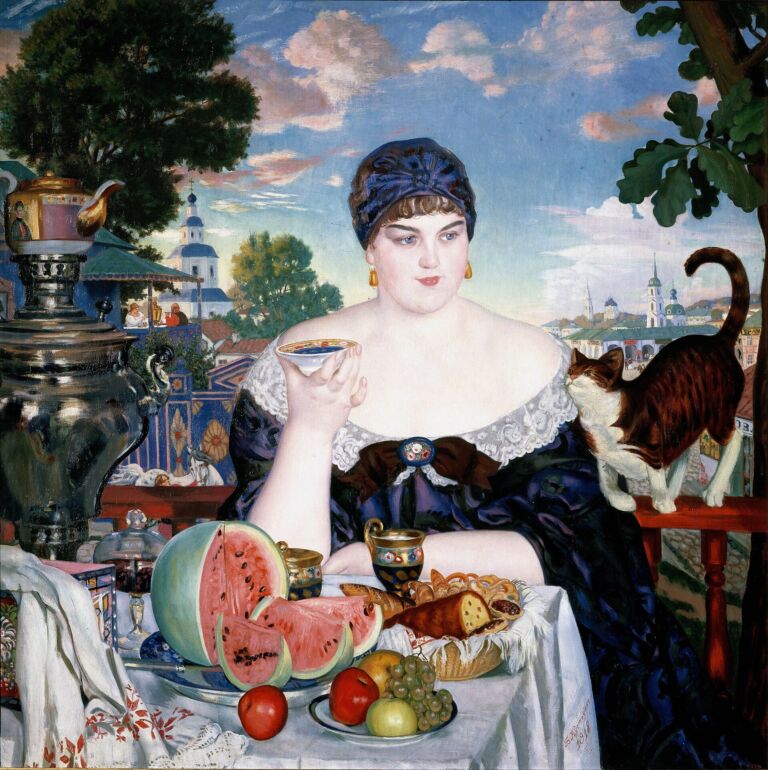
The revolutionary years did not interrupt his work. Merchant's Wife at Tea (1918) was painted in the hungry Petrograd of 1918: the abundance on the canvas came from memory, not from life. Around the same time came The Bolshevik (1920, State Tretyakov Gallery), a rare case of Kustodiev's festive exaggeration serving the new regime; the artist also joined the Association of Artists of Revolutionary Russia. In 1920–1922 he painted the Portrait of Feodor Chaliapin; the story goes that the great bass posed for his ailing friend at the artist's home. In 1919 and 1920 Kustodiev returned twice more to the subject of Shrovetide.
Kustodiev did not so much record everyday life as invent his own Russia in the spirit of the lubok, the brightly colored Russian folk print. He built a picture like a stage set: a high horizon, a panorama seen from above, a dense crowd of small figures and bright, unmixed color borrowed from shop signs, toys and painted trays. Hence the ease of his move into the theater: he designed stage productions, and in 1923 he illustrated Nikolai Leskov's Lady Macbeth of the Mtsensk District.
He worked until his final weeks without leaving his wheelchair, painting, drawing and cutting linocuts. Kustodiev died in Leningrad on May 26, 1927. He was buried in the Nikolskoe Cemetery of the Alexander Nevsky Lavra; his remains were later moved to the Tikhvin Cemetery. The finest collections of his work are in the State Russian Museum and the State Tretyakov Gallery. There is a large collection in the Dogadin Art Gallery in Astrakhan, and the 1919 Shrovetide is in the Isaak Brodsky Museum-Apartment in St Petersburg. His name became a byword: in Russian, a “Kustodiev merchant's wife,” meaning a plump, rosy-cheeked beauty, needs no caption.
Major works
Click a painting to see the details.
-
 01
Merchant's Wife at Tea
1918 · State Russian Museum, St Petersburg -
 02
Shrovetide
1916 · State Russian Museum, St Petersburg
Related artists
 Ilya Repin
1896–1903 · teacher; Kustodiev assisted him on Ceremonial Session of the State Council