World of Art
1898–1924 · Russia
About the movement
It began as a school friendship. In the late 1880s three graduates of Karl May's private gymnasium in St Petersburg, Alexandre Benois, Dmitry Filosofov and Walter Nouvel, met to give talks on art to one another and jokingly called themselves the "Nevsky Pickwickians." They were soon joined by Konstantin Somov, Léon Bakst and Filosofov's cousin Sergei Diaghilev, newly arrived from Perm. It was Diaghilev who turned the circle into an enterprise. Early in 1898 he staged an exhibition of Russian and Finnish artists, and at the end of that year, with money from Princess Maria Tenisheva and the industrialist and patron Savva Mamontov, the first issue of the journal Mir iskusstva (World of Art) came out.
The World of Art group fought on two fronts. They saw the Imperial Academy of Arts as a dead school, and the late work of the Peredvizhniki, or Wanderers, the realist painters who had dominated Russian art since the 1870s, as literature in paint, where the theme mattered more than the painting. What they wanted was art valued for its own sake: style, taste, historical accuracy, a well-made book, a well-made stage costume. The journal printed articles on the forgotten Russian 18th century side by side with pieces on contemporary European art, and its design became a model for all Russian book graphics. Vladimir Stasov, the Wanderers' leading champion, responded with charges of decadence.
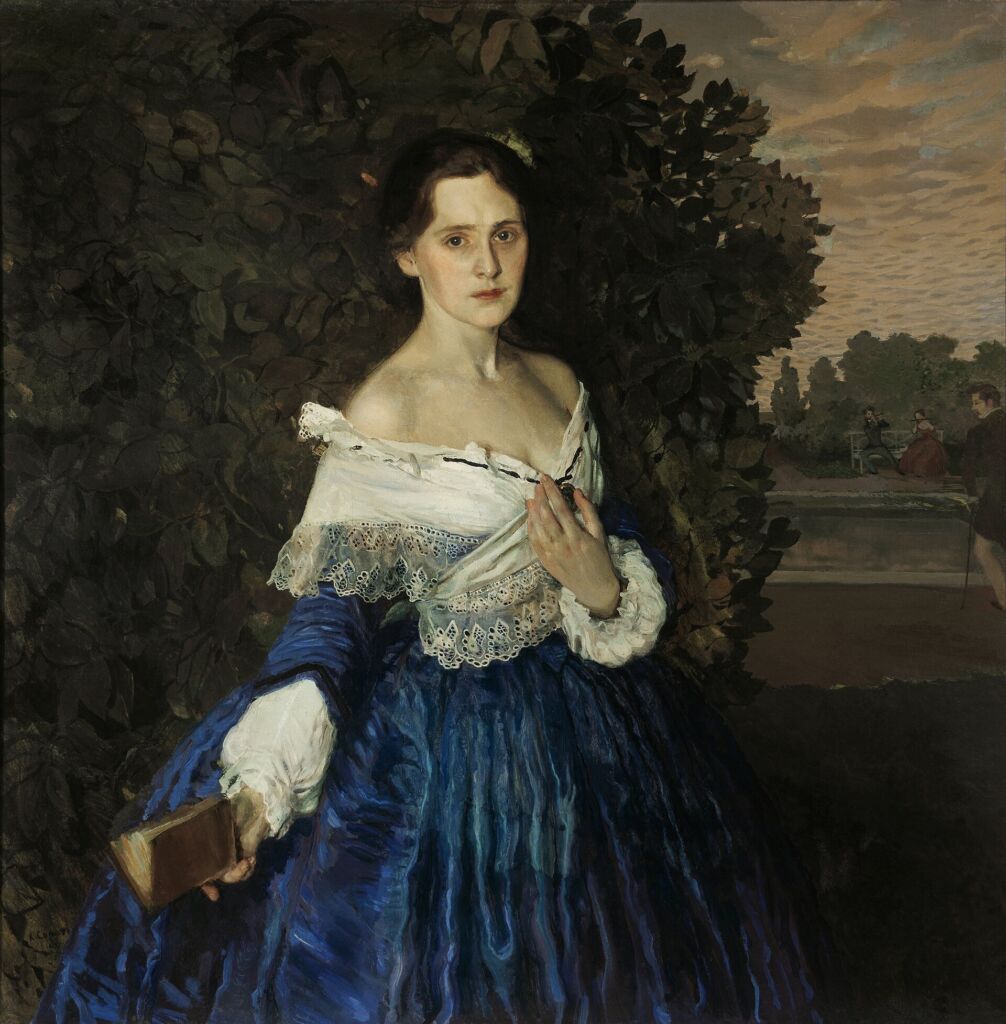
Their great subjects were the past and the theater. Somov painted Lady in Blue (1897–1900, State Tretyakov Gallery), a portrait of the artist Yelizaveta Martynova in an old-fashioned dress, in which a contemporary woman becomes the ghost of a vanished age. In his Versailles series of the 1890s and 1900s Benois showed Louis XIV out on his promenades, while Eugene Lanceray and Mstislav Dobuzhinsky depicted St Petersburg old and new. In 1899 Ivan Bilibin illustrated the fairy tale of Prince Ivan and the Firebird and found his instantly recognizable style in Russian folk prints. In Terror Antiquus (1908, State Russian Museum) Bakst turned the destruction of Atlantis into a Symbolist landscape. Exhibiting alongside them were Valentin Serov, Nicholas Roerich and, later, Zinaida Serebriakova and Boris Kustodiev, the painter of Shrovetide (1916) and Merchant's Wife at Tea (1918, State Russian Museum).
The group's most spectacular undertaking was the Historical and Artistic Exhibition of Russian Portraits, which Diaghilev mounted at the Tauride Palace in 1905: several thousand portraits of the 18th and 19th centuries, gathered from country estates and museums. The speech "In the Hour of Reckoning," which he gave in March 1905 at a banquet in his honor at the Metropol hotel in Moscow, sounded like a farewell to a Russia that was passing away. By then the journal had closed, its last issue dated 1904, and in 1906 Diaghilev organized a farewell exhibition of the original World of Art.
From there the energy moved west. In 1906 Diaghilev brought an exhibition of Russian art to the Salon d'Automne in Paris; in 1908 he staged Mussorgsky's opera Boris Godunov there with Feodor Chaliapin, and in 1909 the Saisons Russes (Russian Seasons) began. Sets and costumes by Benois, Bakst, Roerich and later Natalia Goncharova set the fashion for all of Europe. Bakst's Scheherazade (1910) influenced Parisian fashion and interiors more than any exhibition could.
In 1910 the society was revived with Roerich as chairman. It was now a broad exhibiting platform where Kuzma Petrov-Vodkin, Martiros Saryan and Nathan Altman showed next to the founders. The last exhibition in Russia took place in 1924, and in 1927 émigrés organized a show under the same name in Paris. The World of Art gave Russian art back its sense of style and tied it to Europe, and its graphic art, book design and stagecraft became the foundation for the generations that followed, including those who later dismissed the group as outdated.
Artists
Major works
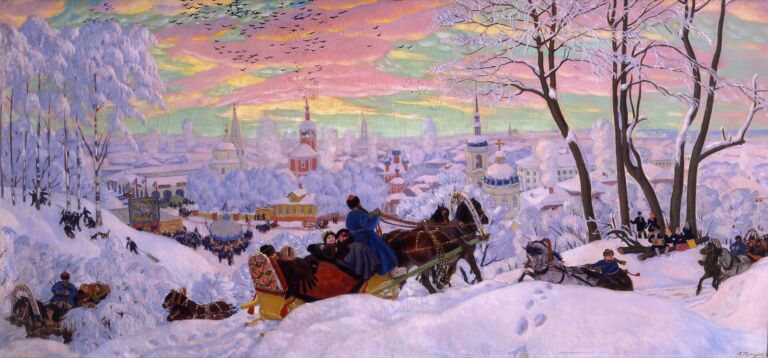 ShrovetideBoris Kustodiev · 1916
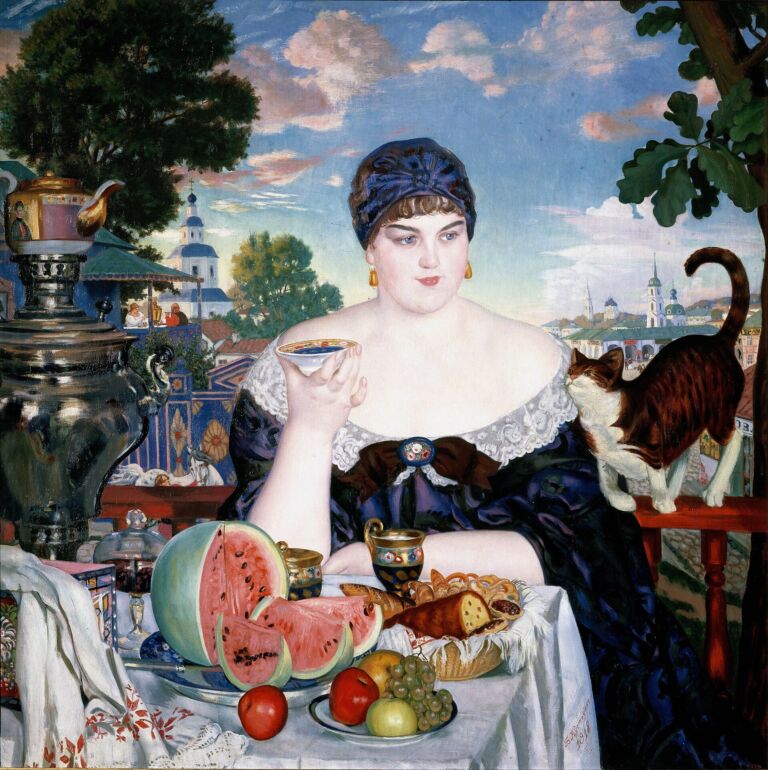 Merchant's Wife at TeaBoris Kustodiev · 1918