Russian art · Artist
Ivan Aivazovsky
Ivan Konstantinovich Aivazovsky · 1817, Feodosia — 1900, Feodosia
Biography
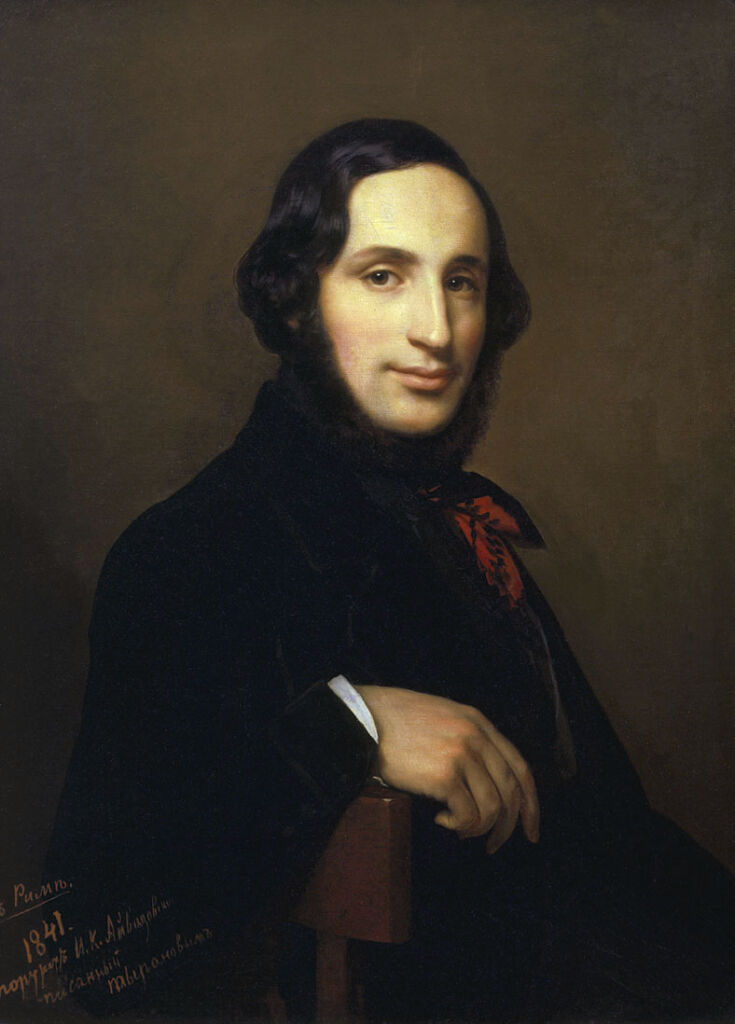
Feodosia, a port on the Crimean coast, was both the beginning and the end for Aivazovsky. He was born there on July 29, 1817 (July 17 by the Old Style calendar) as Ovanes Gaivazovsky, the son of an impoverished Armenian merchant; he came back after his triumphs in the capital, and he died there. The gifted boy caught the eye of the town governor, Alexander Kaznacheev, who helped him into the secondary school in Simferopol and, in 1833, into the Imperial Academy of Arts in St Petersburg. There Aivazovsky studied in Maxim Vorobiev's landscape class and with the French marine painter Philippe Tanneur.
In 1837 he won the Academy's large gold medal and, with it, the right to travel abroad. Four years in Italy (1840–1844) made him a European celebrity: his canvases sold in Rome and were shown in Paris and Amsterdam. He returned in 1844 as an academician and official painter to the Main Naval Staff, and became a professor in 1847. Back in 1836, while still a student, he had met Pushkin, and he painted the poet by the sea more than once. From 1845 he lived in Feodosia, traveling to St Petersburg when he had to.
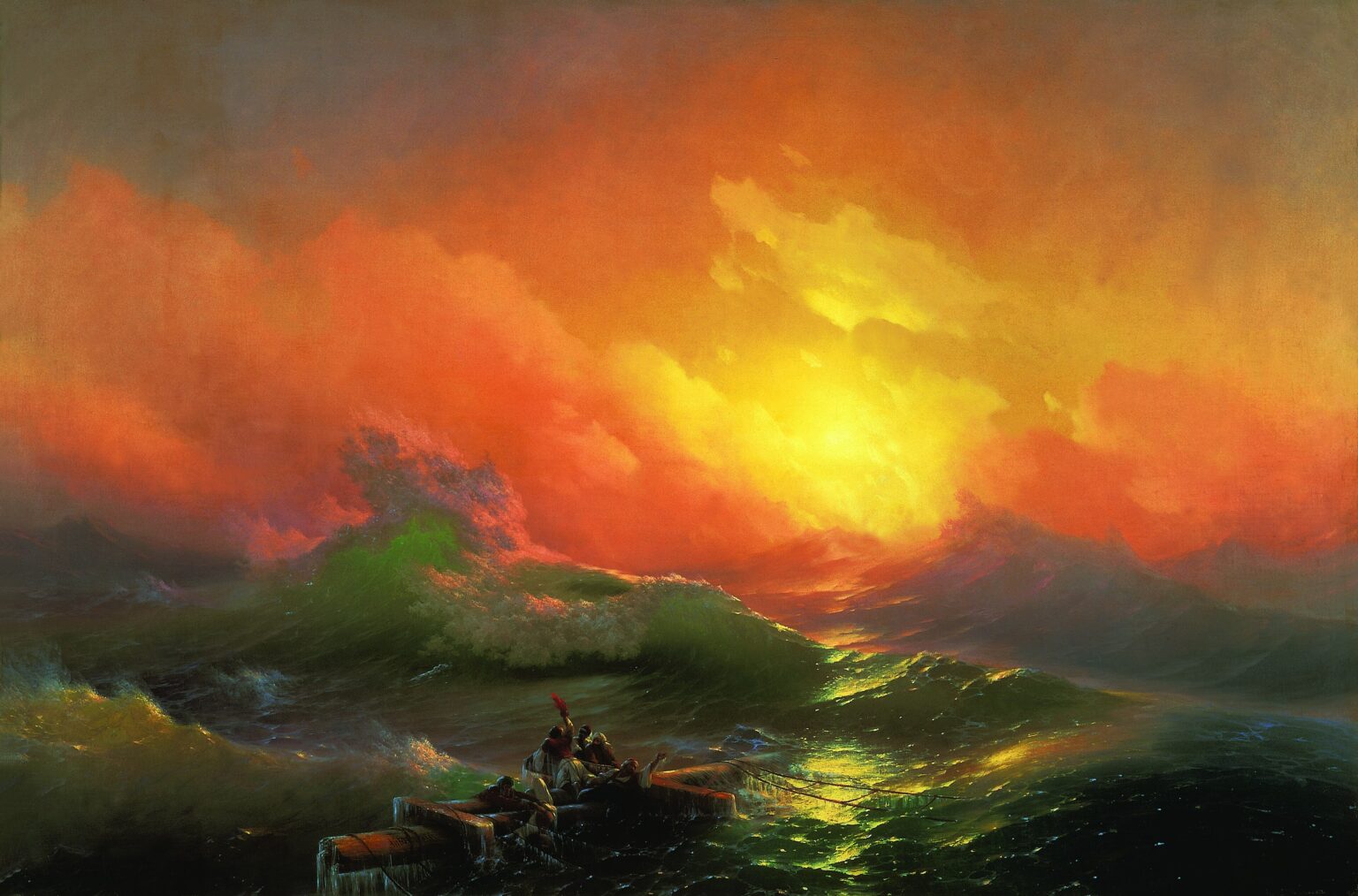
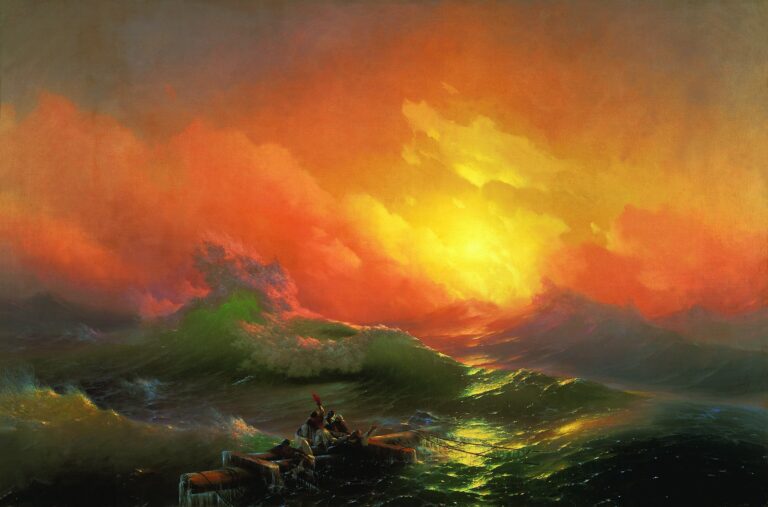
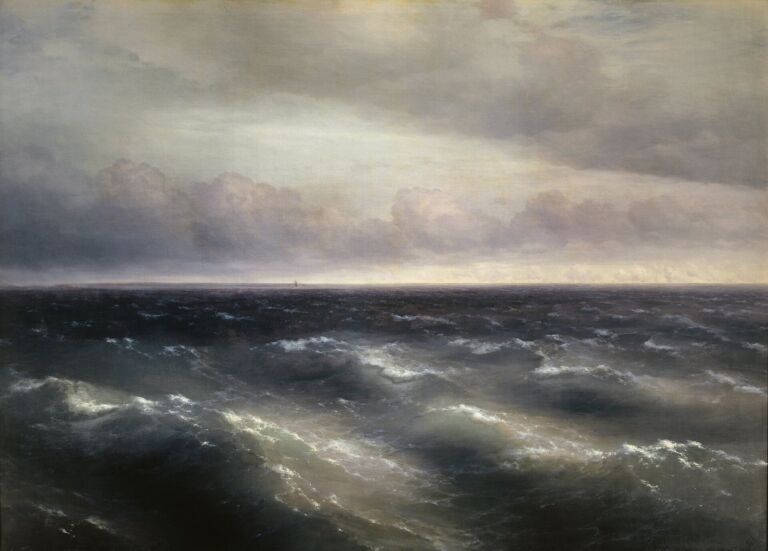
His most important pictures are less about places than about history. The Battle of Chesma (1848) opened a long series on the Russian navy, from Peter the Great to the wars with Turkey. The Ninth Wave (1850), now in the State Russian Museum, has long been all but synonymous with his name. The Rainbow (1873) and The Black Sea (1881) hang in the State Tretyakov Gallery; the second is also known as A Storm Is Breaking on the Black Sea. He painted the late canvas Among the Waves (1898) in his eighties, and it stayed in Feodosia.
What astonished his contemporaries was the way he worked. He hardly painted from life at all: he painted the sea in the studio, from memory, convinced that no brush could keep pace with moving water. Hence his speed (smaller canvases were finished in a single session) and his signature effects: a wave lit from within, the moon behind a cloud, a fiery glow over dark water. His late pictures are quieter in color and stricter in composition than the early ones.
Recognition came early, and from the top. Karl Bryullov and the poet Vasily Zhukovsky admired him, and Turner is said to have praised him highly. The imperial court and the Admiralty bought his work eagerly. The other side of success was the critics' charge of repetition: he painted some 6,000 pictures in his lifetime, and their quality, as the Great Russian Encyclopedia concedes, is uneven.
He gave Feodosia more than paintings. In 1865 he opened a studio there for pupils, in 1880 an art gallery; later he pressed for a railway to the town and gave it the water from his Subash estate. His first marriage, to the governess Julia Graves, broke down; in 1882 he married Anna Burnazian. Aivazovsky died on May 2, 1900 (April 19, Old Style) and was buried in the grounds of the Armenian church of Surb Sarkis.
The gallery he left to the town bears his name and remains the largest collection of his work. The State Russian Museum and the State Tretyakov Gallery also hold major groups of his paintings; for his bicentenary in 2016 the Tretyakov showed about 120 of them. For the general public he is still Russia's great painter of the sea; for historians he is the artist who turned Romanticism into an official, state genre.
Major works
Click a painting to see the details.
-
 01
The Ninth Wave
1850 · State Russian Museum, St Petersburg -
 02
The Black Sea
1881 · State Tretyakov Gallery, Moscow
Stories about Ivan Aivazovsky
Related artists
MV
Maxim Vorobiev
1833–1837 · teacher
PT
Philippe Tanneur
1830s · teacher
AP
Alexander Pushkin
1836 · acquaintance; paintings devoted to him
 Karl Bryullov
1830s–1840s · admirer and supporter