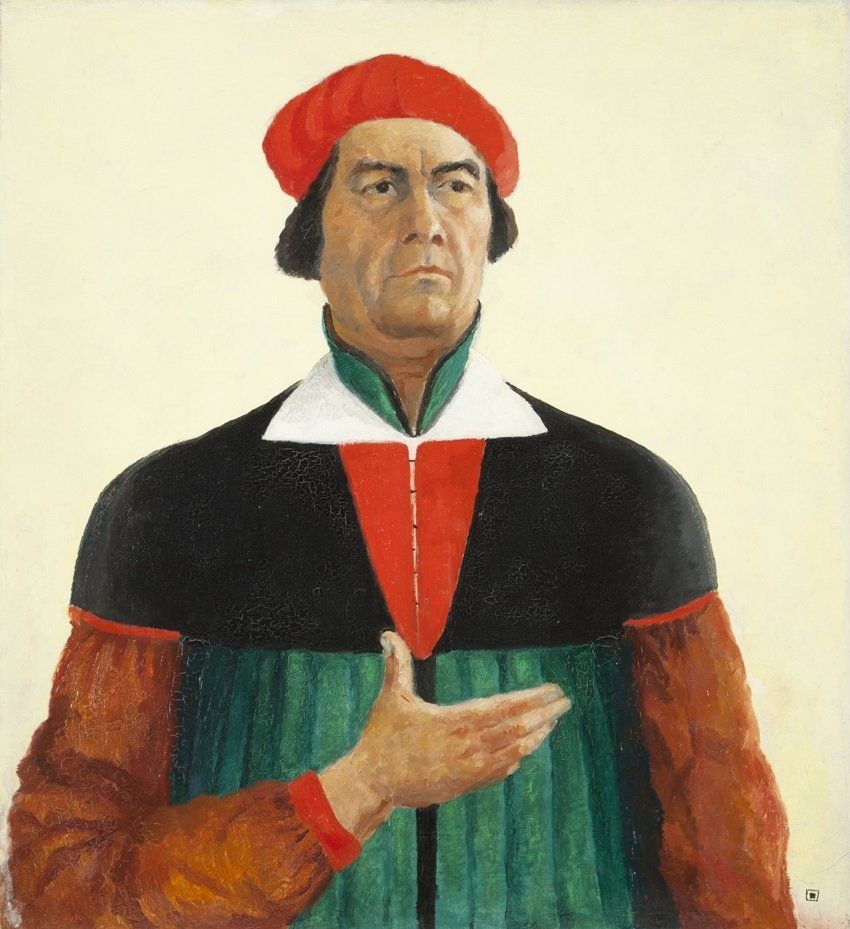
Kazimir Malevich
Kazimir Severinovich Malevich · 1879, Kyiv — 1935, Leningrad
Biography
Kazimir Malevich was born in Kyiv on February 23, 1879 (February 11, Old Style), into a family of Polish origin; the artist himself gave his birth year as 1878, and that date long circulated in reference books. The family moved often in search of work, and as a teenager Kazimir worked alongside his father at a sugar refinery. He studied at the Kyiv Drawing School in 1895–1896.
In 1904 Malevich moved to Moscow, and in 1905–1910 he studied at Fyodor Rerberg's studio. He started out with pictures like The Flower Girl (1903), but soon moved on: in 1910 he took part in the Jack of Diamonds exhibition, and in 1912 in the Donkey's Tail. The Neo-primitivist Floor Polishers (1911) was followed by the Cubo-Futurist The Knife Grinder (Principle of Glittering) (1912) and Aviator (1914). In 1913–1914 he painted Perfected Portrait of Ivan Kliun and Composition with La Gioconda (Partial Eclipse), both now in the State Russian Museum.
In 1913 he designed the Futurist opera Victory over the Sun, and in December 1915, at the exhibition "0,10" in Petrograd, he showed 39 canvases under the collective title "Suprematism of Painting." The black square, then titled Quadrilateral, hung in the "beautiful corner," the place where Russian homes keep their icon. Malevich himself later dated it 1913. In 2015 researchers at the Tretyakov Gallery found two earlier images beneath the black paint, along with a pencil inscription alluding to the joke "black picture" by the French humorist Alphonse Allais. The canvas Suprematism, from the same year, 1915, is in the State Russian Museum.
After the Revolution Malevich sat on the Commission for the Protection of Artistic Treasures and served as commissar for the protection of the Kremlin's treasures. From 1919 to 1922 he taught in Vitebsk, at the art school then headed by Marc Chagall, and in 1920 he founded the UNOVIS group there. In 1922 he moved to Petrograd, and in 1923 he became director of the Museum of Artistic Culture, which was later turned into GINKhUK, the State Institute of Artistic Culture.
For Malevich, painting went hand in hand with theory. He wrote treatises, completed the manuscript of Suprematism: The World as Non-Objectivity in 1922 and, in Leningrad, built architectons, models of a utopian architecture. In 1927 he traveled to Warsaw and Berlin, and in 1930 he gave a lecture course on the theory of painting at the Leningrad House of Arts.
In 1929–1930 he also taught at the Kyiv Art Institute. On September 30, 1930, Malevich was arrested in Leningrad; the case was closed on November 29. In 1932–1933 he ran an experimental laboratory at the State Russian Museum. In his last years he returned to figurative painting. He himself inscribed Red Cavalry (c. 1932) with the date "1918," and for a long time it was the only one of his paintings that official Soviet art history acknowledged.
Malevich died of cancer in Leningrad on May 15, 1935. His students made him a Suprematist coffin; the body was cremated in Moscow, and on May 21 the urn was buried under an oak tree at Nemchinovka, where Nikolai Suetin set a wooden cube bearing a black square over the grave. The grave has since been lost, and from 1935 to 1962 his work was not exhibited in the USSR. The main collections are at the State Tretyakov Gallery, the State Russian Museum and the Stedelijk Museum in Amsterdam.
Major works
Click a painting to see the details.
-
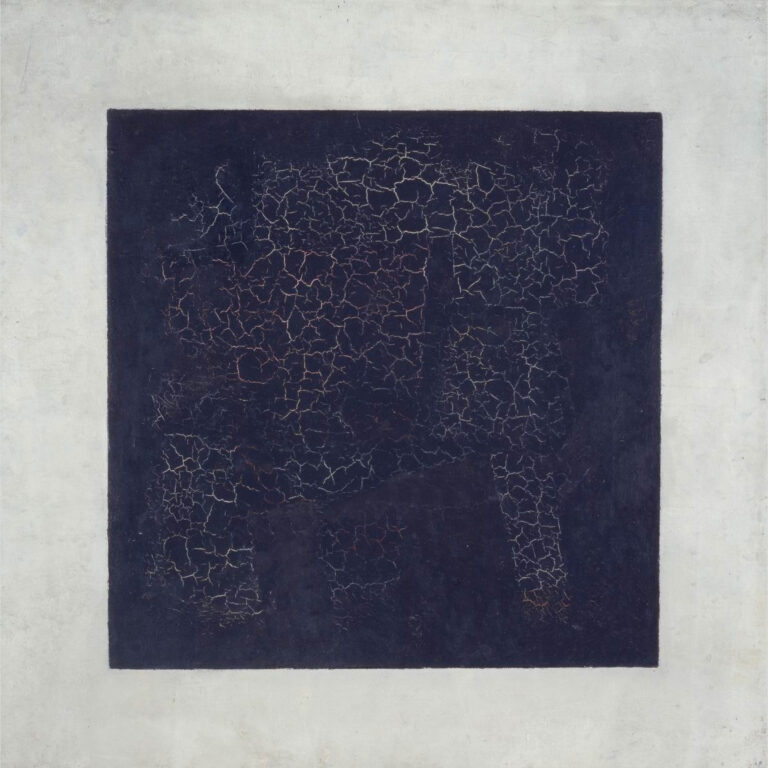 01
Black Square
1915 · State Tretyakov Gallery, Moscow -
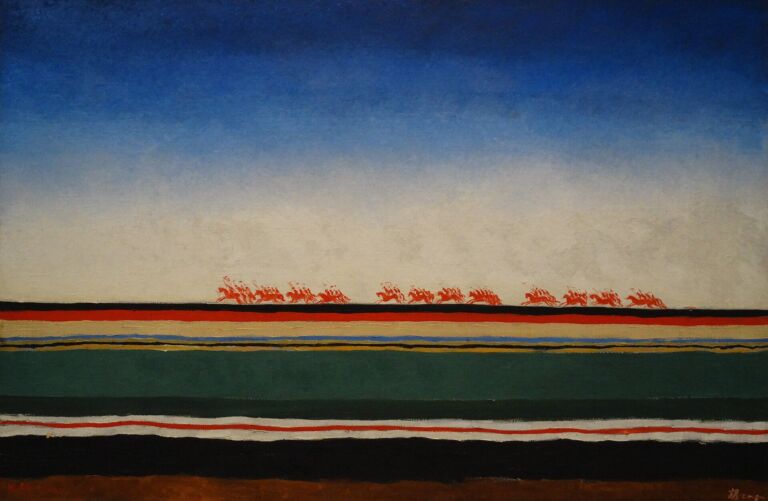 02
Red Cavalry
c. 1932 · State Russian Museum, St Petersburg -
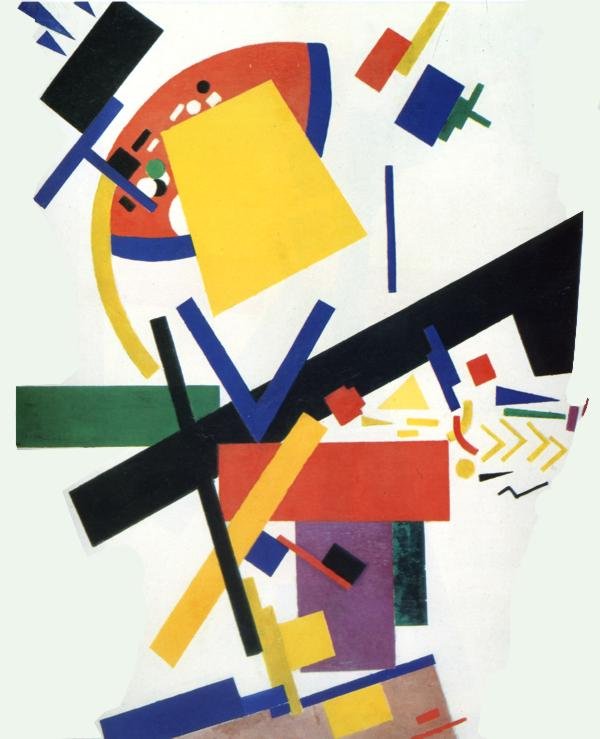 03
Suprematism
1915 · State Russian Museum, St Petersburg
Related artists
 El Lissitzky
1890–1941 · UNOVIS colleague