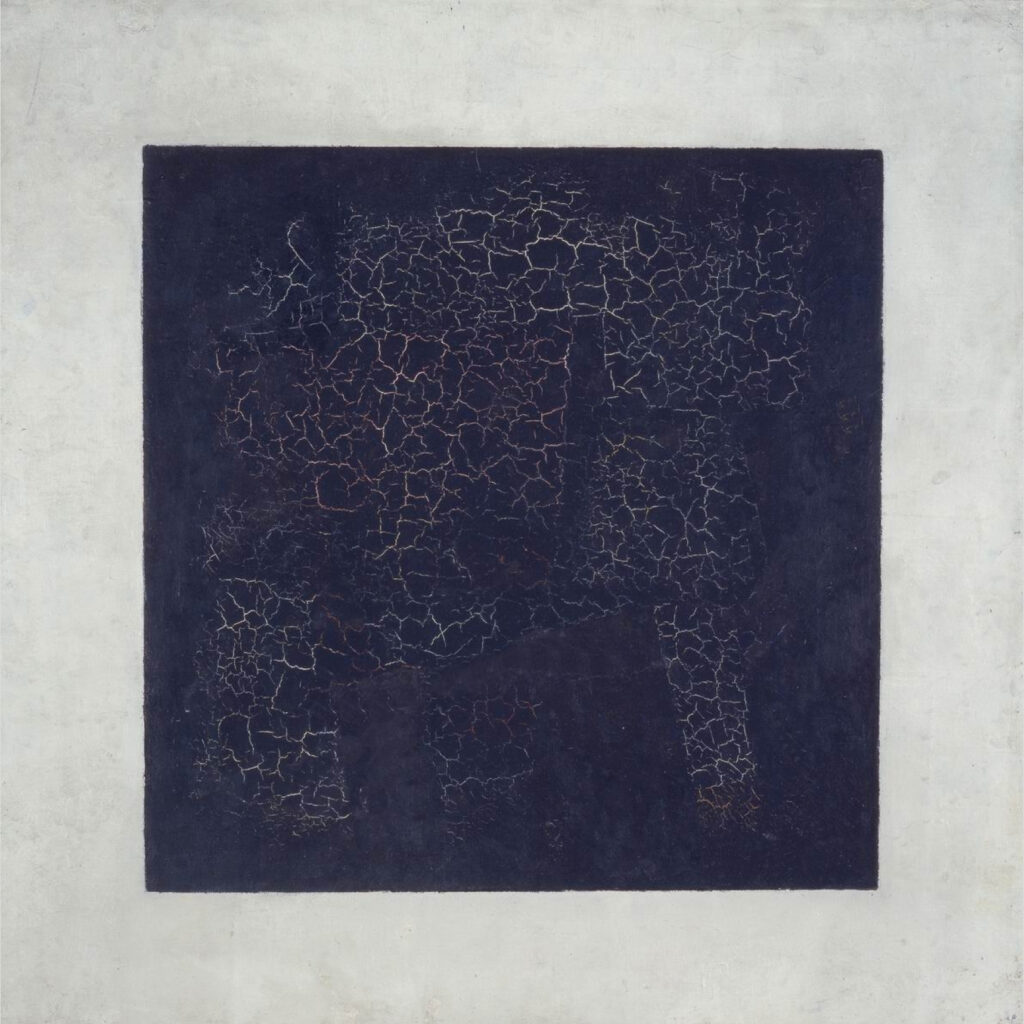
Kazimir Malevich, Black Square, 1915
Suprematism
1915 to the late 1920s · Russia
About the movement
On December 19, 1915, "The Last Futurist Exhibition of Paintings 0,10" opened in Nadezhda Dobychina's Art Bureau on the Field of Mars in Petrograd. Kazimir Malevich hung 39 non-objective canvases there and placed Black Square high up under the ceiling, across a corner, where an icon hangs in a Russian peasant house. At the same time he published a pamphlet, From Cubism to Suprematism: The New Painterly Realism. The new movement took its name from the Latin supremus, "highest": Malevich believed that pure sensation of color stood above any depiction.
Suprematism struck everything from the picture except form and color. Squares, rectangles, circles and bands depict nothing; they float on a white field that Malevich compared to infinity. It was an answer to Cubism and Futurism at once: where they broke the object into pieces, Suprematism gave it up entirely. The artist himself said that Black Square was meant to end the old art and begin the new. Later he divided Suprematism into three stages: black, colored and white.
The reaction was immediate. In January 1916, in the newspaper Rech, Alexandre Benois called the square an icon that the Futurists were offering in place of the Madonnas. Malevich replied with an open letter. The exhibition also split the avant-garde itself: the long rivalry between Malevich and Vladimir Tatlin, who showed his counter-reliefs at 0,10, grew sharper, and the participants divided into two camps.
In 1916–1917 the Supremus society formed around Malevich. Its members included Lyubov Popova, Olga Rozanova, Ivan Kliun, Nadezhda Udaltsova and Alexandra Exter; they prepared a journal of the same name, which never appeared. Suprematism quickly moved from canvas to textiles, embroidery and book covers. The peak of the painterly line was the white stage: Suprematist Composition: White on White (1918, Museum of Modern Art, New York). At his solo exhibition in Moscow in 1919–1920, Malevich reached the logical limit and showed stretchers with blank canvases.
From the autumn of 1919 Malevich taught at the People's Art School in Vitebsk, where the group UNOVIS, "Champions of the New Art," came into being. Students wore black squares on their sleeves. In the poster Beat the Whites with the Red Wedge (1919–1920), El Lissitzky turned Suprematist geometry into the language of the Civil War, and then into his Prouns, projects on the border between painting and architecture. Nikolai Suetin and Ilya Chashnik decorated porcelain from the State Porcelain Factory in Petrograd with Suprematist ornament. In Leningrad, as head of the State Institute of Artistic Culture (GINKhUK), Malevich began in the mid-1920s to build architectons, three-dimensional plaster models intended as prototypes for a new architecture.
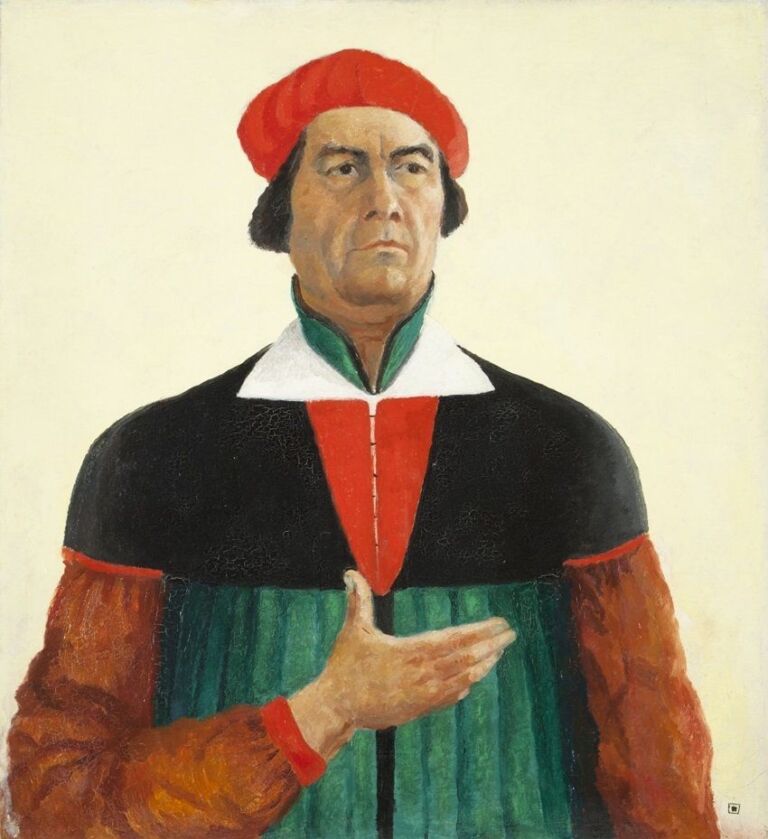
In 1927 Malevich traveled to Warsaw and Berlin, where his work was shown at the Great Berlin Art Exhibition. On his way back to the USSR he left a large part of his paintings and his archive in Germany. Many of these works later reached the Stedelijk Museum in Amsterdam through the architect Hugo Häring. At home, meanwhile, a different aesthetic was winning: in 1930 Malevich was arrested for several months, and in his last years he painted figurative pictures, signing some of them with a small black square. He died in Leningrad in 1935; his coffin was painted with Suprematist motifs.
The 1915 Black Square itself is in the State Tretyakov Gallery, and it is perhaps the most debated Russian painting of the 20th century. Through Lissitzky, Suprematism reached the Bauhaus and the Dutch group De Stijl and influenced typography and design. In the 1960s the American Minimalists saw Malevich as their direct predecessor.
Artists
Major works
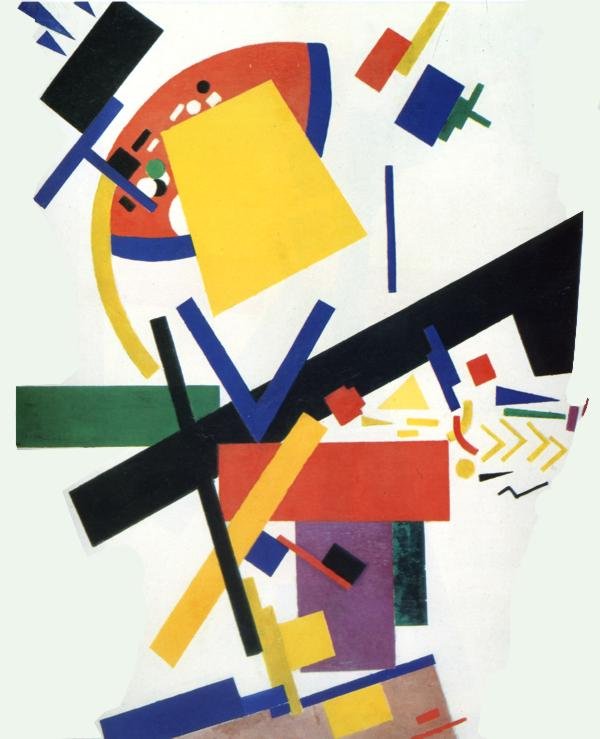 SuprematismKazimir Malevich · 1915
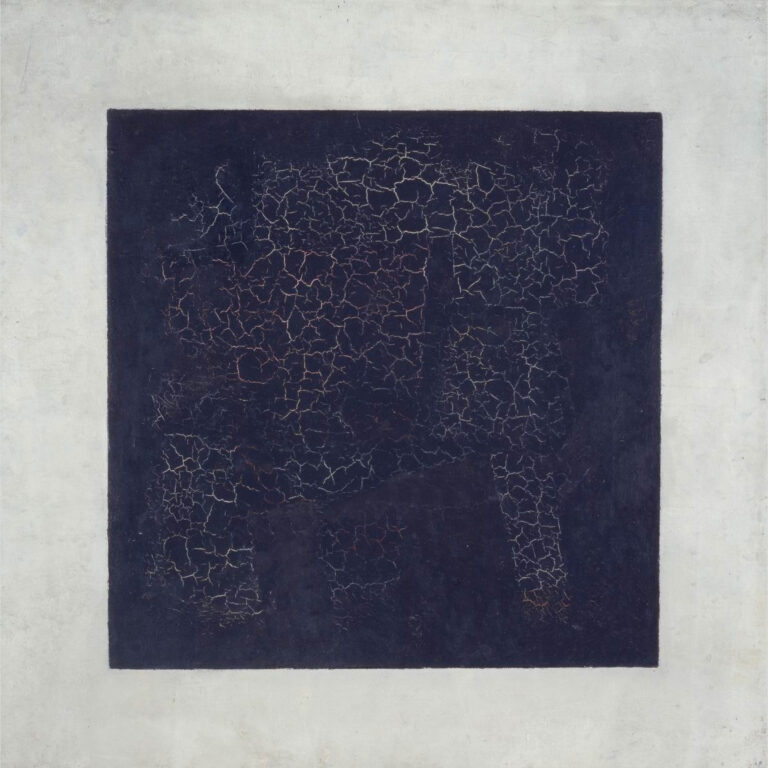 Black SquareKazimir Malevich · 1915