Russian art · Artist
Vasily Perov
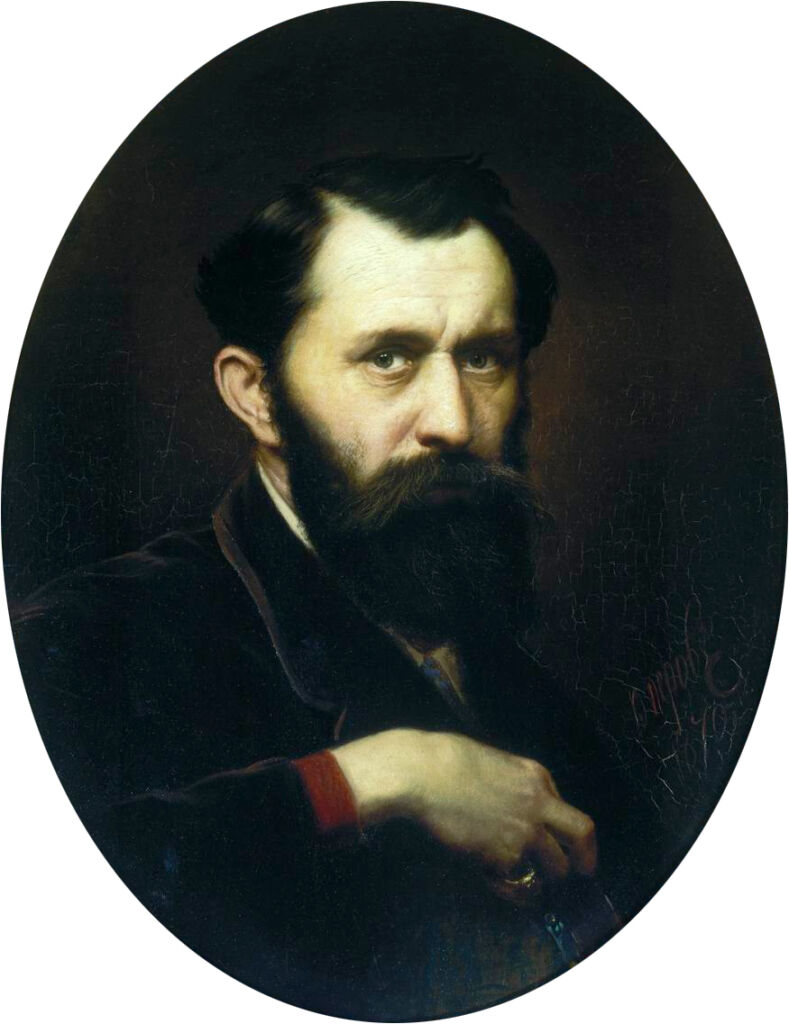
Vasily Grigoryevich Perov · 1834, Tobolsk — 1882, Kuzminki
Biography
The future painter got the name Perov not from his father but from the village sexton who taught him to read and write. As the illegitimate son of Baron Grigory Kridener, the public prosecutor of Tobolsk, he could not legally bear his father's name and was registered as Vasiliev, after his godfather. The sexton nicknamed the boy Perov (from pero, "pen") for his fine handwriting, and the nickname became the signature on paintings that changed Russian genre painting.
He was born in Tobolsk on January 2, 1834 (December 21, 1833, Old Style). He had his first drawing lessons at Alexander Stupin's school in Arzamas, one of the first provincial art schools in Russia. In 1853 he entered the Moscow School of Painting and Sculpture, where he studied under Mikhail Scotti, Apollon Mokritsky and Sergei Zaryanko. Medals followed one after another: for Arrival of the District Police Officer for an Investigation (1858), for The Sexton's Son Promoted to His First Rank (1860), and finally the large gold medal for Sermon in a Village (1861).
The same year, 1861, brought Easter Procession in a Village: a drunken priest, a procession in disarray. Pavel Tretyakov, the Moscow merchant whose collection became the State Tretyakov Gallery, bought the picture, but showing it in public was risky, since the subject was considered an insult to the Church. Awarded a scholarship to travel abroad, Perov went to Germany and Paris, but French life never came easily to him, and as early as 1864 he asked permission to come home and paint what he knew.
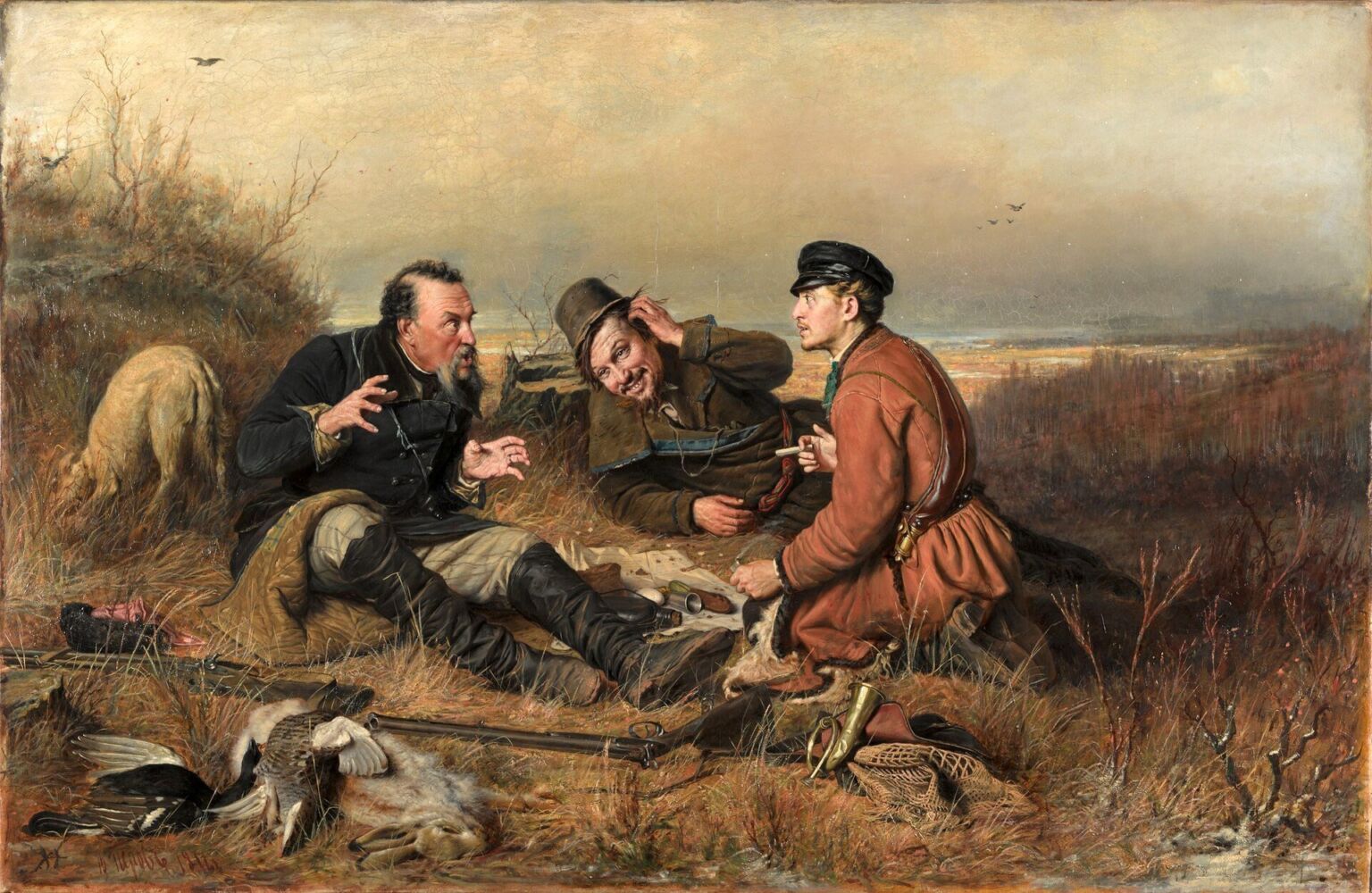
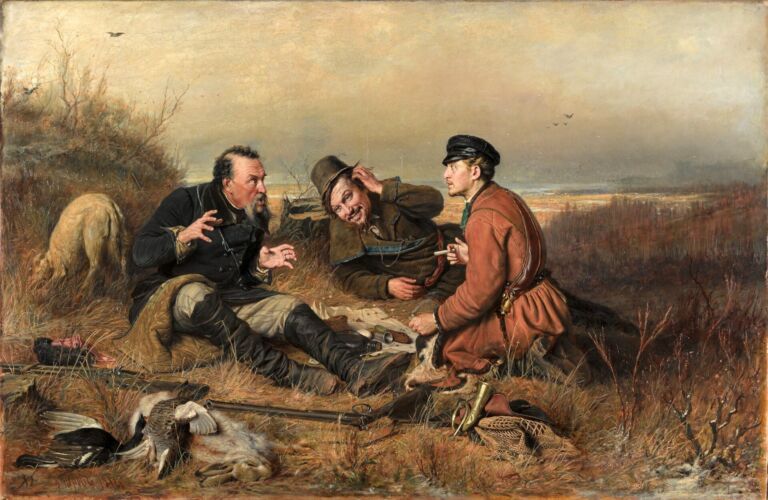
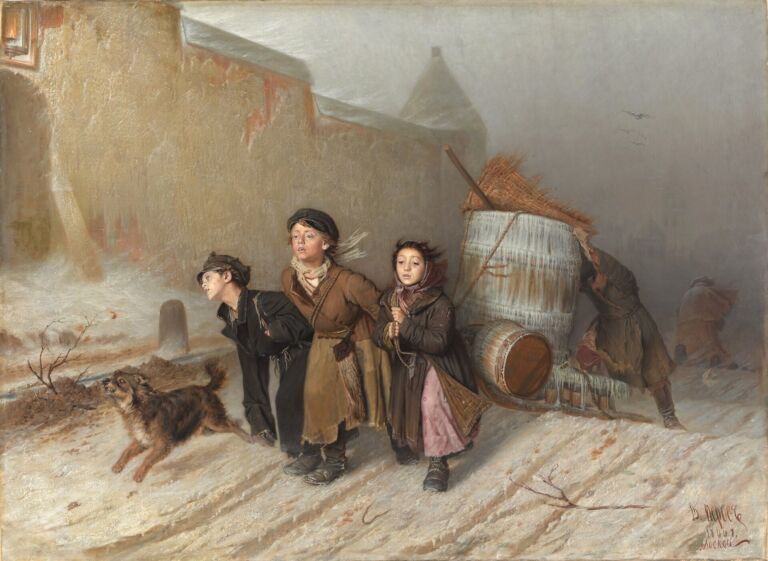
His Moscow years produced his major works. Seeing Off the Dead (1865) and Troika: Apprentices Carrying Water (1866) are pictures about children and poverty; in 1866 Perov was made an academician. Then came The Last Tavern at the City Gates (1868) and a scene in a very different key, Hunters Resting (1871), in which hunters' tall tales become a small comedy of characters. Both Troika and Hunters Resting are now in the State Tretyakov Gallery.
Perov was a storyteller first and foremost: his subjects read like short stories, and his restrained, almost brownish palette serves the mood rather than prettiness. He approached the portrait in the same way. The Portrait of the Writer Fyodor Dostoevsky (1872), commissioned by Tretyakov, and his portrait of the playwright Alexander Ostrovsky (1871) became the defining images of the two writers; this is still how people picture them.
In 1870 Perov was one of the founders of the Association of Traveling Art Exhibitions, the Peredvizhniki (Wanderers), and in its early years he was among its leaders. From 1871 he taught at his old school, where he was made a professor; his students included Mikhail Nesterov, Andrei Ryabushkin and Nikolai Kasatkin. Later his relations with his colleagues soured, and he left the Association.
His last years went into historical projects, among them a series on Pugachev, the leader of the 18th-century peasant uprising, which he never finished, and into writing: Perov wrote short stories. He died of galloping consumption on June 10, 1882 (May 29, Old Style), at Kuzminki near Moscow. He was buried in the cemetery of the Danilov Monastery; when the cemetery was destroyed in 1931, his remains were moved to the Donskoy Monastery.
The finest collection of Perov's work is in the State Tretyakov Gallery, and the State Russian Museum also has paintings by him. He left behind not only pictures but a school: his studio produced the generation that set the course of Moscow painting in the 1880s and 1890s.
Major works
Click a painting to see the details.
-
 01
Hunters Resting
1871 · State Tretyakov Gallery, Moscow -
 02
Troika: Apprentices Carrying Water
1866 · State Tretyakov Gallery, Moscow
Stories about Vasily Perov
Related artists
PT
Pavel Tretyakov
1832–1898 · buyer; commissioned portraits
FD
Fyodor Dostoevsky
1821–1881 · sitter, 1872 portrait
AO
Alexander Ostrovsky
1823–1886 · sitter, 1871 portrait
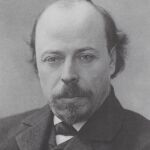 Mikhail Nesterov
1862–1942 · pupil
AR
Andrei Ryabushkin
1861–1904 · pupil