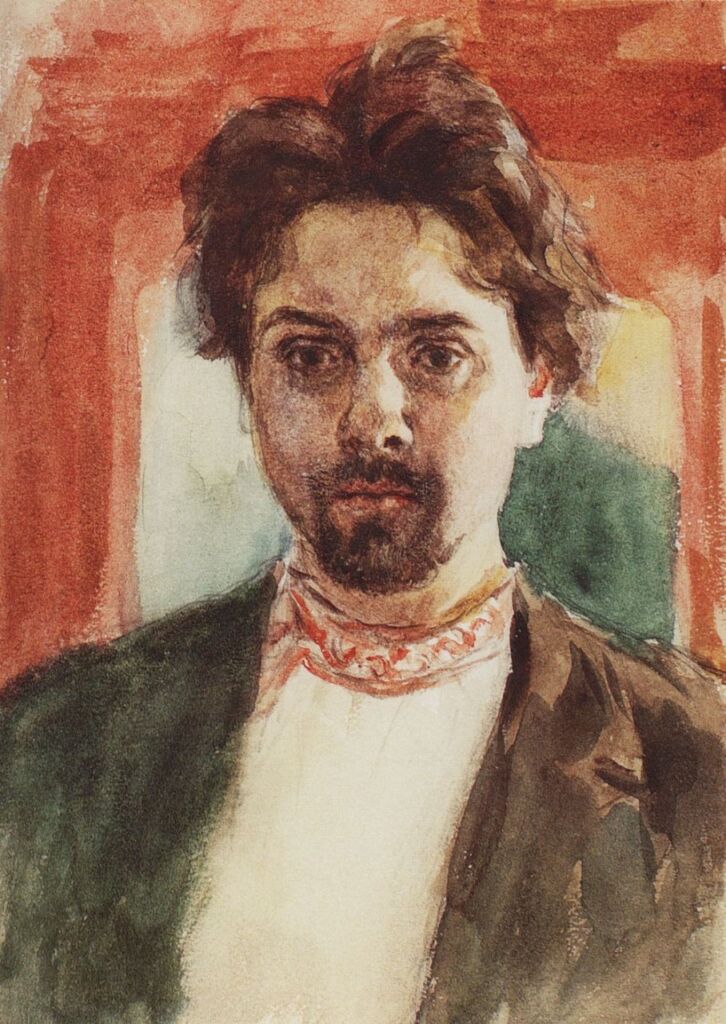
Vasily Surikov
Vasily Ivanovich Surikov · 1848, Krasnoyarsk — 1916, Moscow
Biography
Vasily Surikov was born on January 24, 1848 (January 12, Old Style), in the Siberian city of Krasnoyarsk. His father was a minor government clerk from an old Cossack family, and Surikov was proud of his Don Cossack ancestry. He learned to draw from Nikolai Grebnev, a teacher at the local district school. His father died in 1859, and the family got by on odd jobs.
In 1868 the young man set off for St Petersburg, his way paid by Pyotr Kuznetsov, a Krasnoyarsk gold-mine owner and the town's mayor. The Imperial Academy of Arts turned him down at the first attempt. He spent several months at the drawing school of the Society for the Encouragement of the Arts, entered the Academy as an auditor in 1869 and became a full student in 1870. His principal teacher was Pavel Chistyakov. In 1875 his graduation piece, The Apostle Paul, failed to win him the large gold medal, although Surikov had been one of the leading candidates.
His first major commission came from the Cathedral of Christ the Savior in Moscow: in 1876–1877 he made sketches and then painted four compositions on the Ecumenical Councils of the early Church. From 1877 Surikov lived in Moscow, and in 1878 he married Elizaveta Share.
Morning of the Streltsy Execution (1881) was bought by Pavel Tretyakov, the Moscow merchant whose collection became the Tretyakov Gallery, and Surikov then joined the Peredvizhniki, the Association of Traveling Art Exhibitions. Menshikov in Berezovo (1883) was shown at the 11th Peredvizhniki exhibition and also went to Tretyakov; the money paid for a family trip to Europe. Boyarynya Morozova (1887) was finished in time for the 15th exhibition, and Tretyakov paid 25,000 rubles for it. The critics were divided. Some were put off by the “carpet-like” riot of color across the huge canvas, others saw in it a perfect command of color, and Alexandre Benois valued its break with academic art.
In April 1888 his wife died. Surikov stopped working for a time and in 1889 took his daughters to Krasnoyarsk. “I brought back an extraordinary strength of spirit from Siberia,” he said later. Then came Taking a Snow Town (1891). Yermak's Conquest of Siberia (1895) took four years, and for Suvorov Crossing the Alps (1899) he traveled to Switzerland and, the story goes, slid down the slopes near Interlaken himself to feel the motion. The Suvorov picture was bought by Nicholas II.
Surikov worked from life. For each large picture he gathered studies of people of his own day and went to the places where the events had happened: Siberia, the Don, the Volga, Crimea. From the 1880s he regularly visited France and Italy, and in 1910 he traveled to Spain with his son-in-law, the painter Pyotr Konchalovsky. He was made an academician in 1895; in 1907 he left the Peredvizhniki and joined the Union of Russian Artists.
His last years brought Stepan Razin (1906, later partly repainted), A Tsarevna Visiting a Convent (1912) and The Annunciation (1914). Surikov died in Moscow on March 19, 1916 (March 6, Old Style), at the Dresden hotel, and was buried in the Vagankovo Cemetery beside his wife.
His major canvases are divided between Moscow and St Petersburg. Morning of the Streltsy Execution, Menshikov in Berezovo and Boyarynya Morozova are in the State Tretyakov Gallery; Yermak, Suvorov and Stepan Razin are in the State Russian Museum. In Krasnoyarsk the artist's family estate is now a house museum. The first substantial essay on him, by the poet Maximilian Voloshin, appeared in the journal Apollon in the year of Surikov's death.
Major works
Click a painting to see the details.
-
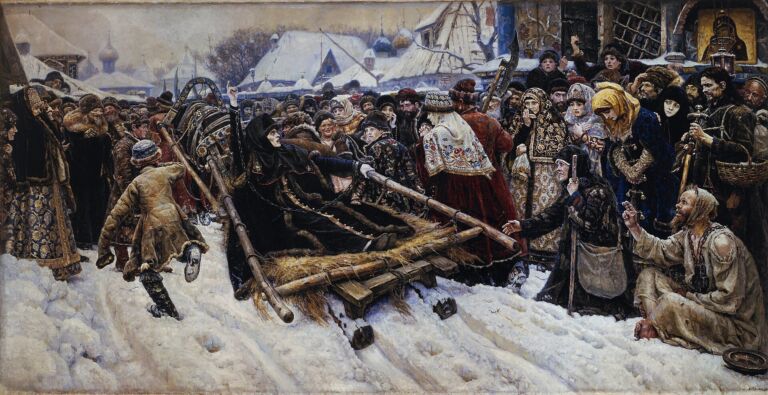 01
Boyarynya Morozova
1887 · State Tretyakov Gallery, Moscow -
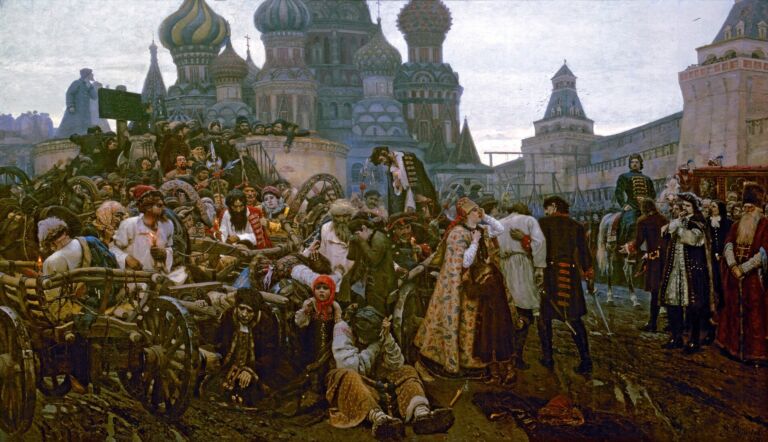 02
Morning of the Streltsy Execution
1881 · State Tretyakov Gallery, Moscow -
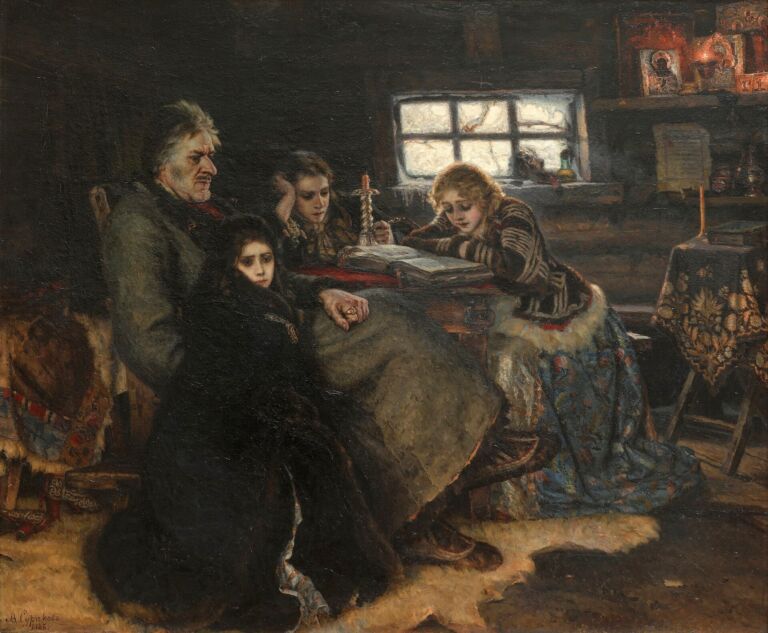 03
Menshikov in Berezovo
1883 · State Tretyakov Gallery, Moscow