Russian art · Realism · Artist
Vasily Vereshchagin
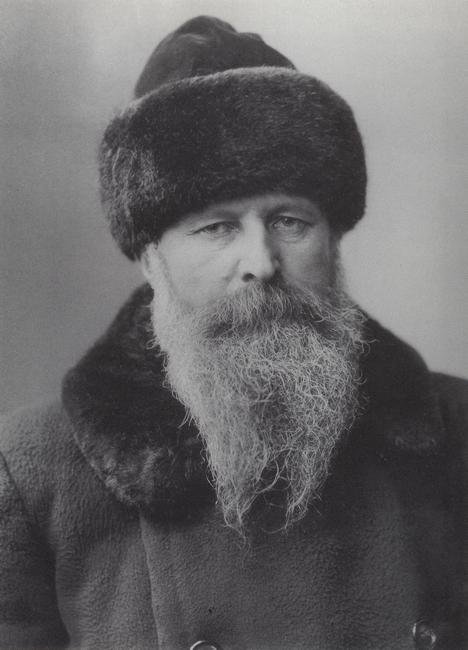
Vasily Vasilyevich Vereshchagin · 1842, Cherepovets — 1904, Outer roadstead of Port Arthur
Biography
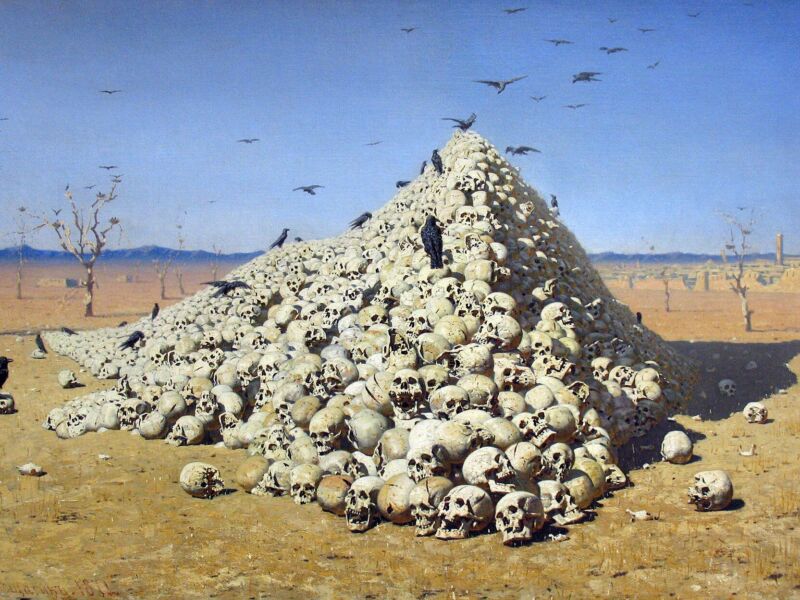
Vereshchagin dedicated The Apotheosis of War to all conquerors, past, present and to come. The author of this dedication was himself a combat officer and a holder of the Order of St George. He was born on October 26, 1842 (October 14, Old Style), in Cherepovets, into a large family of landed gentry. As a boy he was sent to the Alexander Cadet Corps and then to the Naval Cadet Corps in St Petersburg; he graduated first in his class and promptly left the service to devote himself to drawing.
From 1860 to 1863 Vereshchagin studied at the Academy of Arts under Alexei Markov, Fyodor Moller and Alexander Beideman; in 1863 he won a medal for Odysseus Slaying the Suitors. In 1864–1865 he studied in Paris with Jean-Léon Gérôme, although he disagreed with much of his teacher’s method. He was drawn not to the studio but to the road: the Caucasus, Crimea, the Danube.
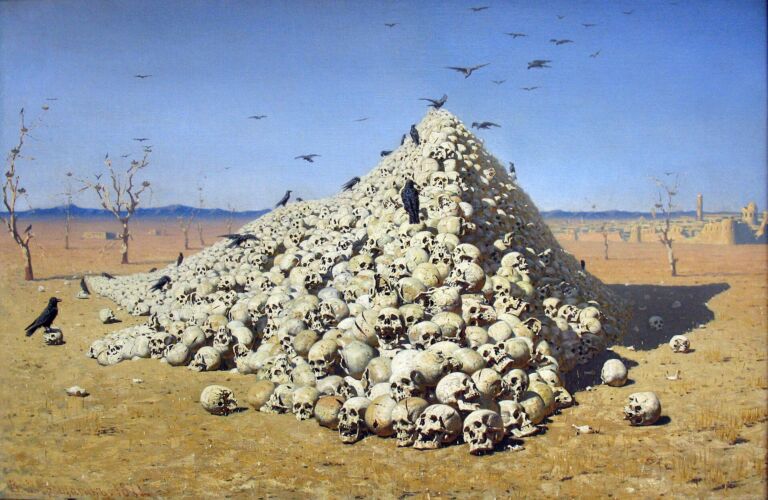
In 1867 he went to Turkestan, attached to General Konstantin von Kaufman. In the summer of 1868, during the defense of Samarkand, the artist distinguished himself in battle, and on August 14 he was awarded the Order of St George, 4th class. He painted the Turkestan series in Munich in 1871–1874; The Apotheosis of War (1871) is now in the State Tretyakov Gallery. In 1873 the series was shown at the Crystal Palace in London.
The St Petersburg exhibition of 1874 ended in scandal. Three pictures, The Forgotten Soldier, Surrounded. Pursued and They Have Entered, were denounced as a slander on the army; Alexander II, according to contemporaries, “expressed his displeasure very sharply,” and Vereshchagin destroyed the three canvases himself. A month later the Academy awarded Vereshchagin the title of professor, and he turned it down. Next came the Himalayas, British India and Tibet (1874–1876), producing The Procession of the Prince of Wales in Jaipur (1876), and a second trip to India in 1882–1883.
Vereshchagin looked at war as an eyewitness. He painted it not as a parade but as the work of death, and he did not hide what he had seen. In the Russo-Turkish War of 1877–1878 he was at Shipka and Plevna, where his brother Sergei was killed, and in June 1877 he was badly wounded aboard the torpedo boat Shutka on the Danube. His painting The Suppression of the Indian Revolt by the English caused controversy in Britain: critics objected that executions by blowing men from cannon had ended in 1857. In 1887 the artist answered them in the Magazine of Art.
After a journey to Palestine (1884) he turned to Gospel subjects, and their realism, too, was considered provocative. In Moscow, where he eventually settled, he produced in the 1890s the series 1812: Napoleon in Russia, thought to have been inspired by Tolstoy’s War and Peace; in 1899 his book on Napoleon’s campaign was published in London. In 1901–1903 he visited the Philippines, the United States, Cuba and Japan.
When the Russo-Japanese War broke out, Vereshchagin went to the front. On April 13, 1904 (March 31, Old Style), he was aboard the battleship Petropavlovsk with Admiral Stepan Makarov; in the outer roadstead of Port Arthur the ship struck mines and sank. The artist died together with the admiral.
The main Vereshchagin collections are in the State Tretyakov Gallery and the State Russian Museum; the 1812 series is in the State Historical Museum in Moscow. Cherepovets has a house museum, a monument and a street named after him; the town of Vereshchagino and the minor planet 3410 Vereshchagin also bear his name.
Major works
Click a painting to see the details.
-
 01
The Apotheosis of War
1871 · State Tretyakov Gallery, Moscow
Stories about Vasily Vereshchagin