Victor Borisov-Musatov
Victor Elpidiforovich Borisov-Musatov · 1870, Saratov — 1905, Tarusa
Biography
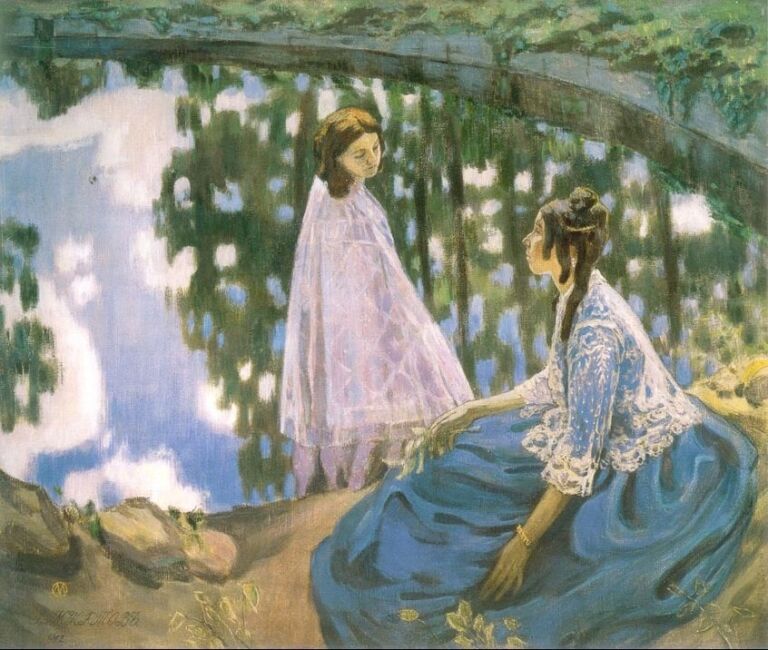
In the summer of 1902, in the park of Zubrilovka, an old estate in the Saratov Governorate, the artist was painting two women by a pond: his sister Elena and his fiancée, Elena Alexandrova. Both posed in dresses in the fashion of the previous century. So began The Pool, Victor Borisov-Musatov's best-known painting and one of the key works of Russian Symbolism.
He was born in Saratov on April 14, 1870 (April 2, Old Style). His father, Elpidifor Musatov, was a minor railway clerk who had been born a serf. At the age of three the boy fell off a bench and injured his spine, and he was left with a hunched back for life. He learned to draw at the Saratov realschule and at a drawing school, and in 1890 he entered the Moscow School of Painting, Sculpture and Architecture. A year later he moved to St Petersburg to study under Pavel Chistyakov at the Academy of Arts, and it was then that he began signing his work with a double surname. The damp climate drove him back to Moscow.
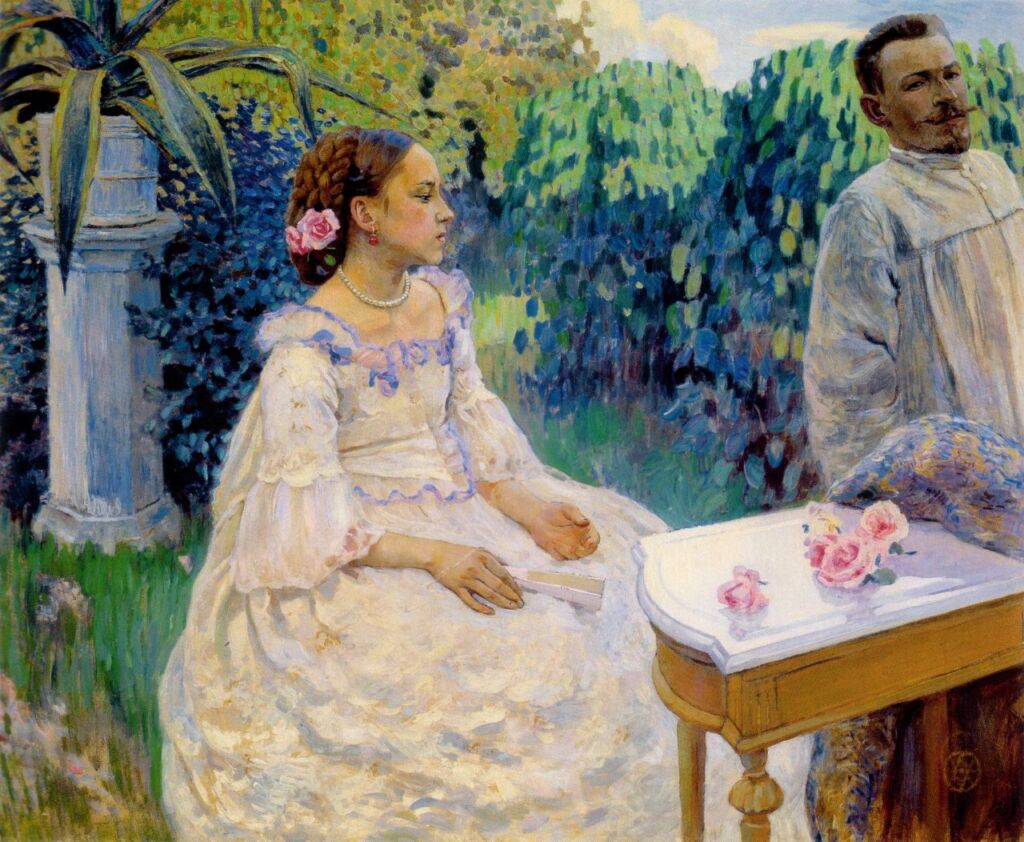
In 1895 Borisov-Musatov went to Paris and spent about three years in the studio of Fernand Cormon. There he studied the Impressionists and Puvis de Chavannes, copied the old masters and took up photography so seriously that for a time he wondered whether to choose it over painting. After returning to Saratov in 1898, he painted Self-Portrait with Sister (State Russian Museum), the work in which his recognizable world first appears.
Then came a series of paintings about an old country estate: Tapestry (1901), The Pool (1902–1903), Phantoms (1903) and Emerald Necklace (1903–1904); the last three are in the State Tretyakov Gallery. The artist himself called Emerald Necklace his “most pagan” work; his models were friends, among them the actress Maria Yagodskaya. He gave the pastel Loneliness (1903) to the cellist Mikhail Bukinik, who gave it its title; it is now in the Serpukhov Museum of History and Art.
Musatov built his waking dreams out of documentary detail. He staged photo shoots with models in costume, but on canvas he cut out everything superfluous: The Pool has no horizon line, and the landscape is completed by its reflection in the water. The figures stand as if on a frieze or a tapestry, the color is muted to blues, gray-greens and lilacs, and oil is combined with tempera and pastel to give the surface the matte look of a woven wall hanging.
Recognition came from the West sooner than at home. In 1904 a solo exhibition of his work was shown with success in Hamburg, Munich, Berlin and Dresden. In Moscow he was a member of the Moscow Association of Artists from 1899 and of the Union of Russian Artists from 1903. In 1902 he married Elena Alexandrova, and in 1904 their daughter Marianna was born.
In the spring of 1905, at the invitation of Ivan Tsvetaev, the father of the poet Marina Tsvetaeva, the family settled in Tarusa, a small town on the Oka River. There Borisov-Musatov worked on Requiem and finished Autumn Song; his widow later gave Requiem to the Tretyakov Gallery. He died on November 8, 1905 (October 26, Old Style), at the age of thirty-five, and was buried on the high bank of the Oka. The tombstone, with the figure of a sleeping boy, was made by his follower, the sculptor Alexander Matveev.
Musatov's legacy is the entire Blue Rose group: Pavel Kuznetsov, Pyotr Utkin and Sergei Sudeikin saw him as their forerunner. His finest works are in the State Tretyakov Gallery and the State Russian Museum, and Saratov has a large collection in the Radishchev Art Museum as well as a house museum. In 2026 (July 9 to November 8) the State Tretyakov Gallery held a major retrospective of 140 of his works.
Major works
Click a painting to see the details.
-
 01
The Pool
1902–1903 · State Tretyakov Gallery, Moscow