Russian art · Expressionism · Artist
Wassily Kandinsky
Wassily Vasilyevich Kandinsky · 1866, Moscow — 1944, Neuilly-sur-Seine
Biography
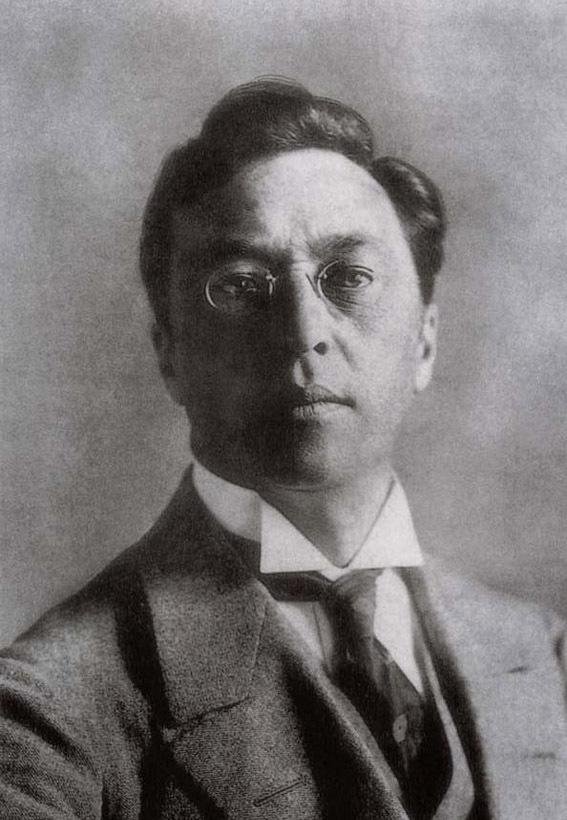
At thirty, Wassily Kandinsky turned down a university post at Dorpat (now Tartu, Estonia) and left for Munich to learn to paint. He later recalled two things that pushed him to that decision: Claude Monet's Haystack at an 1896 exhibition in Moscow, in which at first he could not make out the subject, and Wagner's Lohengrin at the Bolshoi Theater. Kandinsky was born in Moscow on December 4, 1866 (November 22, Old Style), and spent his childhood in Odessa. He graduated in law from Moscow University in 1892; in 1889 he had joined an ethnographic expedition to Vologda province, where the painted peasant houses made a deep impression on him.
In Munich he studied at Anton Ažbe's private school and then, from 1900, at the Academy of Fine Arts under Franz Stuck. In 1901 he founded the Phalanx association and its art school, where he met Gabriele Münter, his companion for the next fifteen years. From 1908 the couple spent long periods in Murnau in Bavaria, and it was there that the landscape in his work began to dissolve into patches of color.
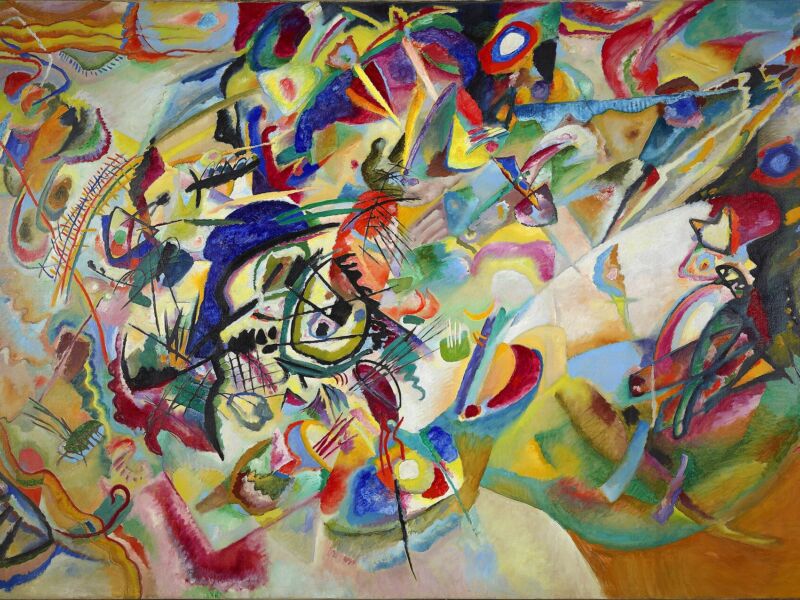
In 1911, together with Franz Marc, he launched The Blue Rider (Der Blaue Reiter), an exhibition and an almanac, which appeared in 1912. Around the same time he published Concerning the Spiritual in Art, which became a manifesto of non-objective painting. The high points of his Munich years are Composition VI and Composition VII (both 1913): the first is in the State Hermitage Museum; the second, enormous and preceded by a great many sketches, is in the State Tretyakov Gallery. That same year Improvisation 27 was shown at the Armory Show in New York; it later entered the collection of the photographer Alfred Stieglitz and is now in the Metropolitan Museum of Art.
When war broke out, Kandinsky returned to Russia. In Moscow he painted Moscow I (1916, State Tretyakov Gallery), and on February 11, 1917, he married Nina Andreevskaya. After the Revolution he worked for Narkompros, the People's Commissariat for Education, and helped set up the Institute of Artistic Culture and the Museum of Painterly Culture. In December 1921 he left for Berlin and never came back.
His method was rooted in music. He divided his pictures into "impressions," "improvisations" and "compositions," a scale running from direct impressions of nature to a long-considered score of color and line. Every color had a sound for him: yellow was a trumpet, blue a deep organ note. At the Bauhaus, where he taught from 1922 until the school closed in 1933, this intuition became a theory, set out in his book Point and Line to Plane (1926).
Recognition came earlier in Germany and America than in France. The collector Solomon Guggenheim and his adviser Hilla Rebay built the finest Kandinsky collection in America, while in 1937 the Nazis put his work in their "Degenerate Art" exhibition. From late 1933 he lived in Neuilly-sur-Seine, just outside Paris, painting small biomorphic compositions. He became a German citizen in 1928 and a French one in 1939. He died in Neuilly-sur-Seine on December 13, 1944.
The largest collections of his work are at the Centre Pompidou, the Lenbachhaus in Munich (a gift from Münter in 1957) and the Guggenheim Museum. In Russia his work is held by the State Tretyakov Gallery, the State Hermitage Museum, the State Russian Museum and dozens of regional museums, to which the state Museum Fund distributed his paintings in the 1920s.
Major works
Click a painting to see the details.
-
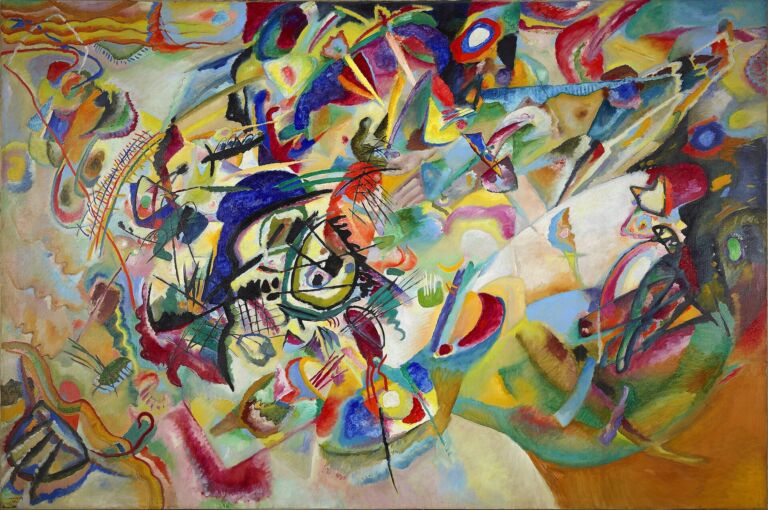 01
Composition VII
1913 · State Tretyakov Gallery, Moscow -
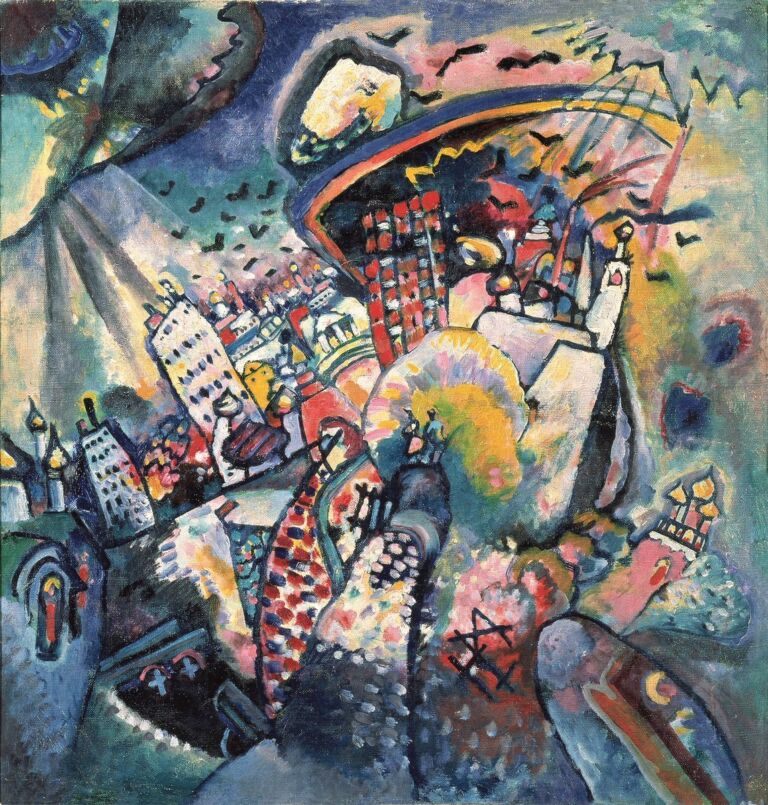 02
Moscow I
1916 · State Tretyakov Gallery, Moscow
Stories about Wassily Kandinsky
Related artists
GM
Gabriele Münter
1902–1916 · pupil and companion
 Franz Marc
1911–1914 · co-founder of The Blue Rider
FS
Franz Stuck
1900 · teacher
NA
Nina Kandinsky (Andreevskaya)
1917–1944 · wife
 Paul Klee
1922–1931 · Bauhaus colleague