Art movement
Aestheticism
1860s–1890s · Great Britain
About the movement
On November 26, 1878, a London court awarded the painter James McNeill Whistler one farthing, a quarter of a penny. He had won his libel suit against John Ruskin, the most influential critic in England, and was ruined by the legal costs. The case arose from Nocturne in Black and Gold: The Falling Rocket (around 1875, Detroit Institute of Arts): Ruskin had written that the artist was asking two hundred guineas for "flinging a pot of paint in the public's face." The trial put on public view, for the first time, the question around which a whole movement was built: does a painting have to mean anything?
Aestheticism took its formula from France. In the preface to his novel Mademoiselle de Maupin (1835), Théophile Gautier declared that only what serves no purpose is truly beautiful; hence "l'art pour l'art," art for art's sake. In 1860s England the idea sounded like rebellion. A Victorian picture was supposed to tell a story and teach a moral, and the Pre-Raphaelites, for all their revolutionary zeal, also carried a message. The Aesthetes proposed valuing color, line and harmony for their own sake. For Ruskin art was a moral matter, and he never forgave Whistler the idea that a painting was under no obligation to prove anything.
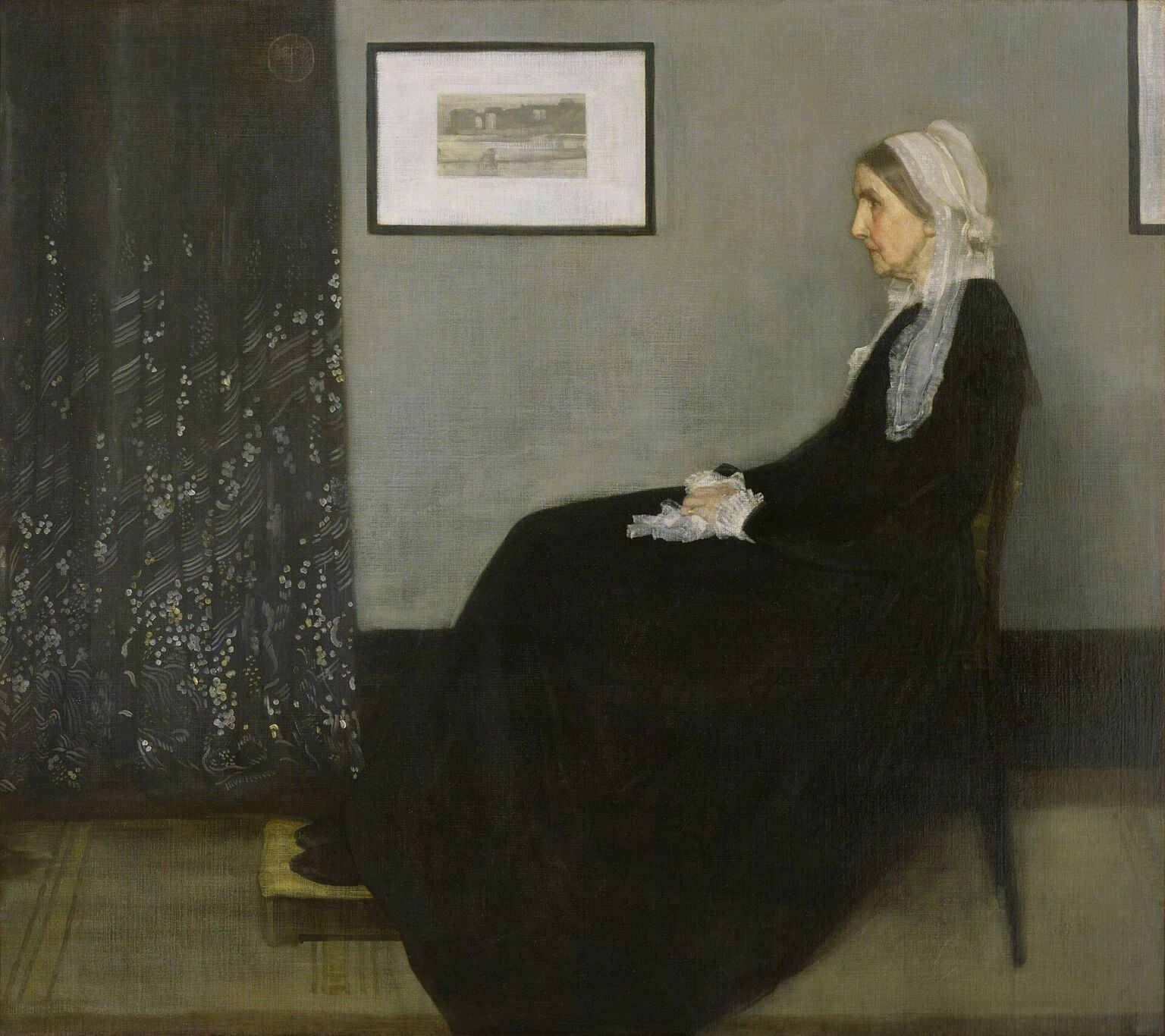
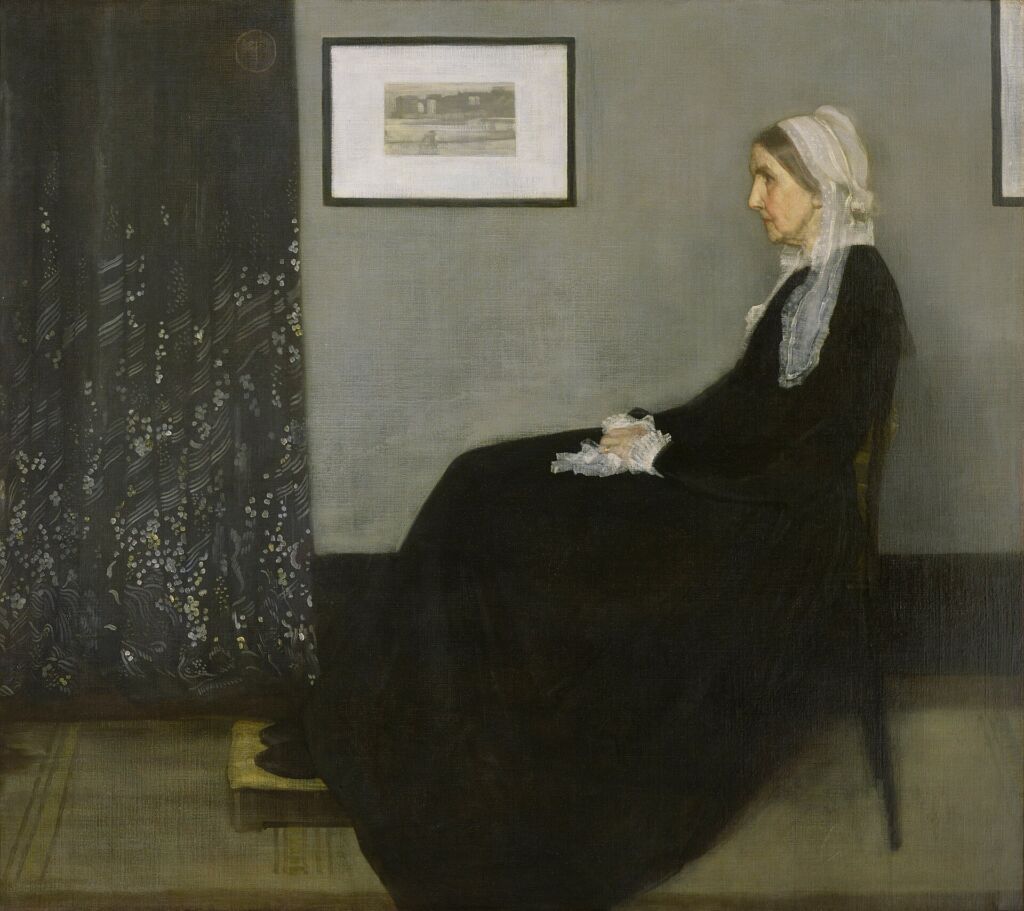
Whistler, an American trained in Paris, gave his paintings titles borrowed from music. Symphony in White, No. 1 (1862) was rejected by the Salon, and Arrangement in Grey and Black No. 1 (1871, Musée d'Orsay), the famous portrait of the artist's mother, was titled so that viewers would think about tone rather than filial devotion. In his late work Dante Gabriel Rossetti moved away from narrative toward solitary half-length female figures; Albert Moore and Frederic Leighton painted classical beauties with no action at all; and Edward Burne-Jones became the star of the Grosvenor Gallery, which opened in 1877 as an alternative to the Royal Academy. In 1876–1877 Whistler decorated the Peacock Room for Frederick Leyland, a prime example of Aestheticism moving from the picture into the interior.
The theory came from Walter Pater, an Oxford classicist. In the conclusion to his Studies in the History of the Renaissance (1873), he urged readers "to burn always with this hard, gem-like flame," living each moment as an experience of beauty. Students read the page to tatters; clergymen saw it as a gospel of hedonism. The movement's chief publicist was Oscar Wilde, who made a lecture tour of America in 1882 and later wrote that "all art is quite useless." The Aesthetes were mocked: Punch printed George du Maurier's cartoons, and Gilbert and Sullivan's comic opera Patience (1881) portrayed them as languid devotees of lilies and sunflowers.
Aestheticism has a surprisingly direct link to Russia. Whistler spent part of his childhood in St Petersburg, where his father was building the railroad to Moscow, and in 1845–1846 he took drawing lessons at the Imperial Academy of Arts. Later Wilde became one of the most widely read authors of Russia's Silver Age, the cultural flowering of the early 20th century, and his paradoxes about beauty echoed through the debates of the Russian Symbolists. The Picture of Dorian Gray appeared in several Russian translations in the early 20th century and became a bedside book for Russian Decadents.
British Aestheticism was brought to an end by the trial of 1895, when Wilde was sentenced to two years' hard labor, and for a time the word "aesthete" became suspect. But the movement had already changed taste: Japanese objects, blue-and-white porcelain, light-filled interiors, the furniture of Edward William Godwin. Its ideas passed to Symbolism and Art Nouveau, and ultimately to 20th-century modernism, with its belief in the autonomy of form.