Whistler’s Mother: the portrait he said wasn’t the public’s business
The world calls it Whistler's Mother, but the painter sent it out as Arrangement in Grey and Black and asked why the public should care who sat for it. Then America put her on a stamp.
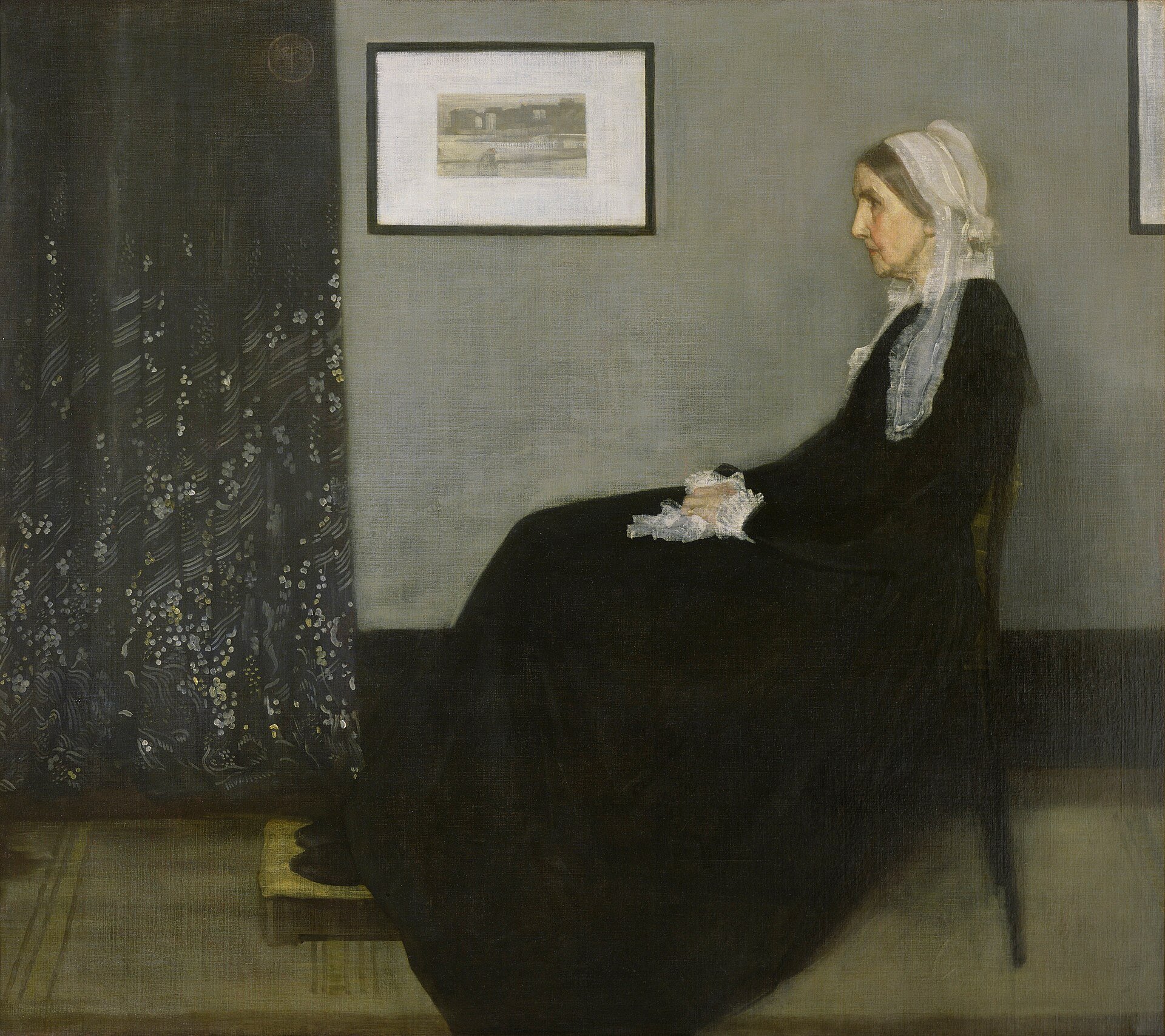
In early November 1871, Anna McNeill Whistler sat down in London to tell her sister how her son’s latest picture had come about. A young model had let him down. So he turned to his mother instead: “Mother I want you to stand for me!”
The result is the painting the world calls Whistler’s Mother. Its official title says nothing about a mother. Whistler sent it out as Arrangement in Grey and Black, and later explained in print why the sitter’s name was beside the point.
The model who failed to come
The letter, to her sister Kate Palmer, is dated November 3–4, 1871. The model was “the youthful Maggie,” who had failed “Jemie,” as the family called him, while he worked on a picture of a girl in blue by the sea, a canvas the Glasgow catalog of Whistler’s paintings links to Annabel Lee.
The letter does not say why Maggie stayed away. The often-repeated story that she fell ill is not in it.
It was Anna, then 66, who was unwell. “I was not as well then as I am now,” she admitted, but did not want to distress her son, so “I stood bravely, two or three days.” It proved too much. Whistler gave up on a standing figure and decided to paint her “sitting perfectly at my ease.”
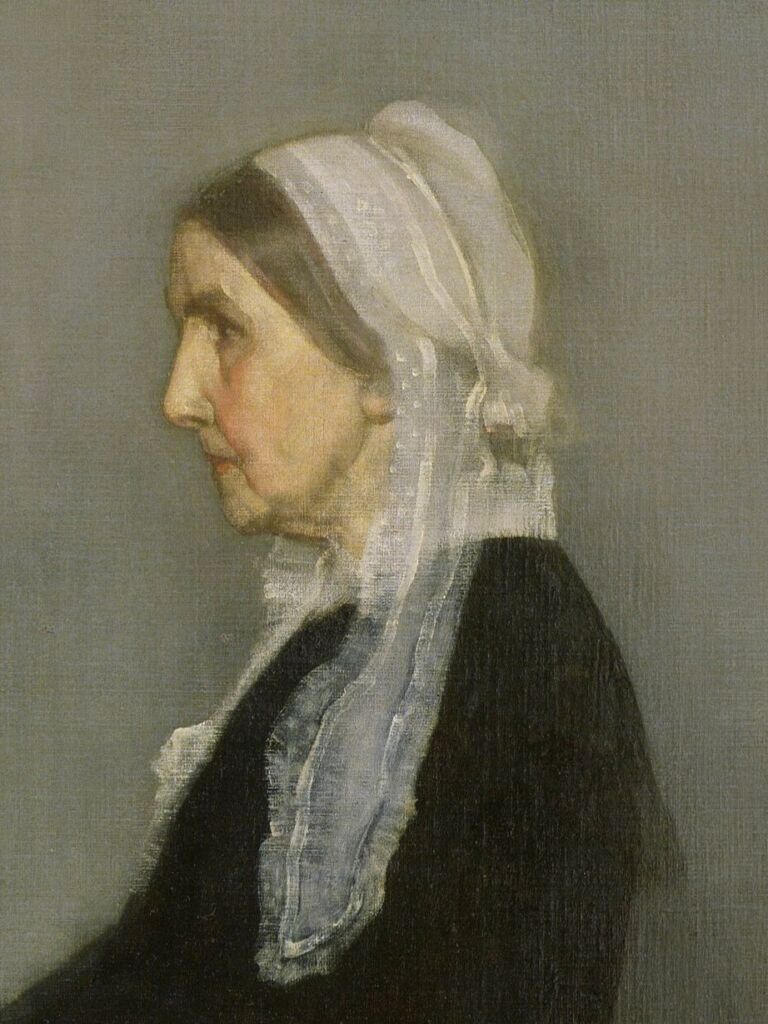
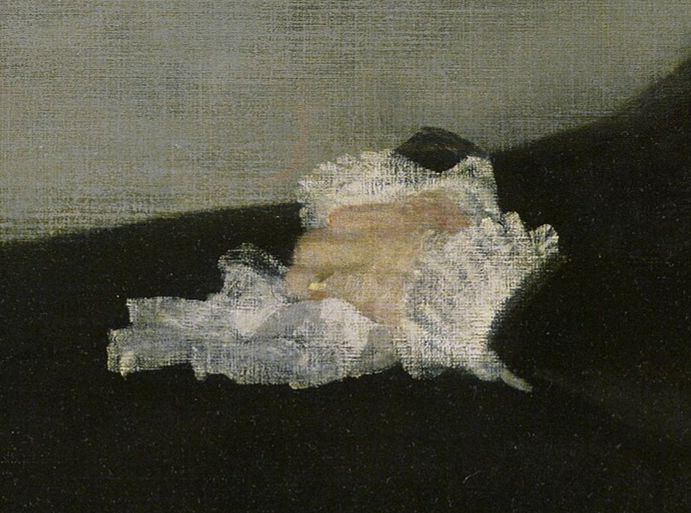
The painting took about three months. The compromise shows in the pose: her hands rest in her lap, and below the hem of the black dress her feet sit on a small footstool, a practical touch in a room otherwise arranged for tone.
Gray and black, and nothing else
In 1872 Whistler sent the canvas to the Royal Academy. According to the Pennells, his early biographers, the selection committee first turned it down.
The painter William Boxall threatened to resign from the council unless it was hung, and it went up as number 941, Arrangement in grey and black: portrait of the painter’s mother, hung “not well, yet not out of sight.”
Even in the catalog, the arrangement came before the mother. Whistler took his titles from music because he wanted a painting judged the way music is judged: by its harmony, not by its story.
He spelled it out in “The Red Rag,” a letter printed in the London weekly The World on May 22, 1878, and reprinted in his 1890 book The Gentle Art of Making Enemies.
“Take the picture of my mother, exhibited at the Royal Academy as an ‘Arrangement in Grey and Black.’ Now that is what it is,” he wrote. It interested him as a picture of his mother, he went on, “but what can or ought the public to care about the identity of the portrait?”
Art, he insisted, “should be independent of all clap-trap” and should not be confounded with “emotions entirely foreign to it,” such as devotion, pity and love. Even his signature fit the scheme. Instead of a name, he painted a small butterfly monogram high on the curtain, as much a part of the pattern as the silver flowers below it.
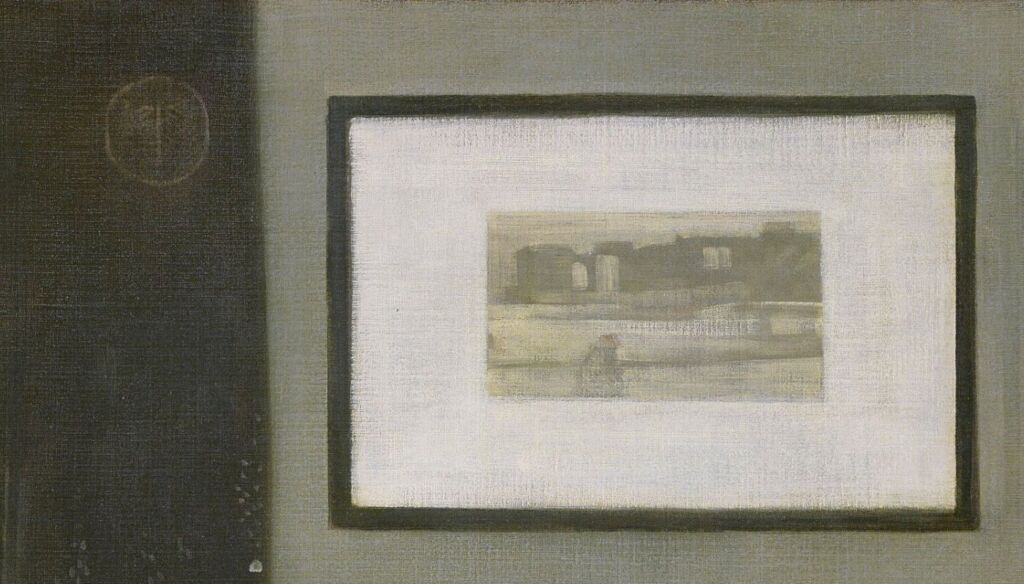
John Singer Sargent later took a sitter’s name off a picture for a different reason. Selling his portrait of Virginie Gautreau to the Met in 1916, he asked, because of an old row with her, that it not carry her name, and it became Madame X.
Four thousand francs and a three-cent stamp
For years the canvas served as collateral: it sat with a London print dealer as security for a loan, and later Whistler mortgaged it for £500.
Then the French state asked to buy it for the Musée du Luxembourg. The poet Stéphane Mallarmé and the politician Georges Clemenceau had lobbied for it, and on November 30, 1891, it went for 4,000 francs, a modest price Whistler accepted.
Two months later he was made a knight of the Legion of Honor. Seeing the red ribbon, his friend Henri Fantin-Latour supposedly quipped: “So that’s why you sold your mother!” (translated here by Hroniki). The painting moved to the Louvre in the 1920s and has been at the Musée d’Orsay since 1986.
In the fall of 1932 the Louvre sent it to New York, where the young Museum of Modern Art made it a centerpiece of American Painting and Sculpture, 1862–1932.
It then toured the country, from San Francisco and Los Angeles to Cleveland, Baltimore and the Century of Progress fair in Chicago, where it stayed five months, and was seen by more than two million people.
On May 2, 1934, before the painting sailed home, the Post Office Department issued a three-cent violet stamp. It was first meant to honor Whistler himself, but at President Franklin D. Roosevelt’s direction it became a Mother’s Day stamp, as the American War Mothers had urged.
Roosevelt sketched the layout himself in pencil. The stamp carried the line “In Memory and in Honor of the Mothers of America.”
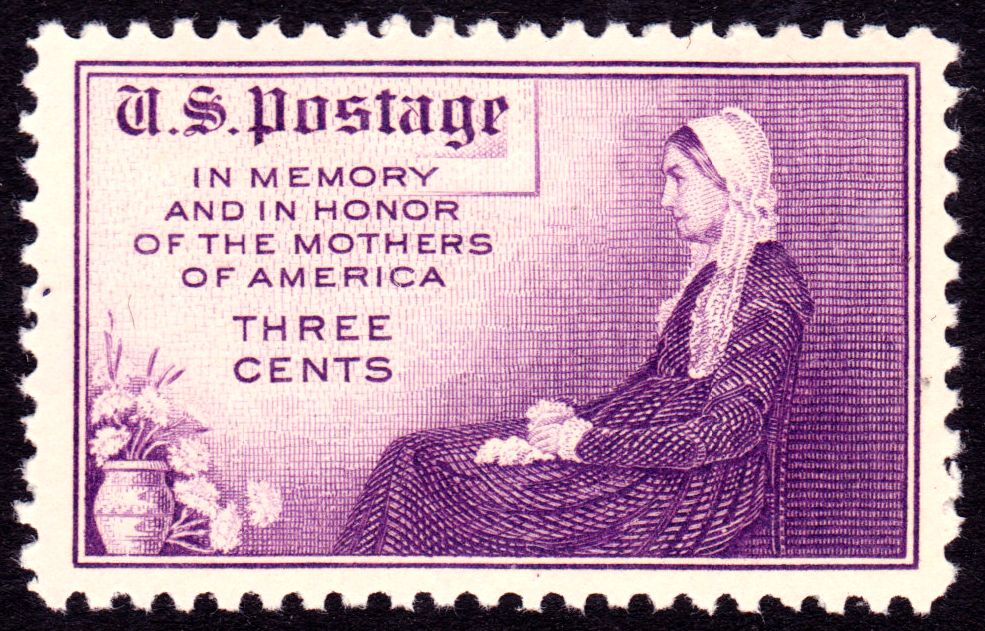
The designers stripped out the background and the framed print, cut off her feet and set a vase of flowers in the corner. Many artists called it a mutilation.
Whistler had made a picture about gray and black. The stamp printed it in violet and made it about the one thing he had told the public not to care about: whose mother she was.
Comments
For Hroniki readers
Comments are open to readers with an account. Signing up is free and takes a few seconds.
No comments yet. Start the conversation.