Hokusai’s Great Wave cost about as much as two bowls of noodles
The Great Wave was a cheap print run off by the thousands. How its key block cracked, and why an early impression looks different from a late one.
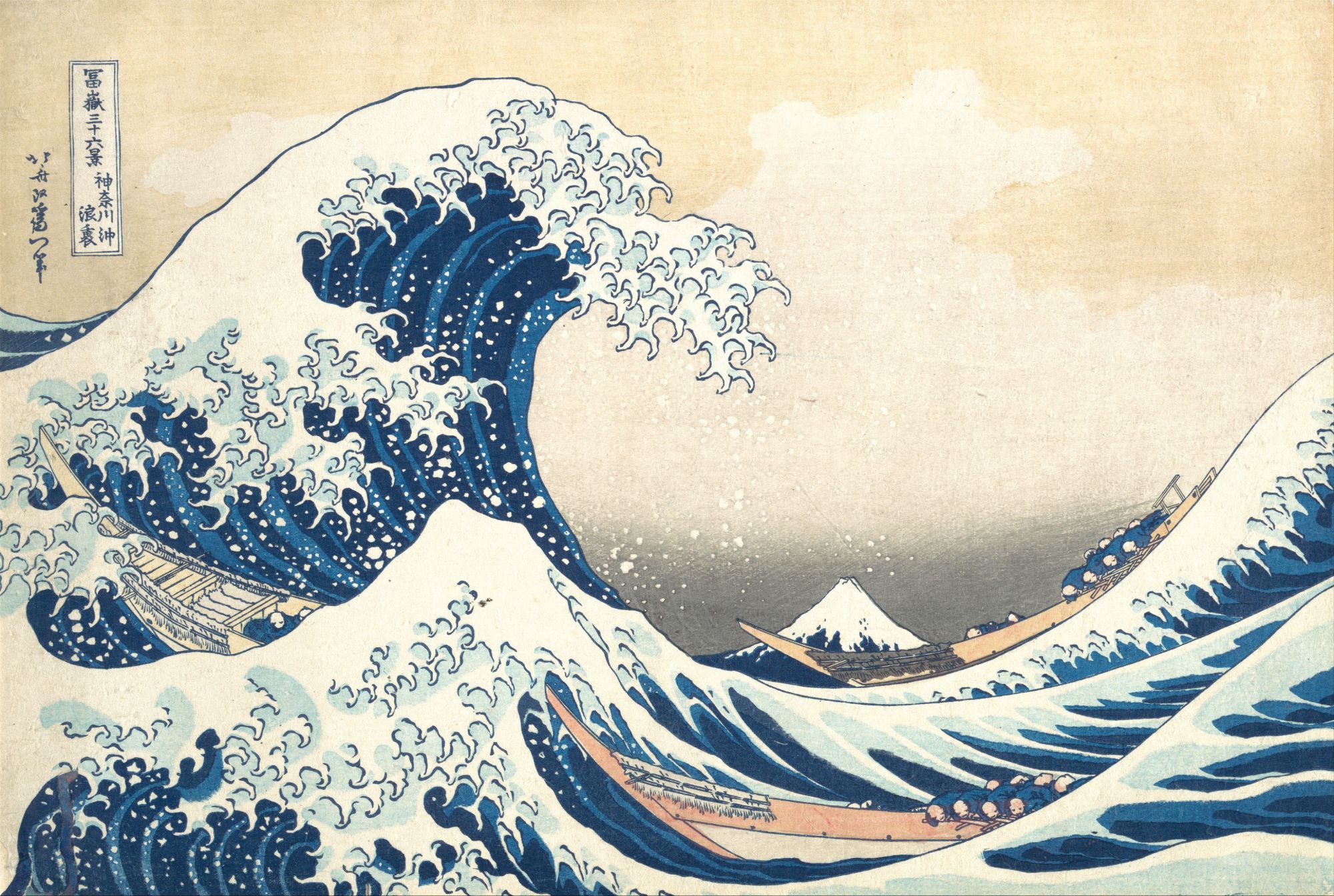
In the mid-19th century an impression of The Great Wave cost about as much as two helpings of noodles, says Capucine Korenberg, a scientist at the British Museum. Perhaps the best-known Japanese image in the world is not a painting but a cheap color woodblock print, pulled by hand again and again from the same blocks.
Katsushika Hokusai designed the sheet, officially Under the Wave off Kanagawa, for the series Thirty-six Views of Mount Fuji; it measures about 26 × 38 cm (10 × 15 in). The publisher Nishimuraya Yohachi, of the firm Eijudo, announced the series for the New Year of 1831.
Hokusai was about seventy when the series came out, around 1829–33. British Museum curators note that he revered Mount Fuji as a talisman of long life. The three boats under the crest are not fishermen caught in a storm but oshiokuri, fast boats that carried fresh fish and dried sardines daily to the markets of Edo, today’s Tokyo.
He believed his best work was still ahead. In a postscript to his book One Hundred Views of Mount Fuji (1834), Hokusai wrote that nothing he had drawn before seventy was of any note, and hoped that by 110 every dot and every line would come alive.
Nobody recorded how many were pulled; the wear on the blocks suggests thousands. Korenberg and Timothy Clark, long the British Museum’s curator of Japanese art, cite an estimate of as many as 8,000.
The run paid off, and ten more views were added later.
Only a fraction survive: prints were thrown away or lost to fires and earthquakes. Korenberg compared photographs of 111 original impressions she found; Clark estimates that “many hundreds” survive.
The blue itself was new to Japanese prints. Prussian blue, or Berlin blue, was invented in Prussia in the early 18th century but grew cheap only in the late 1820s, once it was being made in China. Brighter than indigo, it hardly faded. The Great Wave was among the first Japanese prints to use it.
Yet the printers kept indigo, spectroscopy at the Metropolitan Museum of Art has shown. The outline and the wave’s dark stripes were printed in a mix of the two, with pure Prussian blue laid over the stripes.
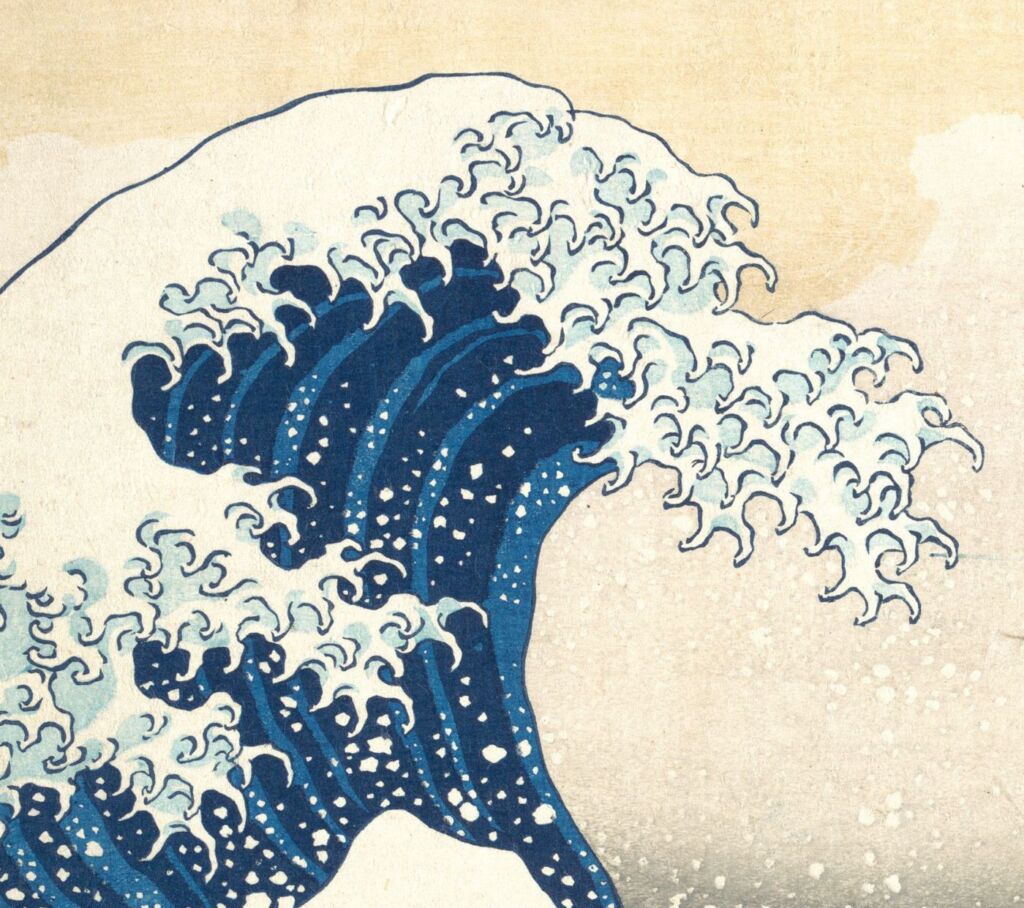
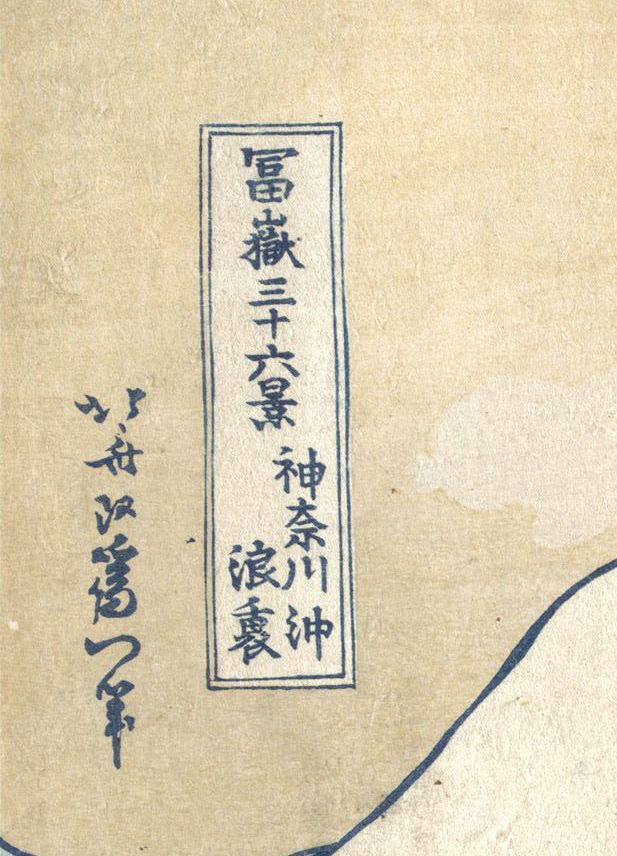
Each color had its own block, the outline its key block. After thousands of impressions its thin raised lines began to break, and late sheets show gaps. Korenberg used them to put the impressions in order: the title cartouche cracked first, then the peak of Mount Fuji, then the cartouche again, the wave on the right, and the cartouche once more.
Late sheets, Clark writes, are “easily spotted by the wide break in the line of the wave behind the boat on the far right.” Toward the end of the run some color blocks were recut, and on the four latest known impressions the boats suddenly turn pink.
Why a new block was cut for the boats is unknown. Korenberg found one clue in a letter of 1836: by the mid-1830s Nishimuraya Yohachi was in financial trouble. That may explain the cruder recutting, perhaps by a less exacting publisher. She tracked down photographs of her 111 impressions in museum databases, auction records, and dealers’ and collectors’ holdings, sometimes even on Flickr, Instagram, and TripAdvisor. She also found fakes: later prints from entirely different blocks, sold as originals.
The sheet at the top belongs to the Met; Marco Leona, head of its Department of Scientific Research, considers it one of the earliest. Specialists believe the artists themselves chose the colors and effects for the first impressions, and the publisher later changed them to tempt buyers or save money. The later the Wave, the less of Hokusai in it and the more of the publisher’s arithmetic.
From a print shop in Edo to auction records
Japanese prints poured into France once Japan opened trade with the West in the 1850s. From the late 1870s Parisian collectors and artists championed The Great Wave, and many of the finest impressions ended up in Paris. Claude Monet owned prints by Hokusai. In 1866 the critic Philippe Burty wrote that Hokusai combined the elegance of Watteau, the fantasy of Goya and the movement of Delacroix.
Claude Debussy kept a framed Great Wave in his studio; it shows in a photograph Igor Stravinsky took in 1910. The first edition of Debussy’s symphonic sketches La Mer (Durand, 1905) carried a detail of the crest on its cover. On who chose it, the sources disagree: the Met says Debussy picked the covers for his scores himself, while the Sibley Music Library at the Eastman School of Music credits the publisher.
The British Museum owns three original impressions, the Met four. One of the Met’s sheets came in 1929 as the bequest of Louisine Havemeyer, widow of the industrialist Henry Havemeyer. One of the British Museum’s belonged to the Paris collector René Druart and was sold at Sotheby’s in Paris in 2007.
In March 2023 a sheet sold at Christie’s in New York for $2.76 million, against an estimate of $500,000–700,000. That was a record for the Wave; the previous one, $1.59 million, had stood for only two years. The seller’s family had bought it in the early 1900s; the Dutch specialist Matthi Forrer placed it “beyond doubt among the 20 or so best impressions surviving today.” It was last shown in public in 1993, at the Ny Carlsberg Glyptotek in Copenhagen. The 2023 record did not last long either: in November 2025 an impression sold at Sotheby’s Hong Kong for HK$21.72 million, about $2.8 million.
Two bowls of noodles or nearly three million dollars for the same print. The difference is what Korenberg read in the breaks on the key block: how early a sheet was pulled and how much of the master survives in it.
Comments
For Hroniki readers
Comments are open to readers with an account. Signing up is free and takes a few seconds.
No comments yet. Start the conversation.