Ultramarine: the blue Renaissance patrons wrote into contracts
Lapis came from Afghanistan, the blue took days to coax out of the stone, and patrons wrote its price into painters' contracts. How ultramarine came to rival gold, and how a chemist named Guimet made it cheap.
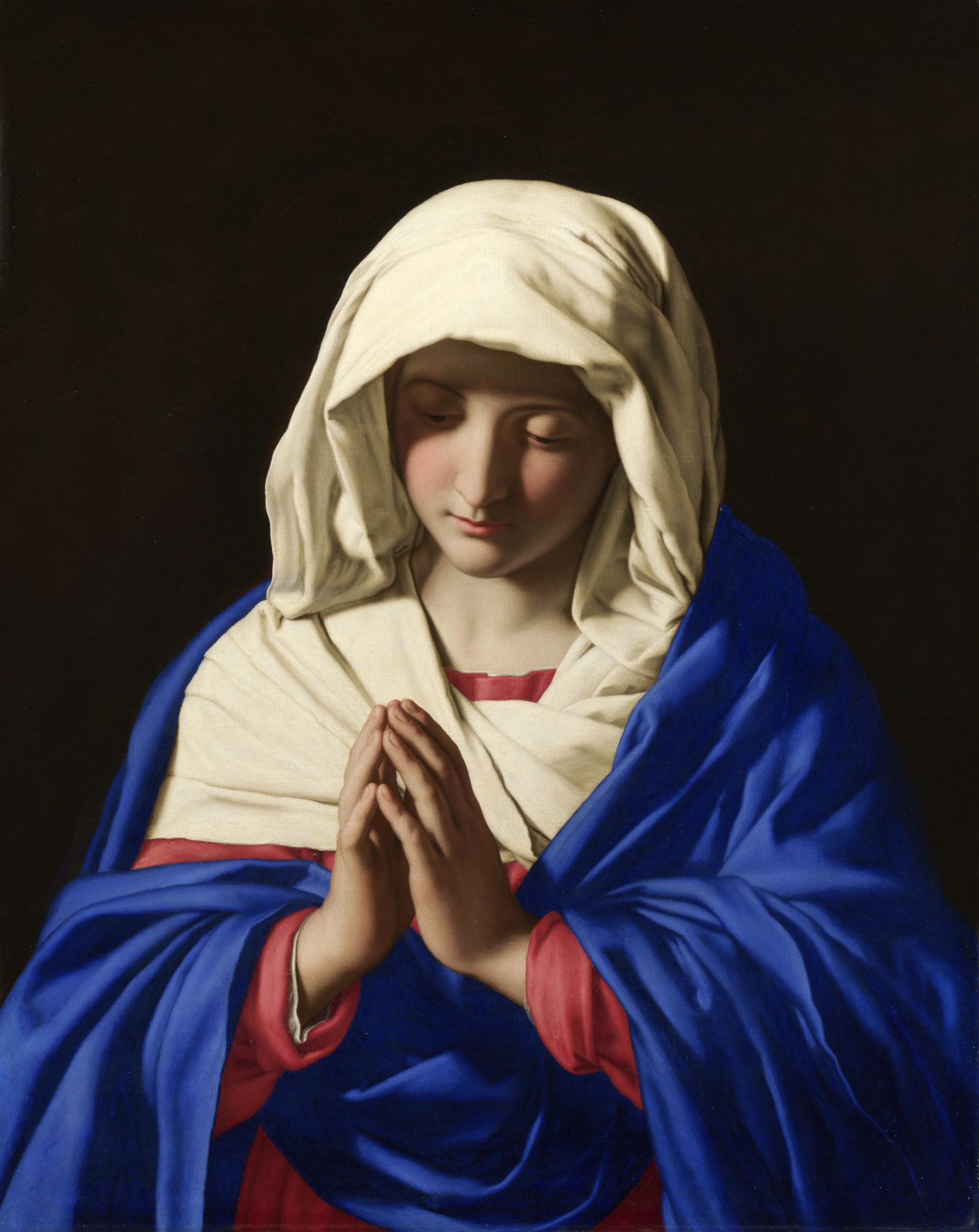
The lower right corner of Michelangelo’s Entombment is nearly empty: just pale, bare priming. The kneeling Virgin was probably meant to go there. Her mantle was traditionally blue, and for it Michelangelo would have needed ultramarine, made from lapis lazuli.
The National Gallery in London suggests he may have been saving the costly pigment until last. The same blue is missing from his unfinished Manchester Madonna. He abandoned The Entombment in 1501, when he left Rome for Florence.
A stone from beyond the sea
The name records the route. Ultramarine means “beyond the sea,” from the Latin ultra mare: the stone reached Europe from Badakhshan, in the mountains of today’s northeastern Afghanistan. Marco Polo noted that the finest lapis was mined there, and the best grade still comes from the Sar-e-Sang mines on the Kokcha River.
Delivering the stone was only half the job. Simply ground, lapis gives a grayish powder, because the blue mineral is mixed with white calcite and golden pyrite. The rock yields only 2 to 3 percent pigment, which was once, in the words of the 1911 Britannica, “weighed up with gold.”
The Tuscan painter Cennino Cennini, a pupil of Agnolo Gaddi, explained how to extract it in his Craftsman’s Handbook. Ultramarine, he wrote, is “a color illustrious, beautiful, and most perfect, beyond all other colors.” The lapis is pounded in a bronze mortar, ground on a porphyry slab and worked into a dough of pine resin, mastic and wax, which must rest at least three days and three nights.
Then it is kneaded with two sticks in warm lye, and the color slowly seeps out. The first yields are the best: according to Cennini, they are worth eight ducats an ounce, while the last two “are worse than ashes.” He considered the work “an occupation for pretty girls rather than for men”: girls stay at home and have gentler hands. Then a warning: “Just beware of old women.”
Some old recipes say to heat the stone first. In 2020 researchers from the Rijksmuseum, two Amsterdam universities and the European Synchrotron in Grenoble showed that painters did: heated, the pigment separates far more easily. Traces of heating turned up in samples from paintings by Rogier van der Weyden and Jan Steen.
Four florins an ounce
Ultramarine was the costliest blue. Beside it sat azurite, a much cheaper copper mineral, and a patron wanted to be sure he was not paying jewel prices for common stone. So the grade and price of the blue went into the contract.
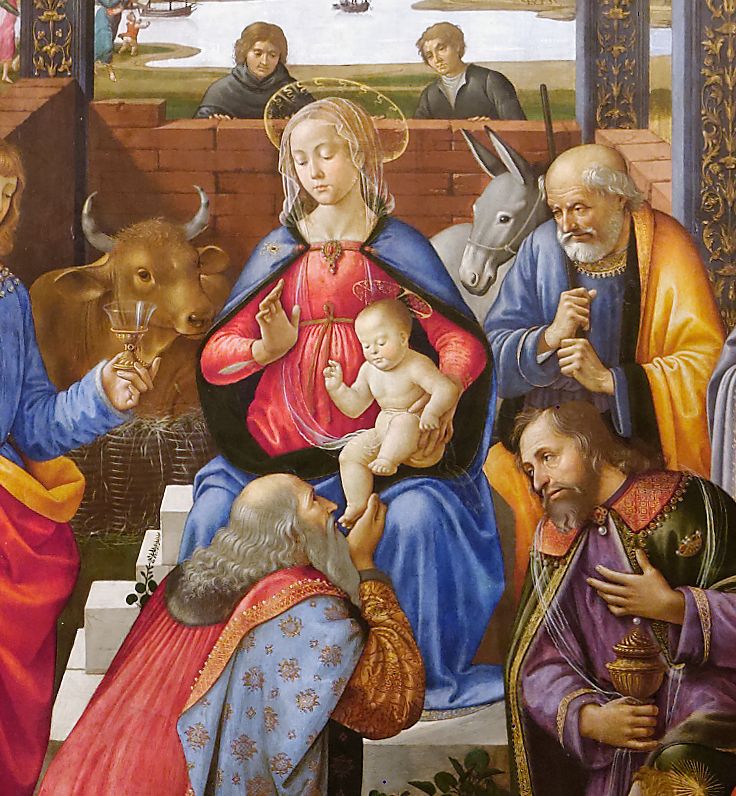
In the fall of 1485 the prior of Florence’s foundling hospital, the Ospedale degli Innocenti, ordered an Adoration of the Magi from Domenico Ghirlandaio for 115 florins. The contract specified that “the blue must be ultramarine of the value of about four florins the ounce.” By custom, the costliest blue went to the Virgin’s mantle.
Where no grade was named, the blue could be humbler. In 1485 Giovanni de’ Bardi, paying Botticelli for an altarpiece for Santo Spirito, itemized the sum: two florins for blue, thirty-eight for gold and preparing the panel, thirty-five pel suo pennello, “for his brush.” The record says only azurro, “blue”—not necessarily ultramarine.
In the spring of 1487 Filippo Strozzi hired Filippino Lippi to fresco his chapel in Santa Maria Novella, and left no room for doubt: the rest of the sky on the vault was to be all fine ultramarine, at least four broad florins an ounce. Here blue was a budget line, like gold.
From Delft to Lyon
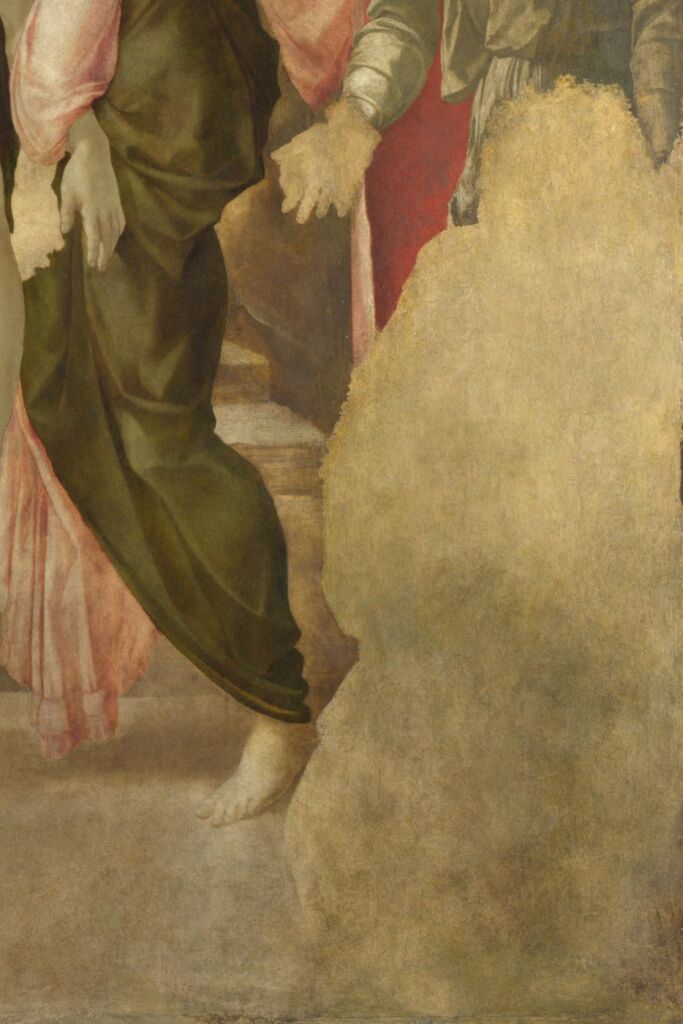
In the 17th century ultramarine was still the most expensive pigment. Nearly all the blue in Sassoferrato’s Virgin in Prayer, from the 1640s, is ultramarine. Most painters rationed it: a little blue where it would count most.
Vermeer was different. National Gallery researchers note that he mixed it into all kinds of colors: shadows on skin, brown ceiling beams, gray-blue floor tiles.
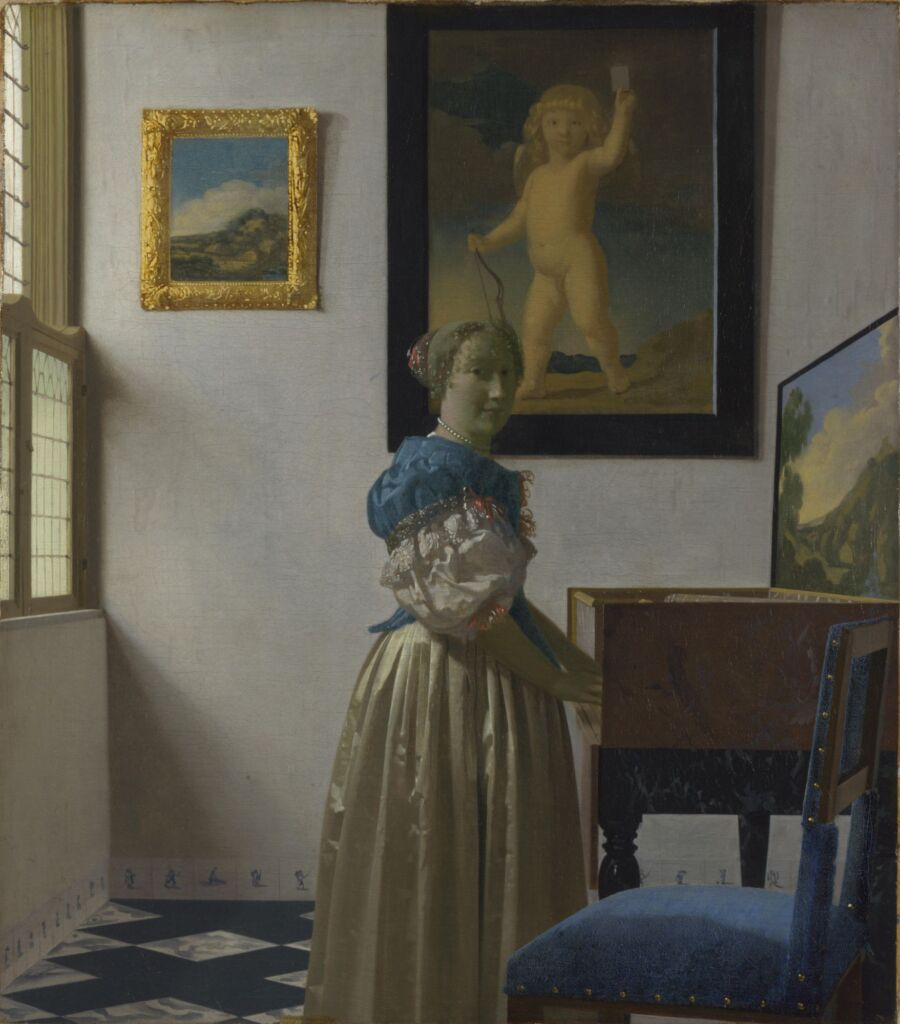
In A Young Woman standing at a Virginal, the chair upholstery in the foreground is pure ultramarine. The chair is empty, yet it holds one of the brightest patches of precious blue in the picture.
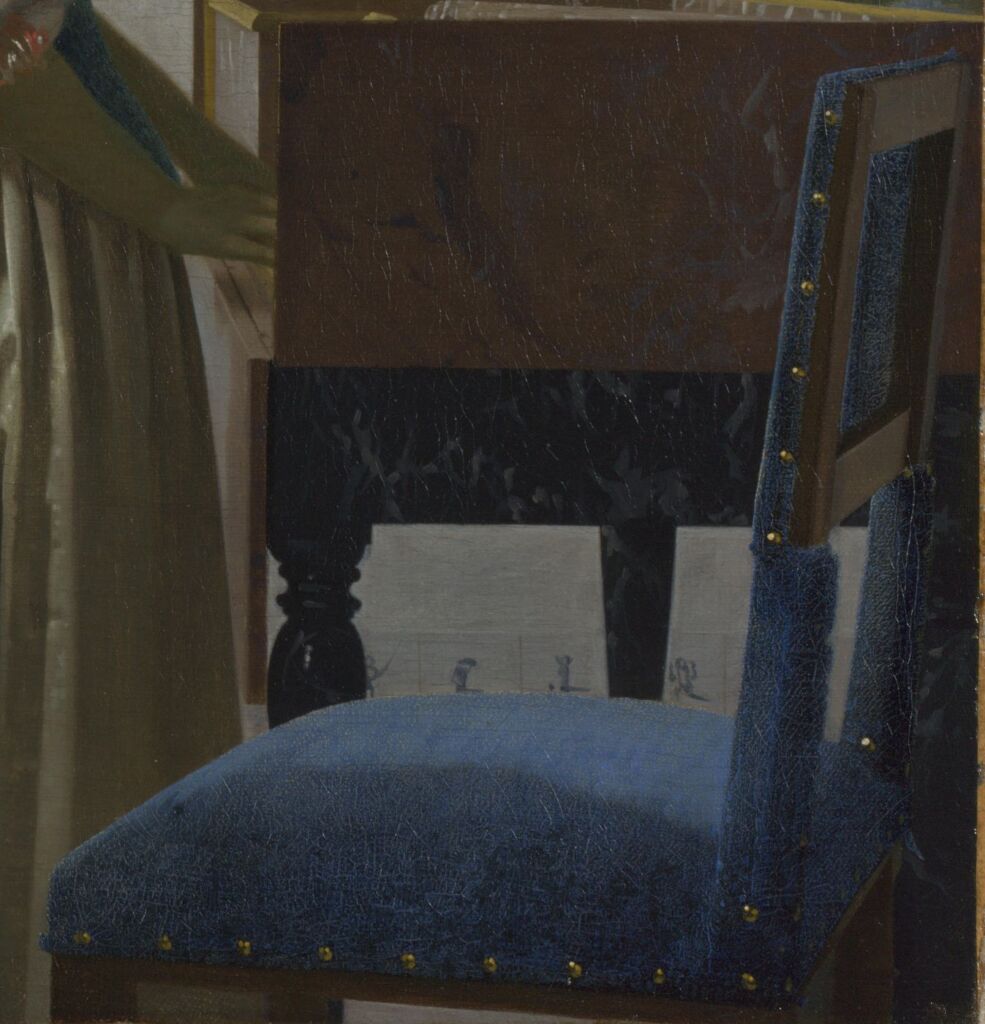
His pigment was not always pure. A sample from a curtain in another of his paintings contained silica: perhaps a dealer had cut it, or Vermeer himself. Ultramarine in oil also tends to whiten, so his blue passages are paler today.
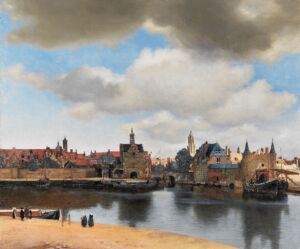
The same Afghan lapis colors the turban in Girl with a Pearl Earring. Vermeer spent nearly all his life in the hometown he painted in View of Delft, yet his blue came from the far side of the world.
Cheap blue came only in the 19th century. In 1824 the Société d’Encouragement pour l’Industrie Nationale in Paris announced a competition for artificial ultramarine; by 1826 the prize stood at 6,000 francs, for a pigment costing no more than 300 francs a kilogram. The natural pigment, according to the Lyon Academy (in French), cost about 4,000.
In 1828 the prize went to the French chemist Jean-Baptiste Guimet, who had found his method two years earlier and kept it secret. That same year Christian Gmelin, a Tübingen chemistry professor, devised and published his own process, so Germany long credited Gmelin with the discovery.
In 1831 Guimet opened a factory at Fleurieu-sur-Saône, outside Lyon. A color once weighed against gold became cheap enough for walls, paper and fabric. In the corner of The Entombment the bare priming remains, where the most expensive blue of its age might have gone.
Comments
For Hroniki readers
Comments are open to readers with an account. Signing up is free and takes a few seconds.
No comments yet. Start the conversation.