Botticelli’s Birth of Venus: who commissioned it and who was the model
No known document mentions The Birth of Venus before 1550, and almost everything about Botticelli's painting rests on conjecture. What we know about the Medici commission, the poems behind the subject, Simonetta Vespucci and the 1987 restoration.
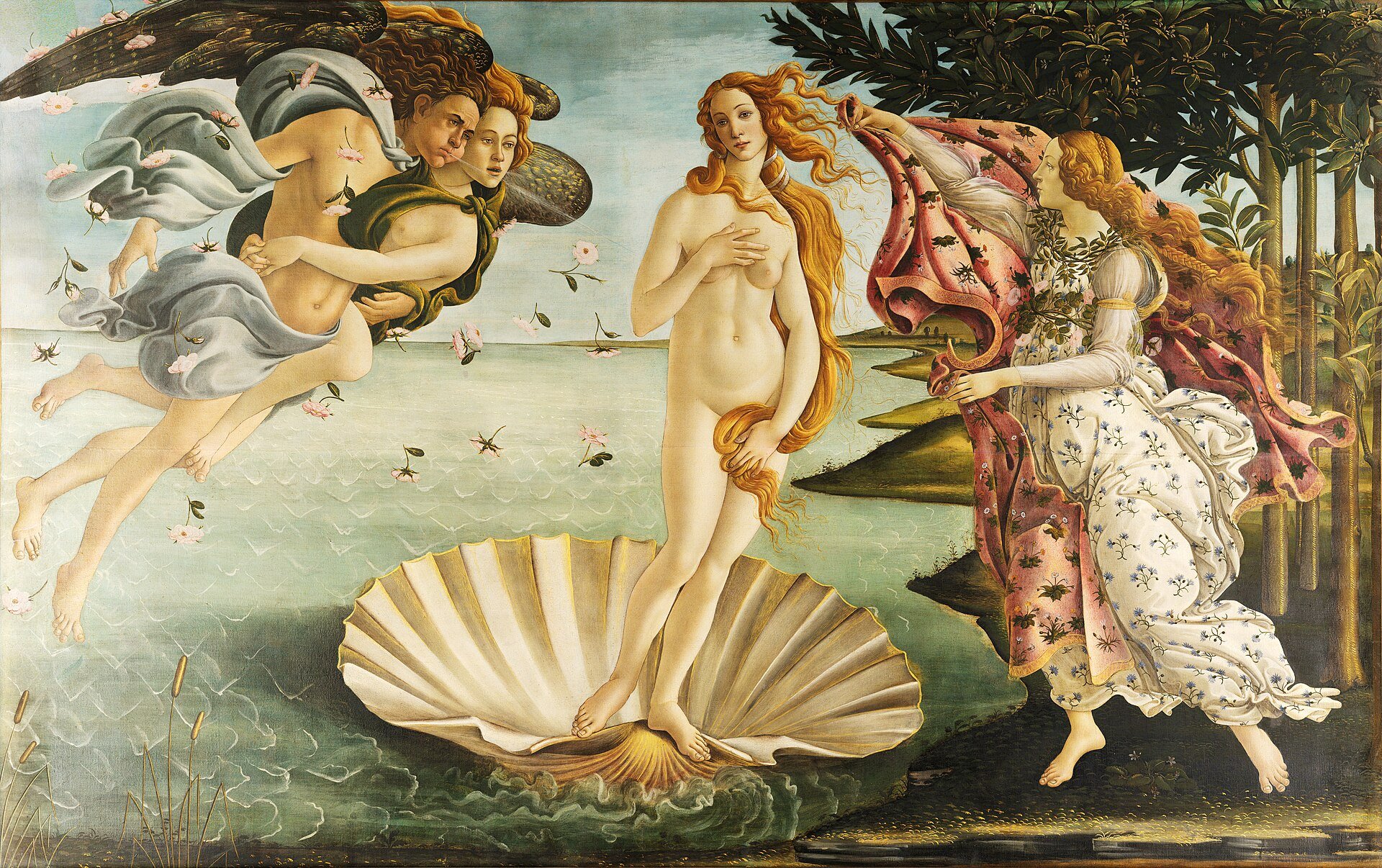
No known document mentions Florence’s most recognizable painting before 1550. Inventories of the Medici villa from that period do not list The Birth of Venus. The first to describe it was Giorgio Vasari, author of the Lives of the Artists.
Nearly everything about Sandro Botticelli’s picture has rested on conjecture ever since: who commissioned it, who posed, even what to call the wind on the left.
Oranges in place of a signature
On its page for the painting, the Uffizi calls a Medici commission highly likely, on circumstantial grounds. One is location: Vasari saw the picture at the Villa di Castello, owned by a junior branch of the family. The other grows along the right edge of the canvas.
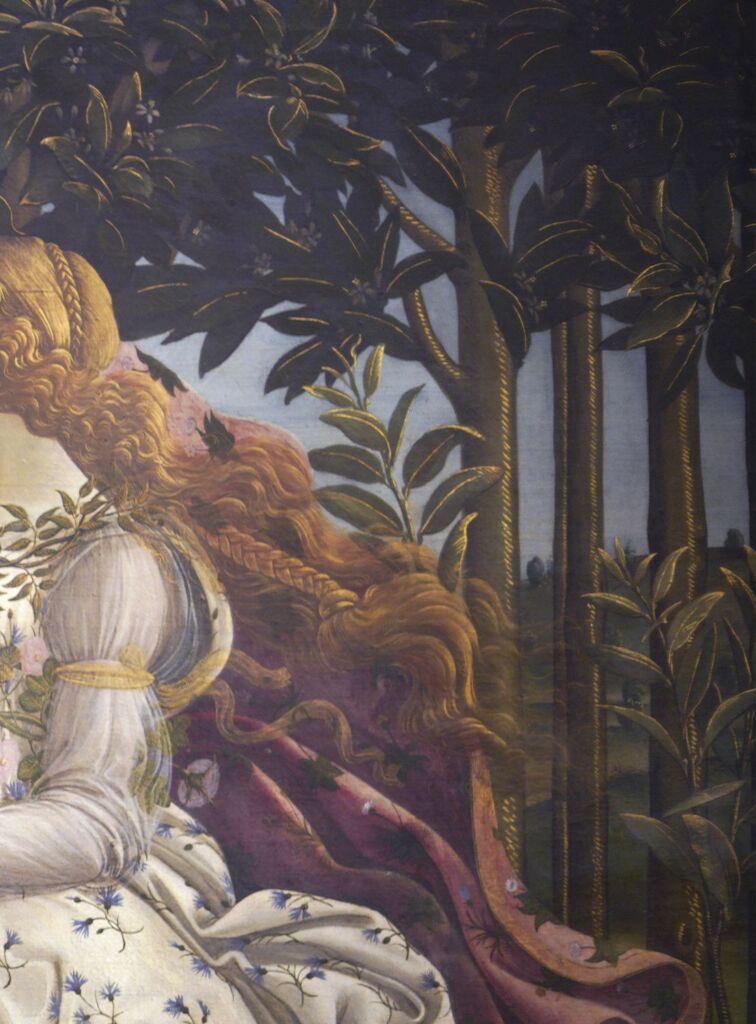
Oranges were called mala medica, “Median apples,” and the museum reads the phrase as a possible Medici emblem. If so, the grove is the patron’s signature, legible only to those who knew Latin.
The patron’s name remains a guess. In 1908 the British scholar Herbert Horne linked the painting to the owners of Castello, the brothers Lorenzo and Giovanni di Pierfrancesco de’ Medici. Britannica allows for either Lorenzo: the Magnificent himself or his kinsman, the banker Lorenzo di Pierfrancesco.
The paperwork argues against Horne. As the Italian Ministry of Culture’s catalog (in Italian) notes, three villa inventories from around 1500 do not mention the painting. It enters the Castello records almost a century later.
What we do have is Vasari. He writes that two Botticelli pictures were at Castello, Duke Cosimo’s villa. In Gaston du C. de Vere’s 1912 translation, one shows “the birth of Venus, with those Winds and Zephyrs that bring her to the earth, with the Cupids”; the other, a Venus adorned with flowers by the Graces, standing for spring.
The painting has no cupids. Vasari may have meant the winged winds, or written from memory. But he tied The Birth of Venus to Primavera, and the two have been paired ever since.
Canvas, not panel
The two Castello pictures differ in support. Primavera is on wood, like altarpieces and formal portraits. The Birth of Venus is tempera on canvas, 172.5 by 278.5 centimeters (about 68 by 110 inches).

The Uffizi explains this by purpose: in 15th-century Florence, canvas was common for decorative paintings in noble houses, so the Venus was meant for domestic rooms, not a church. Britannica calls it the first known Tuscan painting on canvas; the museum makes no such claim.
Two pieces of cloth were sewn together before work began, and the ground was tinted blue. Canvas was also cheaper than panel. Ronald Lightbown, author of a monograph on Botticelli, notes that it was favored for secular pictures in country villas, furnished more simply than town palaces.
From Hesiod’s foam to Poliziano’s shell
The myth begins brutally. In Hesiod’s Theogony, Cronus castrates his father, Uranus, and flings the severed parts into the sea. “A white foam spread around them,” runs Hugh G. Evelyn-White’s translation, “…and in it there grew a maiden.” She drifts first to Cythera, then to Cyprus.
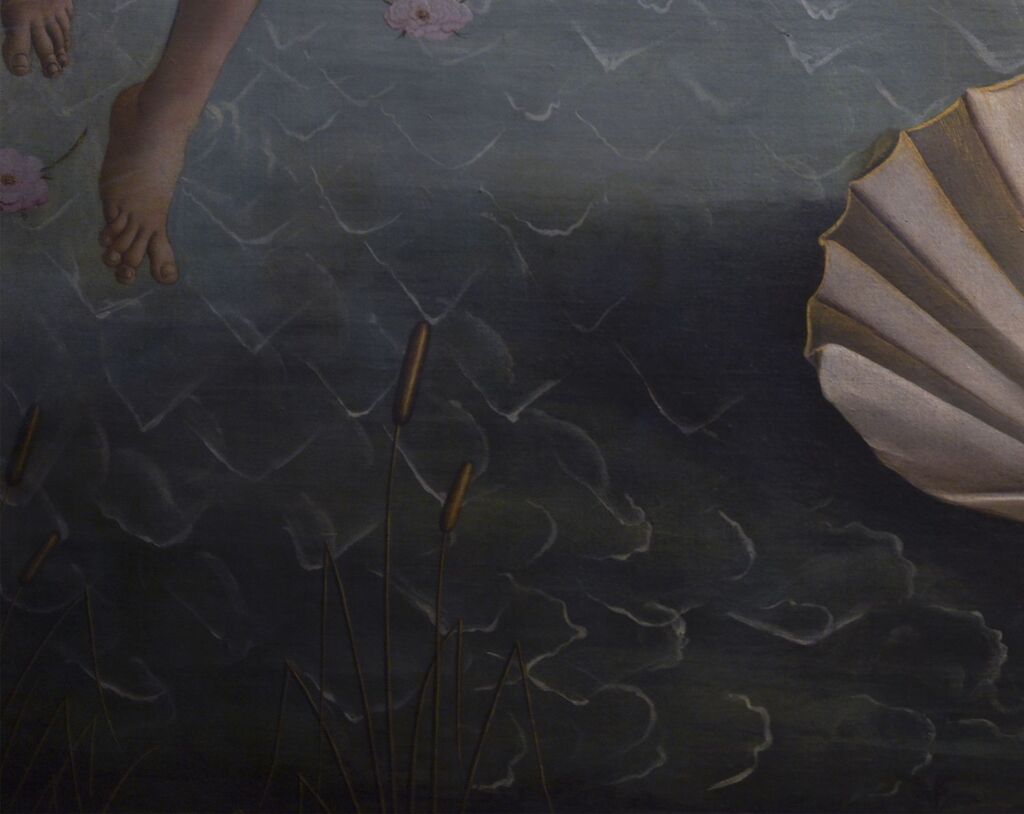
Botticelli keeps only the sea, its waves a row of identical marks. This is water from poetry; no real sea looks like it.
The second text is the short Homeric Hymn to Aphrodite. There “the moist breath of the western wind” carries the goddess to Cyprus, where “the gold-filleted Hours,” the Horae, welcome her and dress her in heavenly garments. Nearly the whole right half of the painting fits in those lines.
The third source was Botticelli’s contemporary. Angelo Poliziano, a poet in Lorenzo the Magnificent’s circle, began his Stanze in the mid-1470s for the joust of Lorenzo’s brother, Giuliano de’ Medici. The poem stayed unfinished: Giuliano was murdered in the Pazzi conspiracy of 1478.
The Stanze describe a relief on the gates of Venus’s palace: a maiden “with a face not human” rides a shell, driven to shore by “playful zephyrs” (our translation). The Uffizi suggests that Poliziano may have proposed the subject.
The ministry’s catalog adds that Botticelli knew Hesiod and the hymn through the Neoplatonists of Lorenzo’s circle: Marsilio Ficino, Pico della Mirandola and Poliziano himself. Botticelli’s goddess knows nothing yet of the Judgment of Paris or the Trojan War. She is still sailing toward the shore.
From the poets, Botticelli took the sea, the wind and the shell. The violence the myth begins with stayed outside the frame.
Two winds and a Hora
A pair flies in from the left, and their names have been disputed since Vasari. The oldest reading goes back to his wording: where de Vere has “Zephyrs,” the Italian has aure, “breezes.” Hence Zephyr and Aura, the personified light breeze.
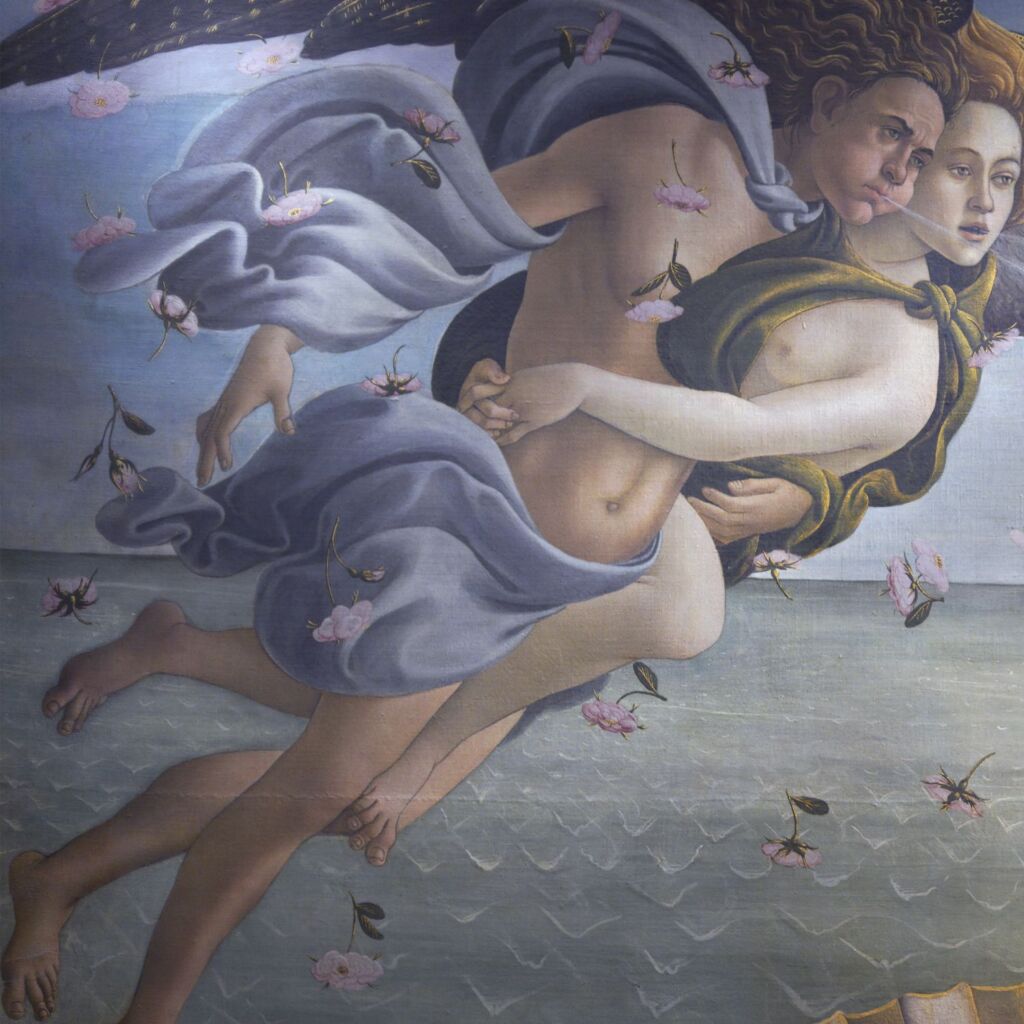
The Uffizi is cautious, naming Zephyr and, perhaps, Aura. The ministry’s catalog names the companion Chloris, borrowing from Primavera, where Zephyr pursues the nymph Chloris, who becomes Flora in Ovid’s Fasti. There is no firm answer, and Botticelli may not have needed one.
The source of the intertwined pair is clearer: according to the museum, Botticelli based it on a Hellenistic carved gem owned by Lorenzo the Magnificent. A stone that fit in a palm grew into the left third of a huge canvas.
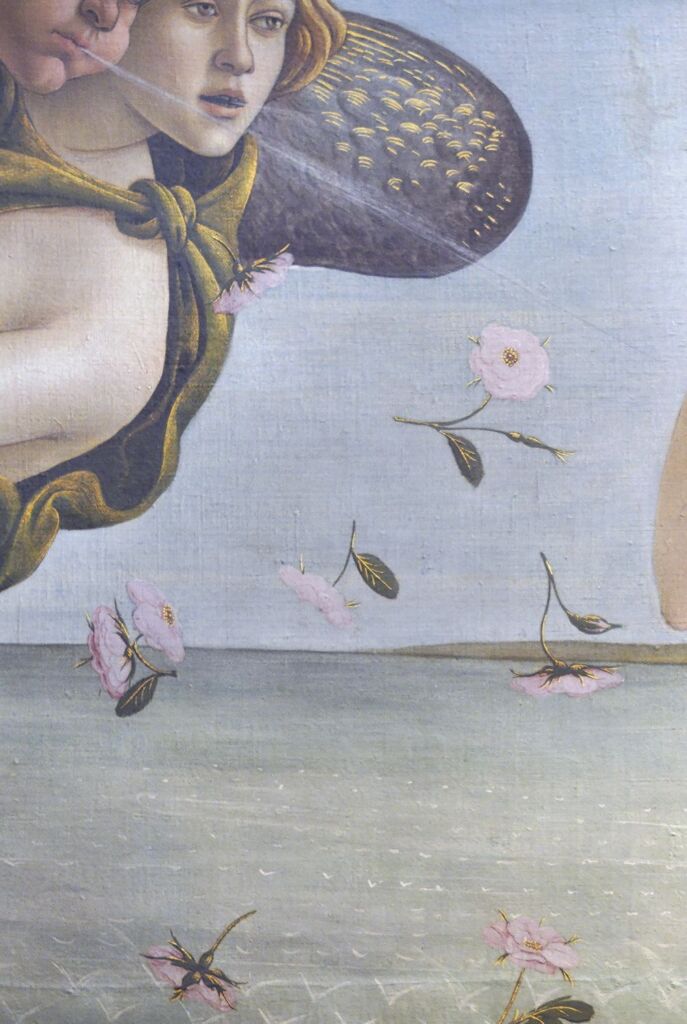
Roses fall between the winds and the goddess. The museum links them, like the flowers on the dress of the woman at right, to spring. The hymn never mentions roses, but another ancient tradition held that they came into the world with Aphrodite.
The woman on the shore holding out a cloak is called one of the Graces or the Hora of spring; Britannica tentatively suggests Flora. Most often she is named a Hora, after the hymn in which the Horae, goddesses of the seasons, greet and clothe Aphrodite.
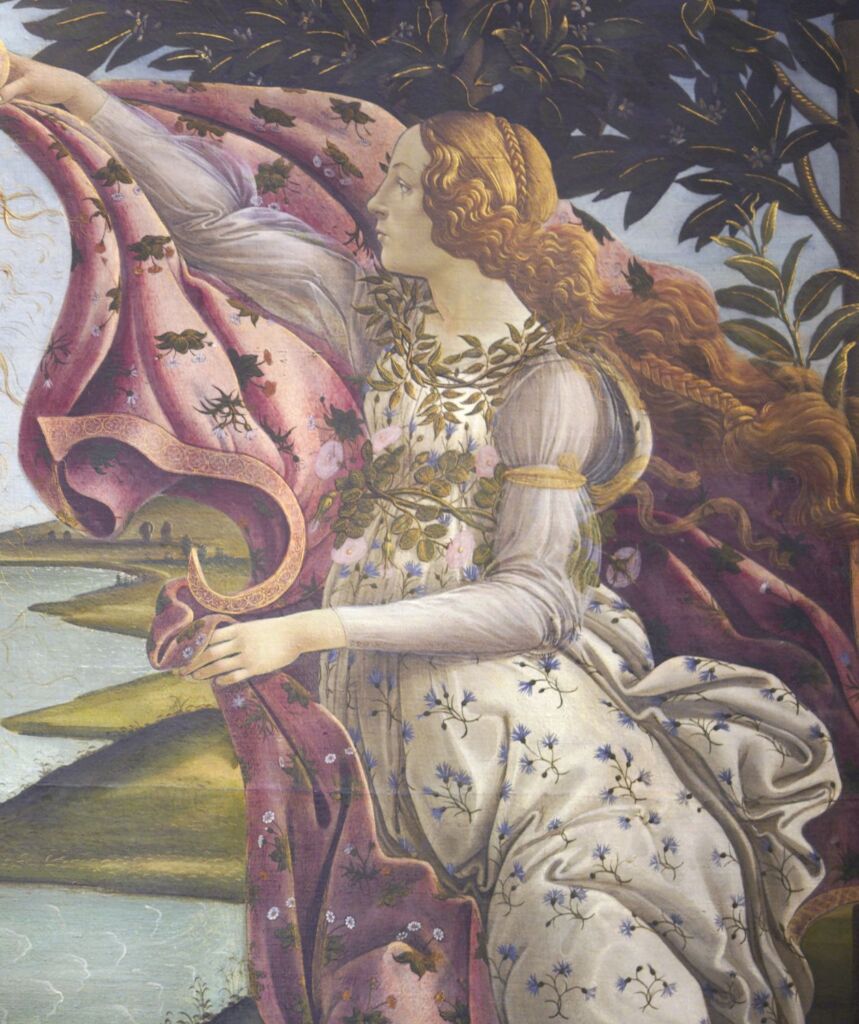
Technical studies show that Botticelli altered this figure while painting. According to Lightbown, the Hora first wore low antique sandals, and her collar was added later.
Simonetta joined the painting in the 19th century
The most persistent legend concerns the face. Venus, the story goes, is Simonetta Vespucci, a Genoese beauty married to Marco Vespucci. At the joust of 1475, Giuliano de’ Medici proclaimed her queen of beauty, and Poliziano made her the heroine of his Stanze.
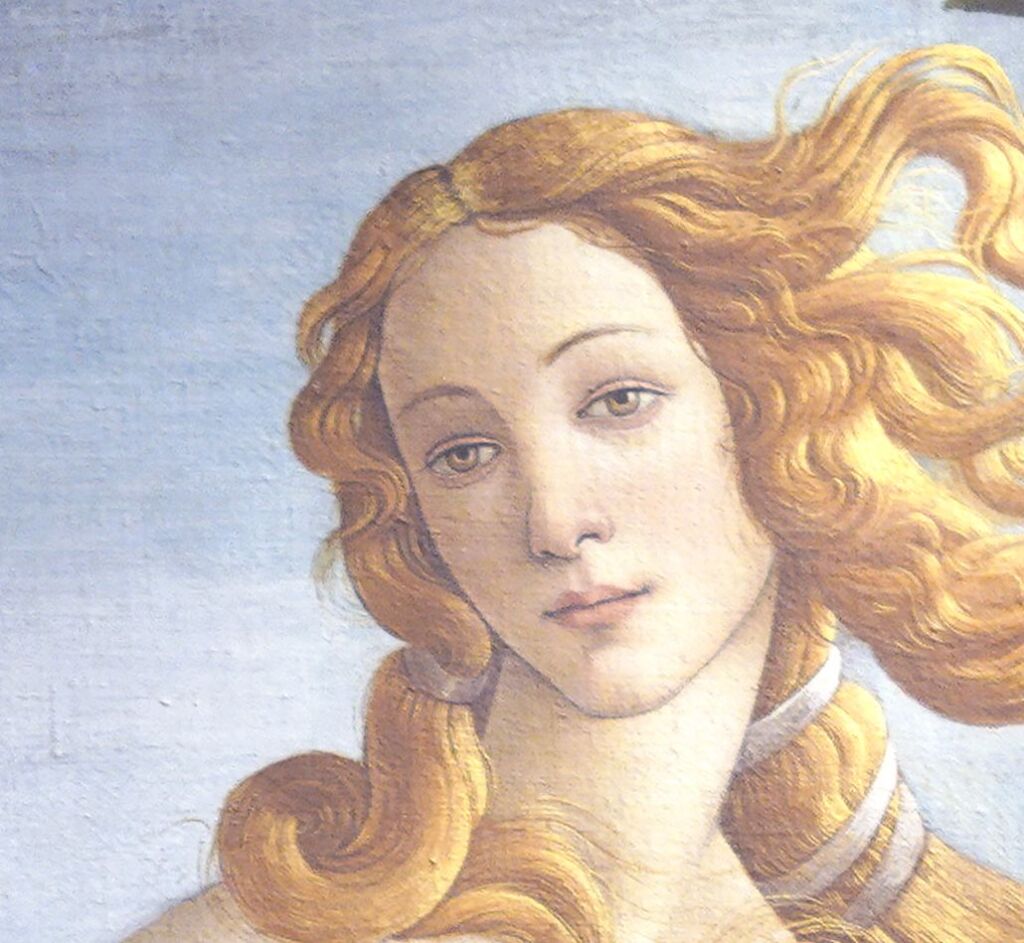
Simonetta died young, in 1476, about ten years before the painting was made. No document says that Botticelli used her as his model.
Botticelli’s link with her name is older than the legend. Vasari mentions a woman’s profile by Botticelli in Duke Cosimo’s collection, said to show Giuliano de’ Medici’s beloved. But identifying Venus as Simonetta began in the 19th century, with the Victorian critic John Ruskin and with Walter Pater, whose essay in The Renaissance made Botticelli a favorite of the Aesthetes.
Out of that reading grew the myth of a single woman who modeled for all of Botticelli’s heroines. Lightbown saw the workshop’s “portraits of Simonetta” as images of ideal beauty, not of real women. Still, the legend has reached even the official catalog, which says Botticelli “seems” to have drawn on Simonetta for the face.
One detail seems to favor the romantics. Botticelli was buried in 1510 in Ognissanti, the Vespucci parish church, where Simonetta also lies. But it was his parish too: his family lived nearby, on Borgo Ognissanti, and was buried there as well.
An ancient pose, but Botticelli’s neck and shoulders
The gesture of Venus’s hands is called Venus pudica, the “modest Venus.” The type goes back to Praxiteles’ Aphrodite of Knidos, of the mid-4th century BC: the goddess covers herself as if she sensed someone watching.
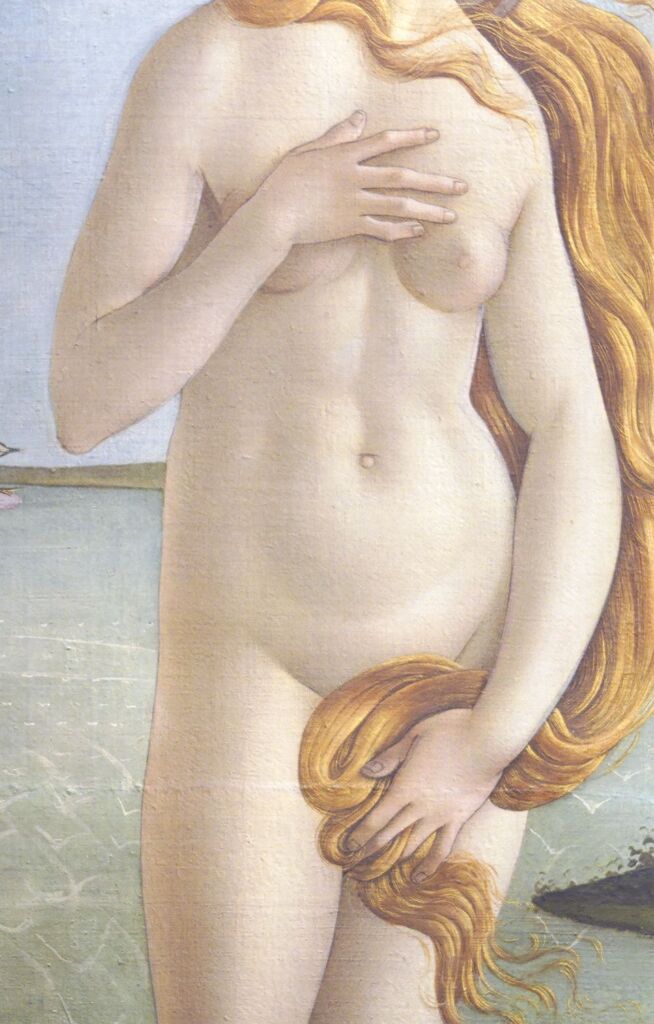
Botticelli is often said to have copied the pose from the Medici Venus; Britannica, too, points to an ancient statue in the family collection. Yet the Uffizi itself says the Medici Venus was found in Rome only in the 16th century, kept for decades at the Villa Medici there, and brought to Florence in 1677.
Botticelli could not have studied it in 1480s Florence. The two share an ancient type; one is not a copy of the other. Today the statue stands in the Uffizi’s Tribuna, a few rooms from the painting.
Beyond the gesture, antiquity gives way. Britannica notes the odd proportions: the elongated neck and an over-long left arm. In The Nude (1956), Kenneth Clark observed that Venus’s shoulders flow down into her arms rather than bracing the torso as in ancient statues.
Antiquity supplied the gesture; the rest of the figure is Botticelli’s own.
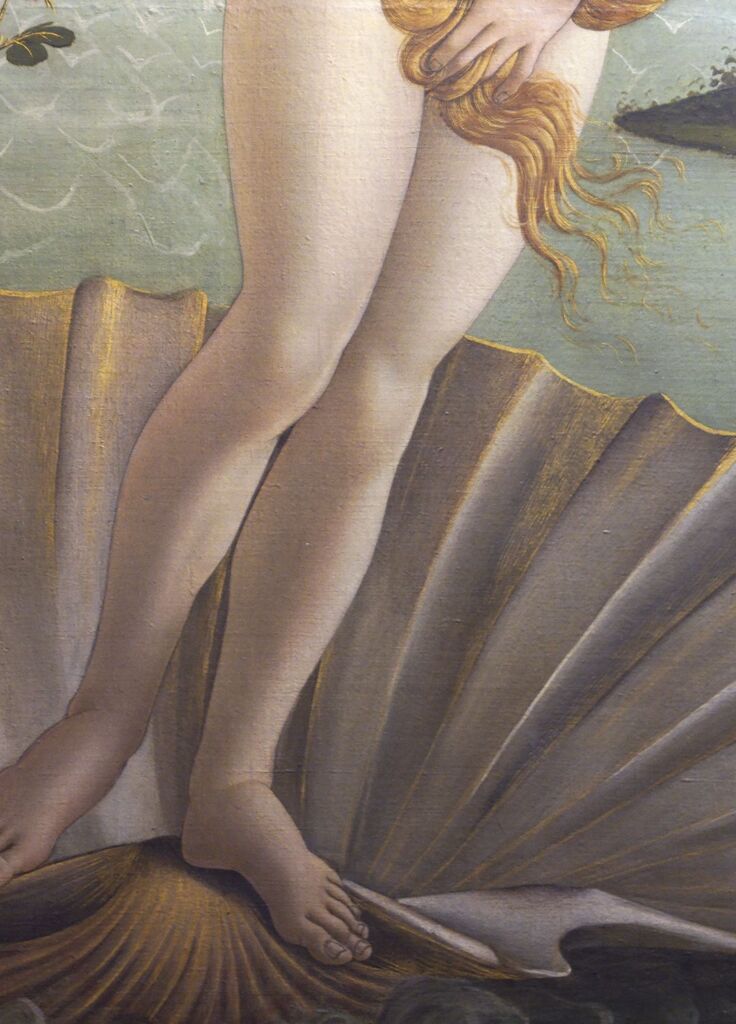
Venus’s weight is shifted so far onto the left leg that a real woman could not stand on the shell this way. The figures cast no shadows. Botticelli wanted a line flowing from nape to foot, and sacrificed anatomy for it.
Gold highlights and oil stains
The painting has been restored twice in modern times: first in 1983, then in the main campaign by Alfio Del Serra, completed in 1987.
The insurer La Fondiaria paid for it, and that year the Florence exhibition “The Birth of Venus and Botticelli’s Annunciation” showed the result. Britannica says the aim was to restore the brightness the picture had when new.
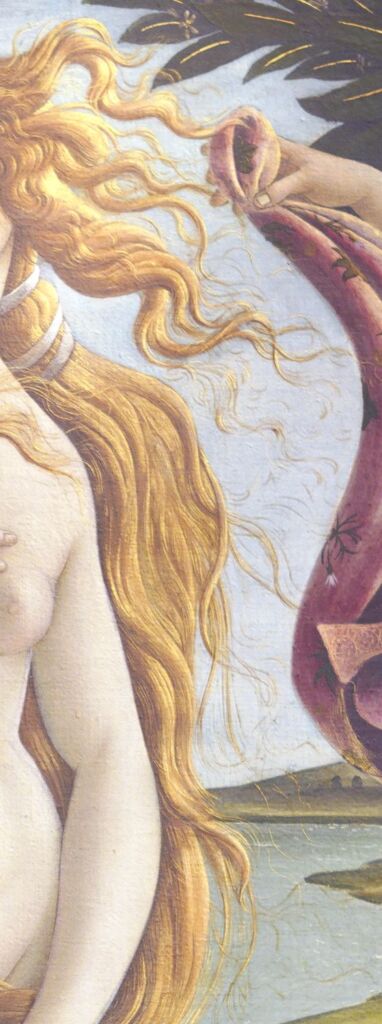
Now the gold is easy to see. According to Lightbown, Botticelli used it generously for highlights in Venus’s hair, the foliage and the tree trunks. Some colors were beyond recovery: the green of Zephyr’s wings and of the orange trees has darkened in the light.
Del Serra called the oil stains the hardest part. He told FAN – Florence Art News, a Florentine publication, that he took on the painting only after finding a way to remove them without harming the original varnish. The search took almost a month. Of all his restorations, he valued this one most.
Five centuries without a bonfire
Another famous legend about Botticelli involves the “bonfire of the vanities.” At the 1497 carnival, followers of the Dominican preacher Girolamo Savonarola burned ornaments, playing cards, gaming tables and what Britannica calls “lewd pictures” in a Florentine square. In May 1498 Savonarola was executed.
According to Vasari, Botticelli became a piagnone, a “weeper,” as the friar’s followers were called, abandoned painting and grew poor in old age. Vasari says nothing about the painter throwing his own pictures into the fire.
That story comes from later writers, often citing Vasari. The dates argue against it: Botticelli painted some works after Savonarola’s death, among them the Mystic Nativity, with the year 1500 in coded form.
Recorded at Castello in the mid-16th century, The Birth of Venus entered the Uffizi from the Medici storerooms in 1815. It hangs upstairs in Room A12, named simply “Botticelli, Venus.”
Since a rehang in June 2026, it looks straight across at Primavera in the next room. Both now hang in sealed cases, with the barriers in front removed. Beside The Birth of Venus are two tondos, the Madonna of the Magnificat and the Madonna of the Pomegranate.
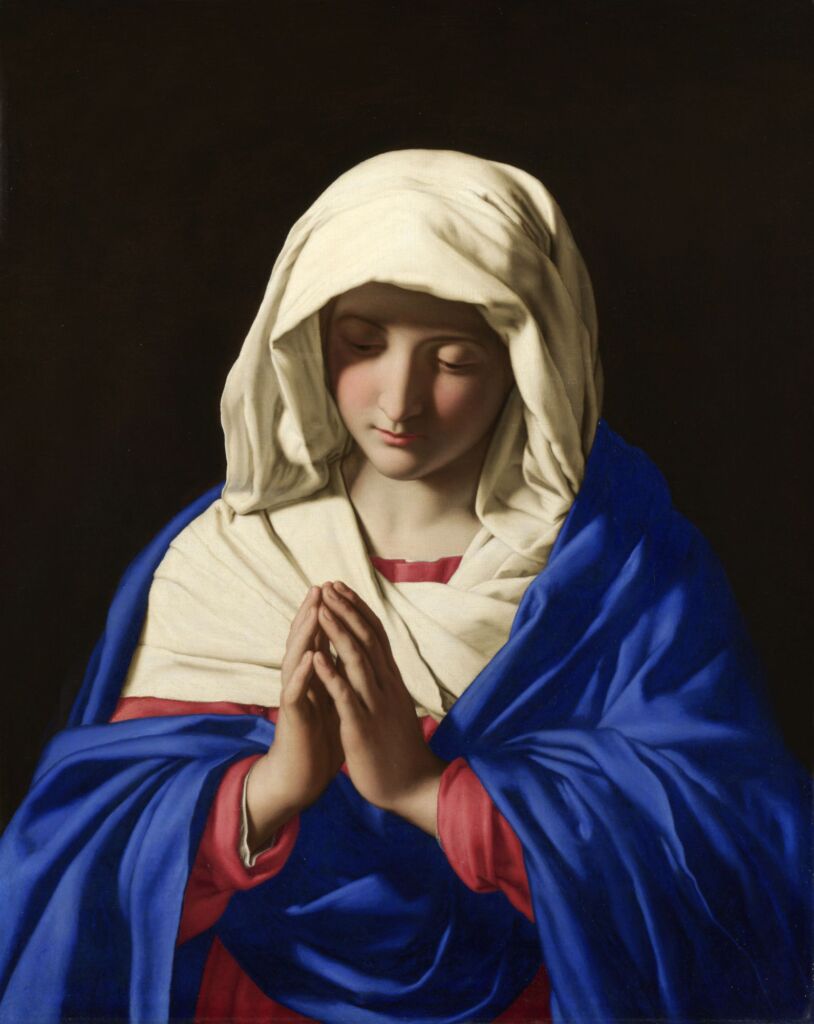
The first question to ask of any painting, “Who is this?”, has no answer here: the goddess has the face of Botticelli’s Madonnas, and no document names the model.
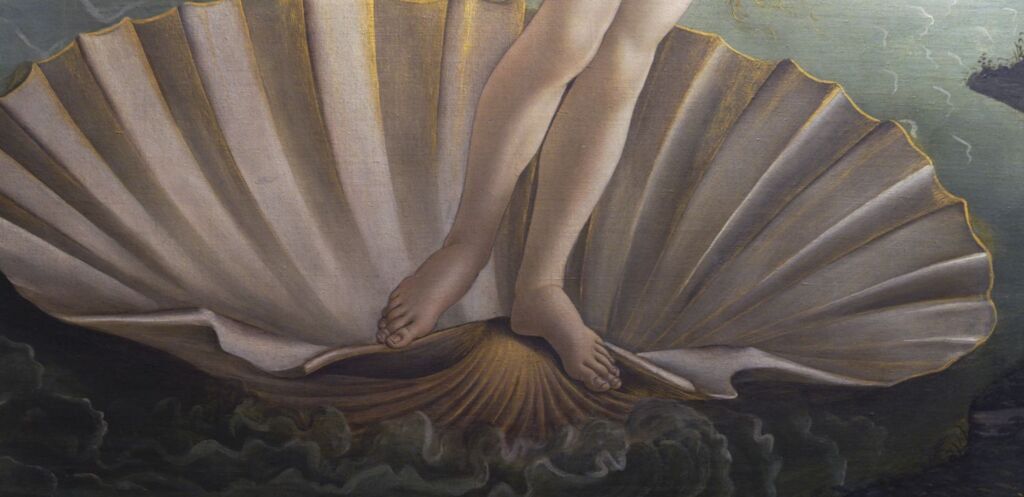
Vasari saw both paintings at Castello. Almost five centuries later they were hung face to face, and the goddess has still not stepped off her shell.

Comments
For Hroniki readers
Comments are open to readers with an account. Signing up is free and takes a few seconds.
No comments yet. Start the conversation.