Wright of Derby’s Air Pump: who decides whether the cockatoo lives
In 1760 a leading lecturer called the air-pump experiment on a live bird too shocking to show. Eight years later Joseph Wright of Derby painted it with a rare cockatoo and left the outcome to us.
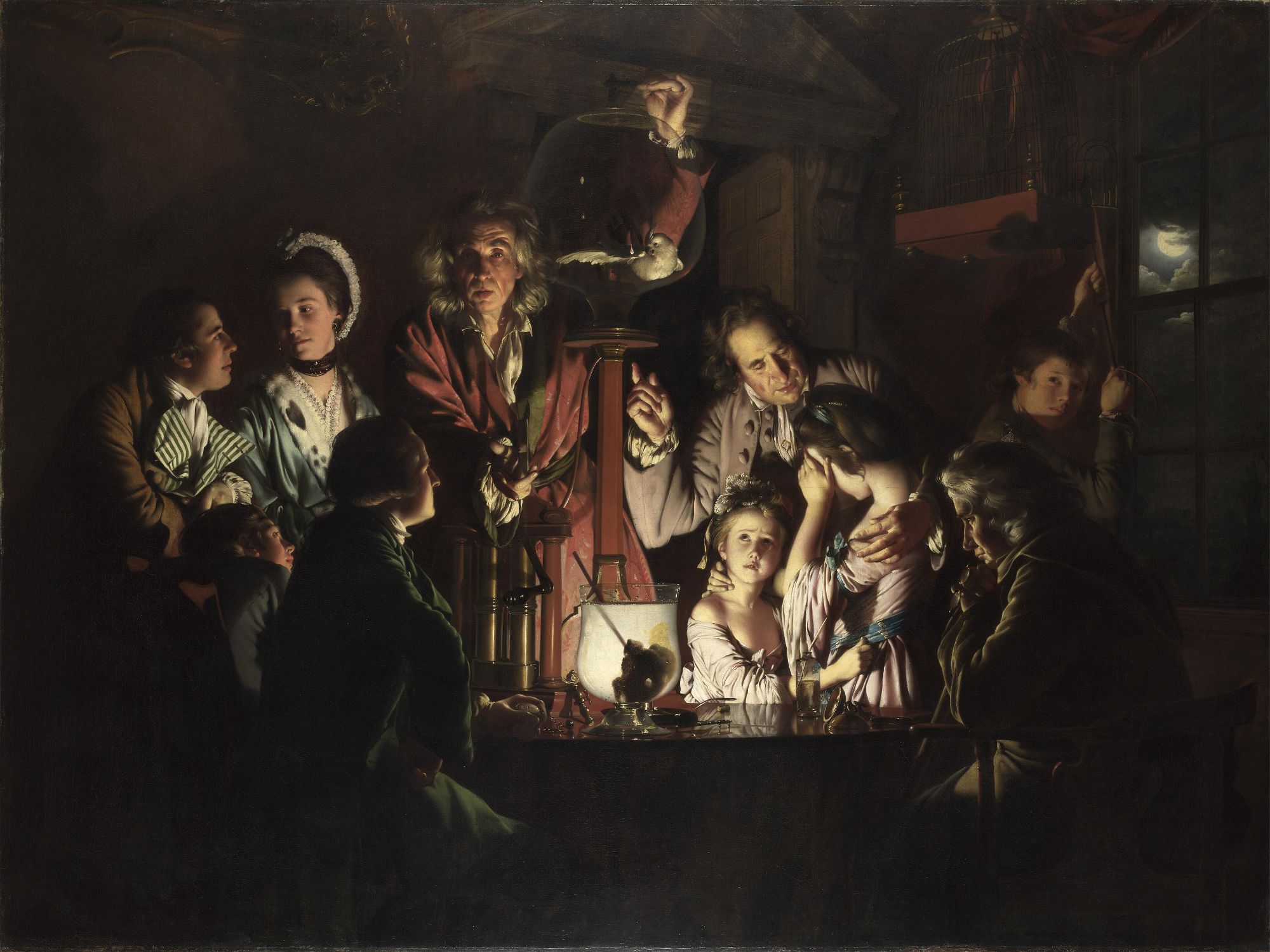
In 1760 the Scottish astronomer James Ferguson published his lectures on natural philosophy. Experiment 18 called for a fowl, a cat, a rat, a mouse or a bird to go under the glass of an air pump while the air was drawn out.
Ferguson would not perform it. The experiment, he wrote in Lectures on Select Subjects, was “too shocking to every spectator who has the least degree of humanity.” A glass with a bladder inside, called the lungs-glass, took the animal’s place.
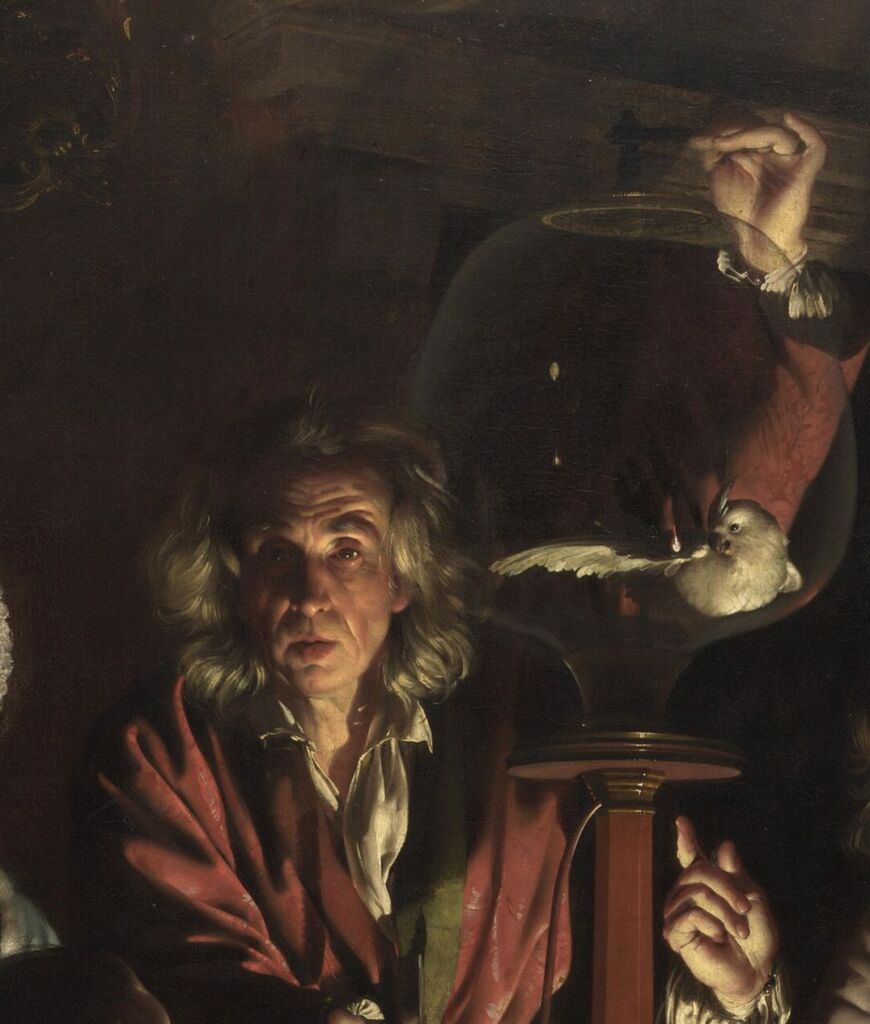
Eight years later Joseph Wright of Derby painted the version Ferguson refused to show, and put a cockatoo under the glass. Which kind is still argued over: the National Gallery says a white cockatoo, while Judy Egerton’s 1998 catalog of the gallery’s British paintings identifies a gray cockatiel. Either bird was a rarity in England in 1768.
An Experiment on a Bird in the Air Pump (1768) belongs to the National Gallery in London. The painting still won’t say whether the bird survives.
A lecture after dark
By 1768 the demonstration was more than a century old. Most people of the day met “science,” the National Gallery notes, through traveling lecturers, who performed in town halls or, as here, in private houses by invitation. What was new was Wright’s subject: the audience.
In 1765 Wright exhibited Three Persons Viewing the Gladiator by Candlelight, and in 1766 A Philosopher Giving That Lecture on the Orrery, now in Derby. The Air Pump is the largest and most theatrical of the series.
For such pictures, Wright’s niece Hannah recalled, he set up two rooms with the door open between them: one dark, holding the lit objects, the other bright enough to see his canvas.
His first idea survives in oil on the back of a self-portrait of about 1767–68, now in a private collection. It has fewer people; the lecturer stands to one side and shows a small bird mainly to the two girls. In the finished canvas Wright moved the pump to the center and handed the lecturer the whole room.
That lecturer does not watch the bird. He looks straight out at us, one hand on the valve, and the choice seems to pass to the viewer: pump out the last of the air, or let it back in. His robe is red damask. Near the flame it turns salmon pink; farther off it darkens to magenta. Wright was running an experiment of his own, on light.
Faces around the table
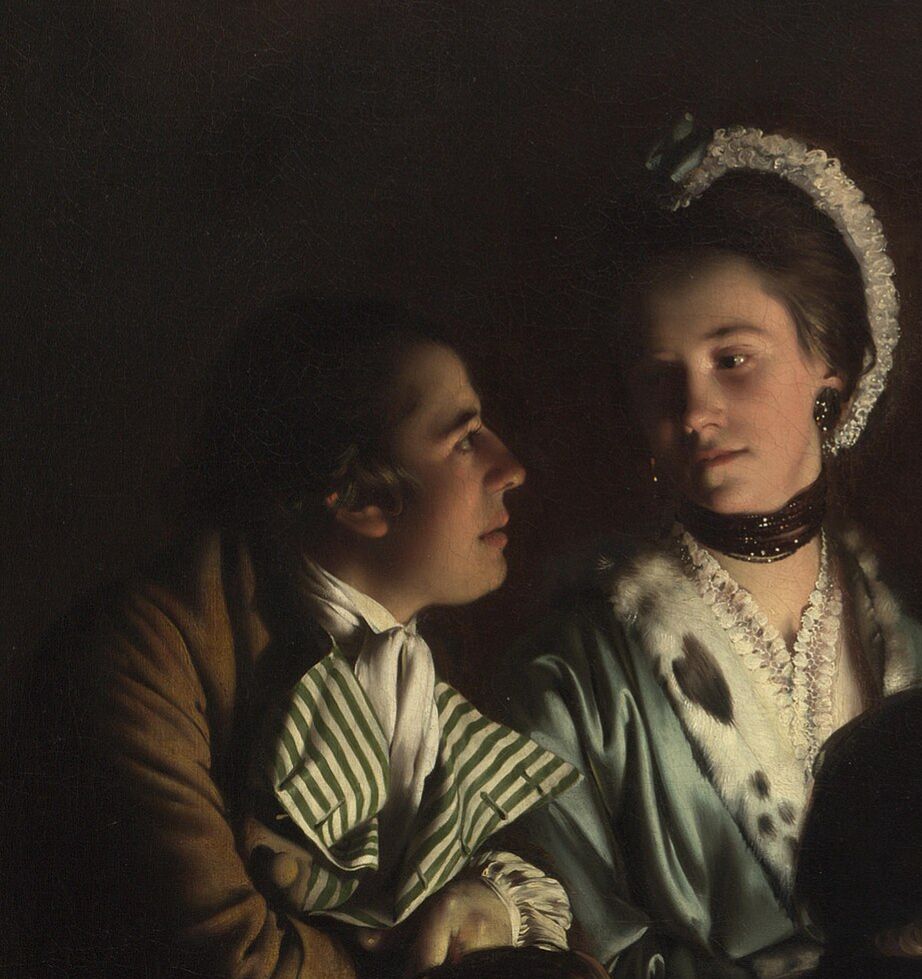
Wright painted types — a lecturer, a family, a courting couple — and published no key to them. The National Gallery names only two of his sitters. The young pair on the left, with eyes only for each other, are Thomas Coltman and Mary Barlow, friends of the artist.
They married in October 1769, and a year or two later Wright painted them again, about to set out on a morning ride. That portrait belongs to the National Gallery too.
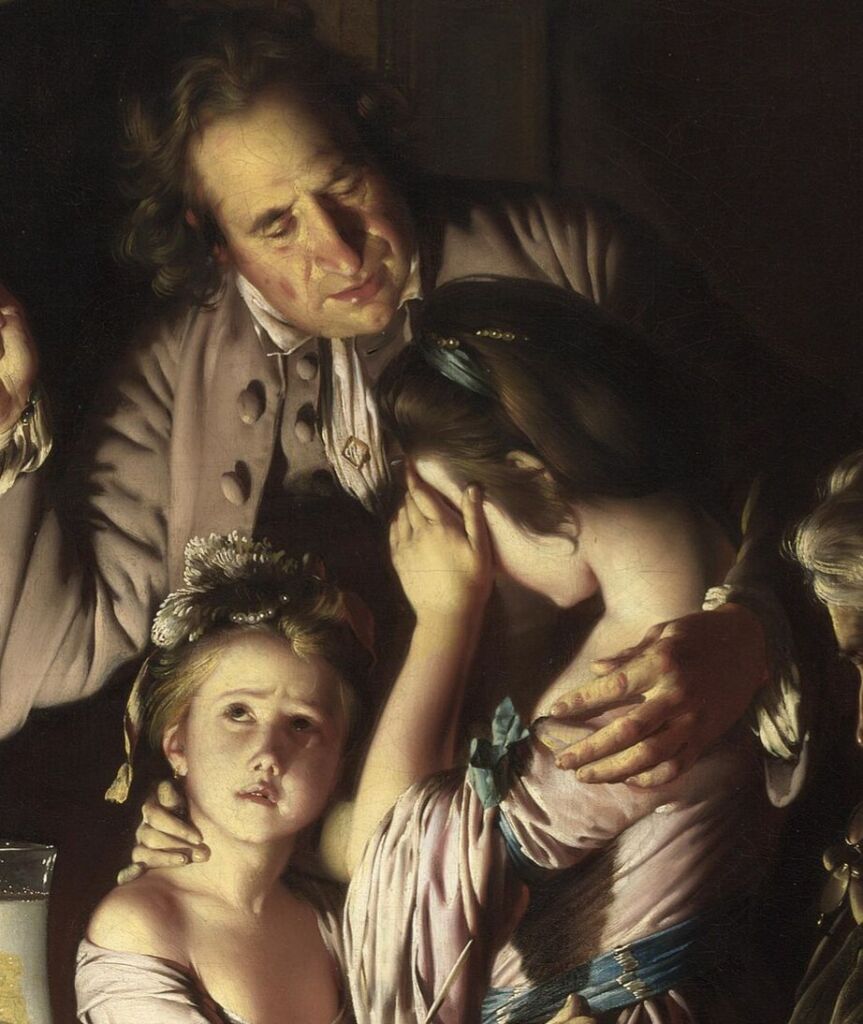
Other names have been proposed — Erasmus Darwin, for one, as the man timing the experiment by his pocket watch — but Wright never confirmed any. The family on the right needs no names. Their father’s arm around the elder girl may be comfort or the start of an explanation; the gallery leaves both open.
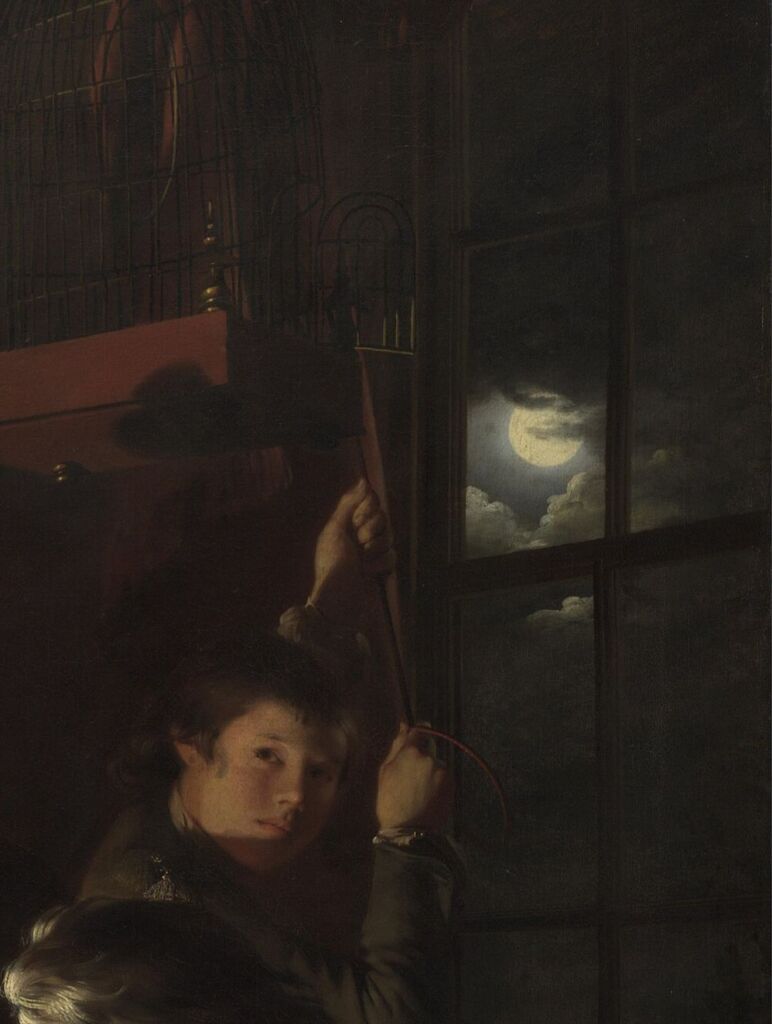
The boy at the window, in the gallery’s reading, is waiting to see whether he will need to lower the empty cage for a reprieved bird.
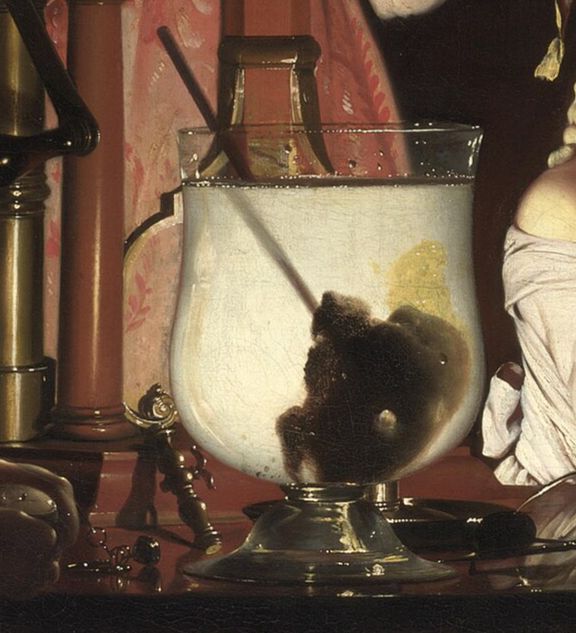
The room has a single candle, and Wright hid it. It burns behind a large glass of murky liquid holding a diseased human skull. Skull and candle are old emblems of mortality. Read with them, the picture becomes a modern vanitas: a meditation on time running out, on the limits of knowledge, on how little it takes to end a life.
A genius “in a peculiar way”
Wright showed the canvas in the spring of 1768 at the Society of Artists’ annual exhibition in London, where admission cost a shilling. It fit none of the accepted categories of British art: too modern for a history painting, too serious for a conversation piece.
The Gazetteer hedged its praise: “Mr Wright, of Derby, is a very great and uncommon genius in a peculiar way.”
The gallery’s provenance record has Dr. Benjamin Bates buying the picture from the artist for £200. Wright’s own account book is murkier: it also lists £210, and the only payment it records is £30. The picture passed to the Tyrrell family, failed to sell at Christie’s in 1854, and in 1863 Edward Tyrrell gave it to the National Gallery.
In November 2025 the gallery opened a show built around it, Wright of Derby: From the Shadows, much as it had done in 2024 for Constable’s The Hay Wain. In June 2026 the exhibition moved to Derby Museum and Art Gallery, and The Air Pump hung beside The Orrery in Wright’s hometown for the first time in 80 years. It closed there on November 1.
Ferguson solved his problem with a bladder in a jar. Wright kept the bird, put the lecturer’s hand on the valve and stopped the clock there. Two and a half centuries on, the boy at the window is still waiting to find out whether he will need the cage.
Comments
For Hroniki readers
Comments are open to readers with an account. Signing up is free and takes a few seconds.
No comments yet. Start the conversation.