Post-Impressionism: from Cézanne’s apples to Gauguin’s Tahiti
Roger Fry chose the name “Post-Impressionists” in 1910 almost out of impatience. What did Cézanne, Seurat, Van Gogh and Gauguin share, apart from coming after the Impressionists?
In 1910 Roger Fry was assembling a London show of new French painting that still had no name. The critic Desmond MacCarthy, its secretary, recalled the moment Fry lost patience: “Oh, let’s just call them Post-Impressionists. At any rate, they came after the Impressionists.”
A label chosen out of fatigue stuck. It still covers painters who barely worked together and never saw themselves as a group: Paul Cézanne, Georges Seurat, Vincent van Gogh and Paul Gauguin. What did they share, apart from a date?
In short, Post-Impressionism is the umbrella term for French painting that grew out of Impressionism in the 1880s and abandoned its central aim, catching the fleeting effect of light. In its place came simplified color, solid form, symbolism and the first steps toward abstraction. There was no common recipe, and at least four separate roads.
An earthquake on Grafton Street
“Manet and the Post-Impressionists” opened on November 8, 1910, at the Grafton Galleries in Mayfair and ran until mid-January. Manet was the bridge: British audiences knew him, and behind him came painters they had scarcely seen. The core was Cézanne, Gauguin and Van Gogh, plus Matisse and Picasso.
It was put together fast, and much of it was for sale, lent by dealers and owners in France, Germany, Holland and America. MacCarthy remembered Fry sitting before the canvases, hands on his knees, repeating, “Wonderful, wonderful.”
The public came: The Burlington Magazine counted more than 25,000 paying visitors. The critics exploded. In the Morning Post on November 7, timed for the press view, Robert Ross called Van Gogh a lunatic and said these painters’ emotions were “of no interest except to the student of pathology and the specialist in abnormality.”
On November 15 the poet and traveler Wilfrid Scawen Blunt wrote in his diary that the exhibition was “either an extremely bad joke or a swindle.” Further down the same entry he called it a pornographic show.
There were defenders, painters among them. Spencer Gore, one of the young London artists, began his December review by conceding that the pictures had been “so ill received.” Some, he added, were “extremely interesting.”
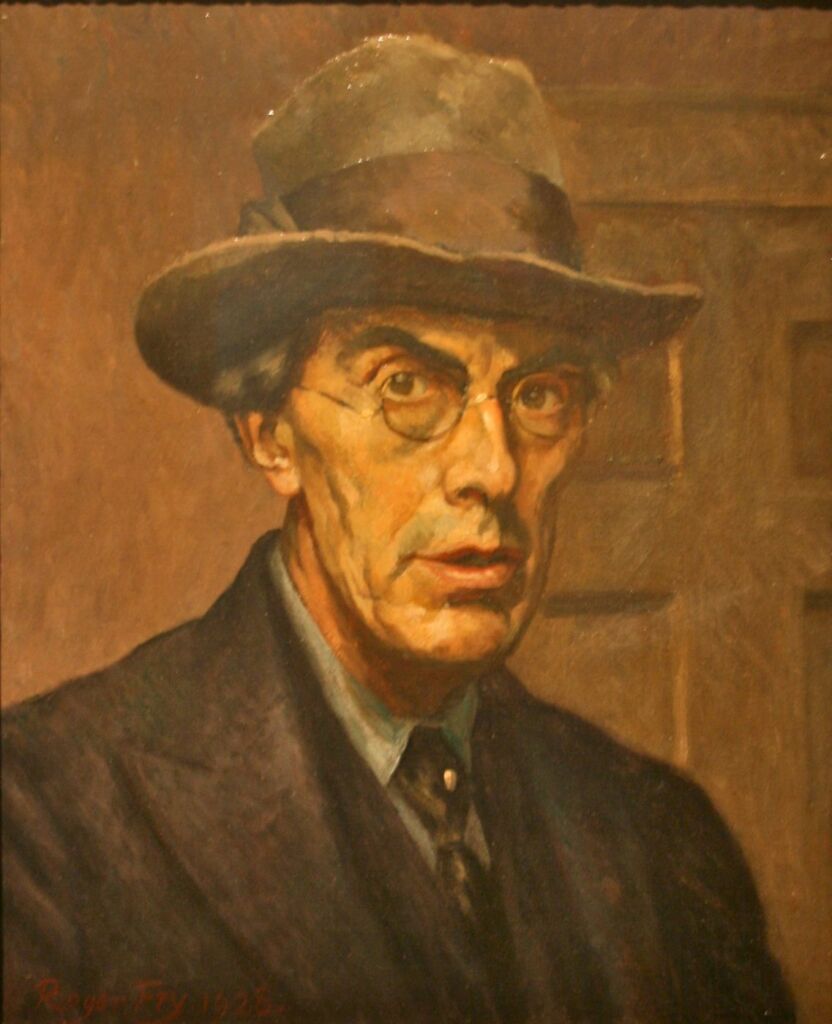
Fry himself took a beating. “Kind people called him mad,” MacCarthy recalled, “and reminded others that his wife was in an asylum.” In 1945 MacCarthy called that winter “the Art-Quake of 1910.”
Fourteen years on, Virginia Woolf, a close friend of Fry’s, wrote in “Mr. Bennett and Mrs. Brown”: “On or about December 1910 human character changed.” She never names the show, but the date has been tied to Grafton Street ever since.
A table without right angles
Cézanne (1839–1906) was the eldest of the four. He had shown with the Impressionists, but by the late 1870s was working alone in the south, in Aix-en-Provence.
He is credited with wanting to make of Impressionism “something solid and durable,” and with the boast “With an apple I will astonish Paris.” Both survive only secondhand, but apples keep returning in his still lifes.
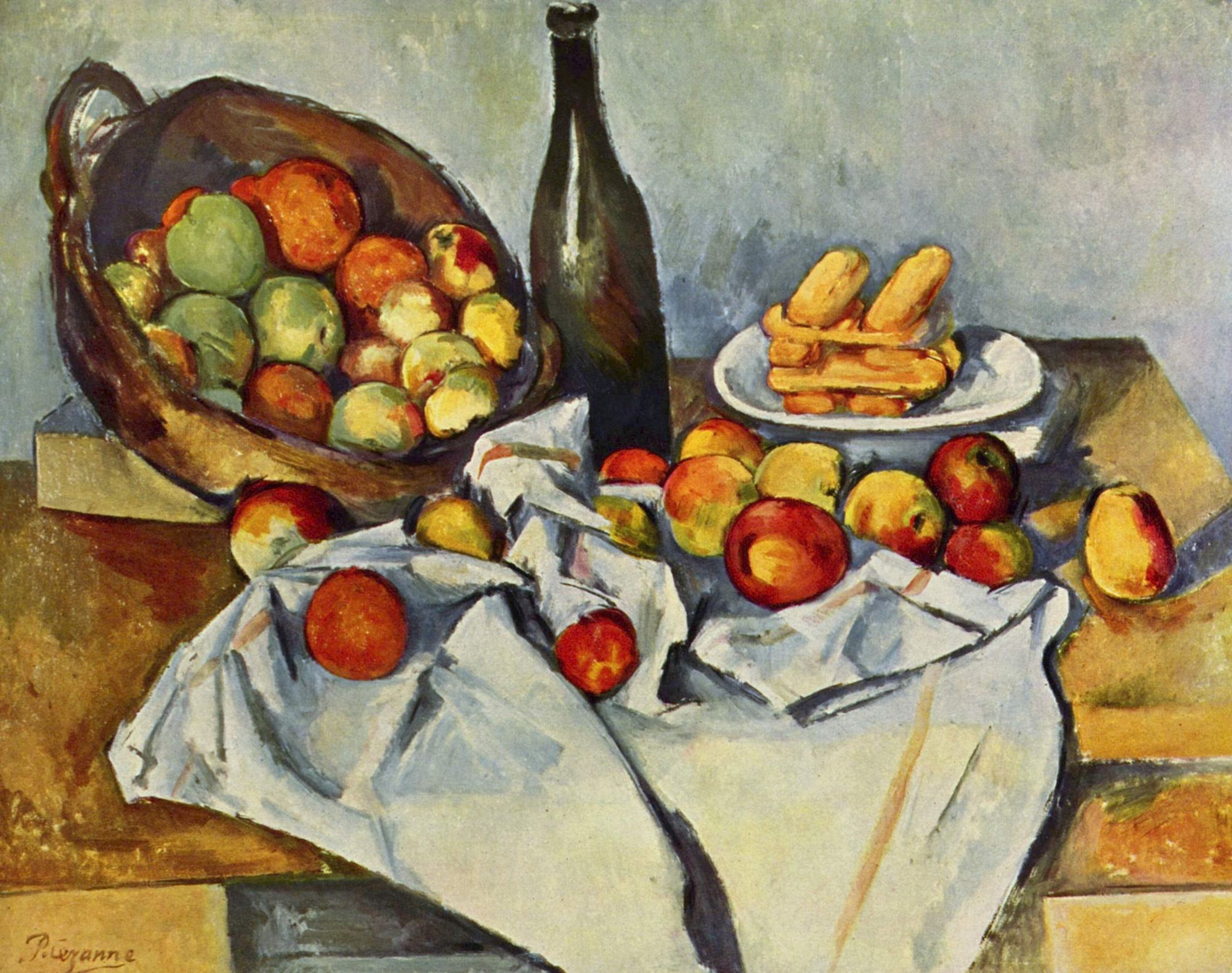
Paris saw The Basket of Apples in 1895, at a show mounted by the dealer Ambroise Vollard. It is one of Cézanne’s rare signed works, and that show was the first chance in nearly twenty years to see his paintings. The canvas is modest, 65 by 80 centimeters (about 26 by 32 inches).
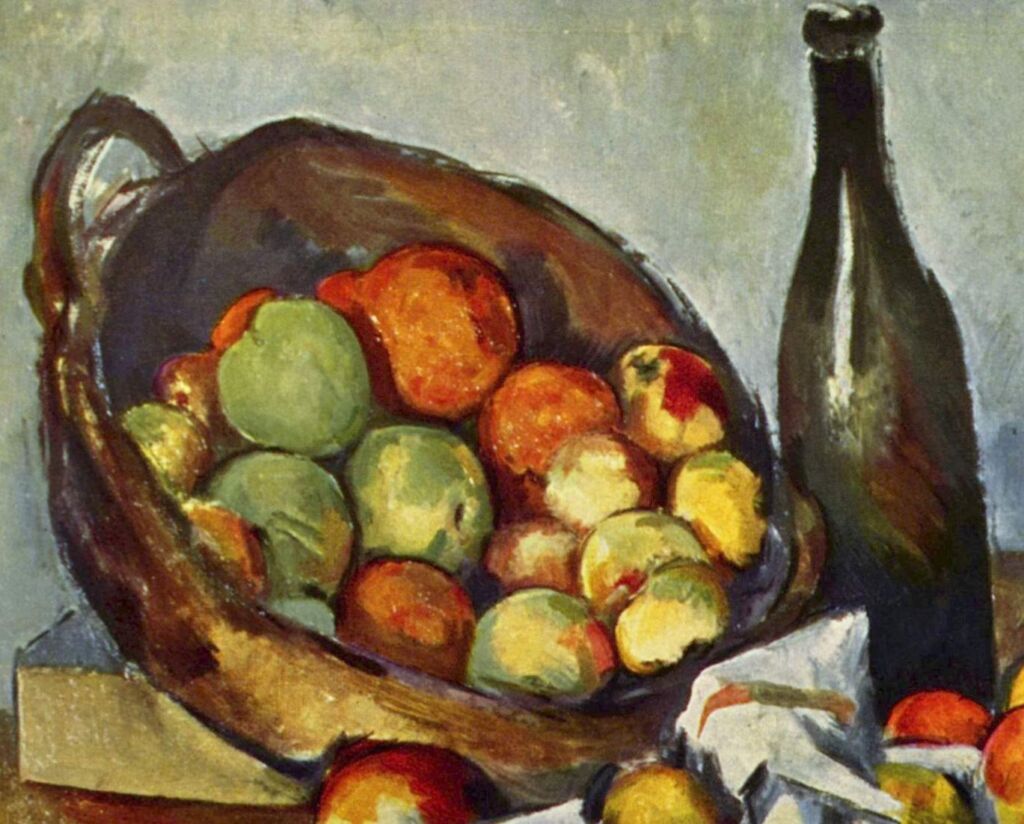
The Art Institute of Chicago calls the table “an impossible rectangle with no right angles.” The rest you can see for yourself: the bottle leans, the basket pitches forward, and the table edges on either side of the cloth refuse to line up. Yet nothing falls; the weight is held by heavy folds of cloth and dense, almost stony brushwork.
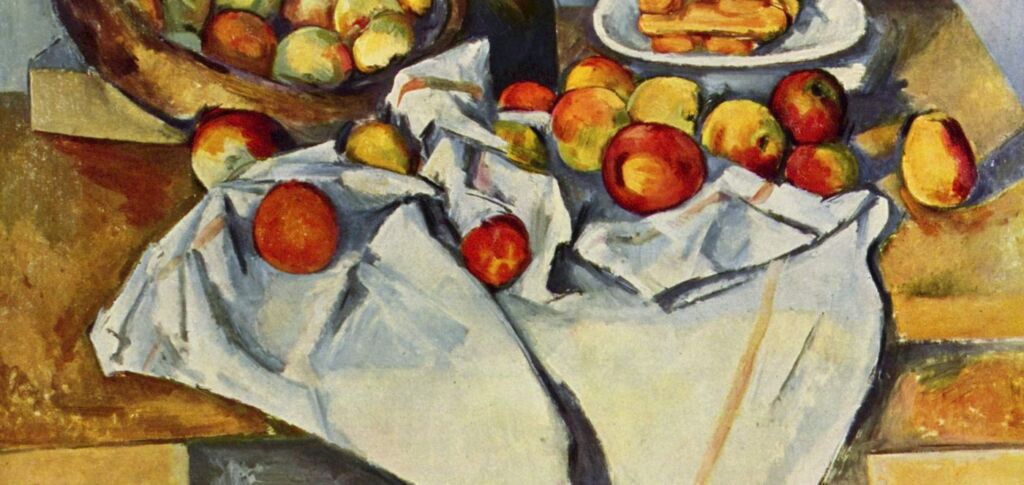
Claude Monet painted the light of a single minute; “Impressionism” itself was named after his Impression, Sunrise, a harbor at dawn. Cézanne cared about what lies beneath the light: volume, weight, the skeleton of a thing. In 1904 he told the young painter Émile Bernard to “deal with nature by means of the cylinder, the sphere and the cone.”
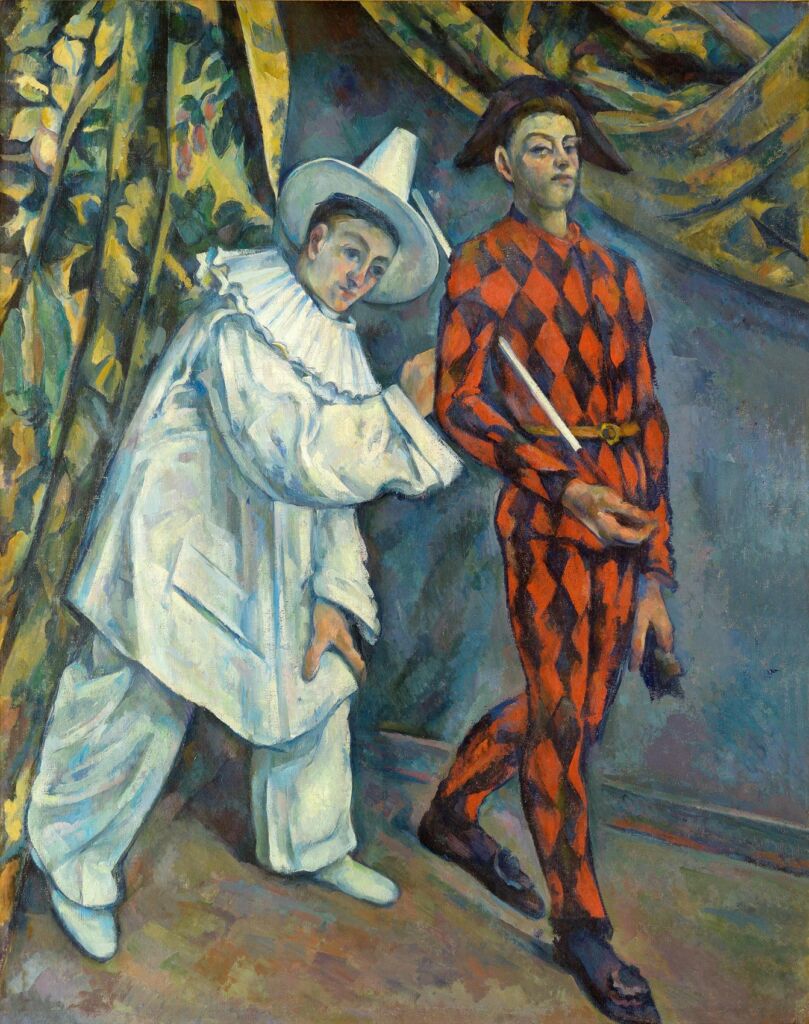
Moscow caught on early. The textile magnate Sergei Shchukin bought Pierrot and Harlequin in 1904, from the gallery of Paul Durand-Ruel. His fellow merchant Ivan Morozov began buying Cézanne in 1907, after the posthumous retrospective at the Salon d’Automne. Pierrot and Harlequin now hangs in the Pushkin State Museum of Fine Arts in Moscow.
Dot by dot
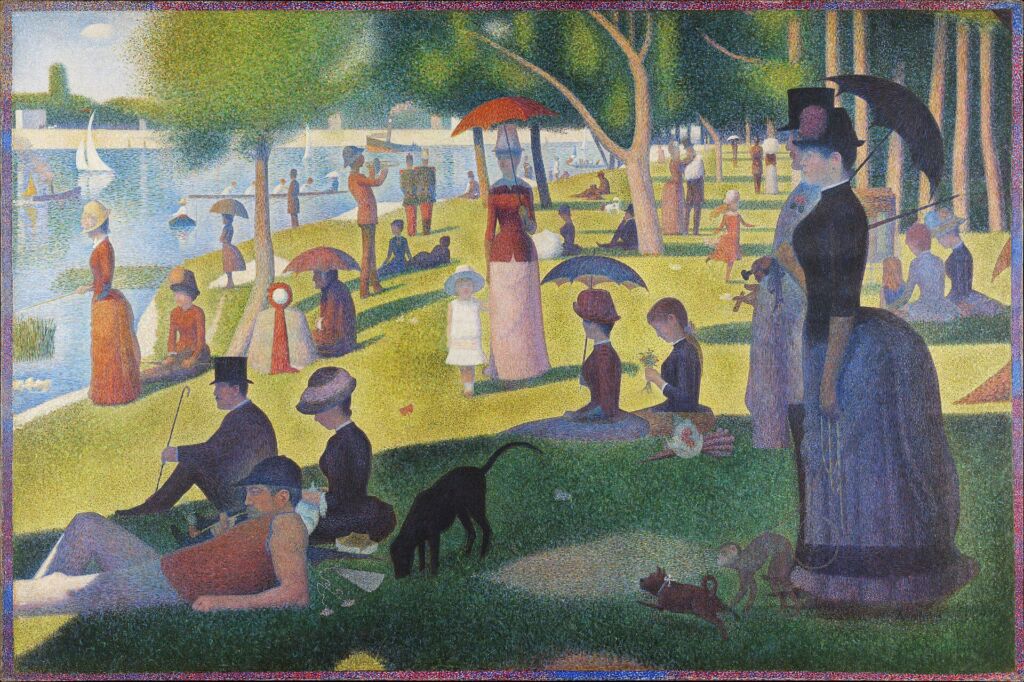
Seurat (1859–1891), the youngest of the four, went the opposite way from Van Gogh and Gauguin: toward system rather than feeling. He set tiny strokes of pure color side by side to mix in the viewer’s eye, later applying the method to scenes of leisure and even a circus under artificial light.
The method was called Neo-Impressionism, and more casually Pointillism, from the French point, a dot. His best-known picture, A Sunday on La Grande Jatte, debuted in 1886 at the last Impressionist exhibition. We have written about it and the lady with a monkey on a leash.
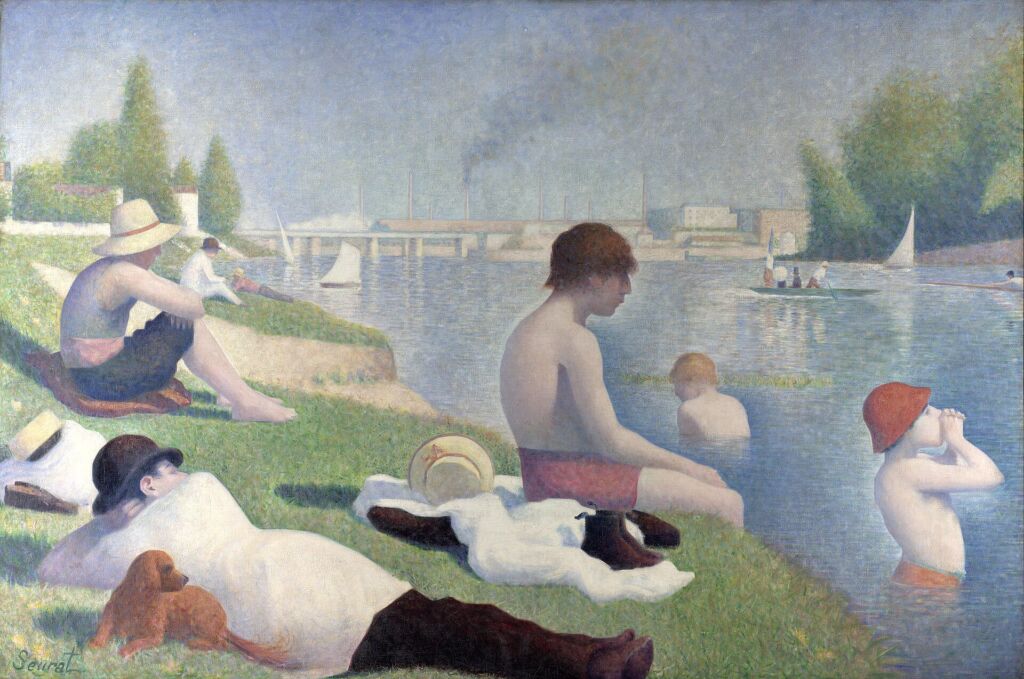
Bathers at Asnières, his first large painting, is three meters (nearly ten feet) wide. The Salon rejected it in 1884, so Seurat showed it at the new Salon des Indépendants. There are hardly any dots in it: the method came later.
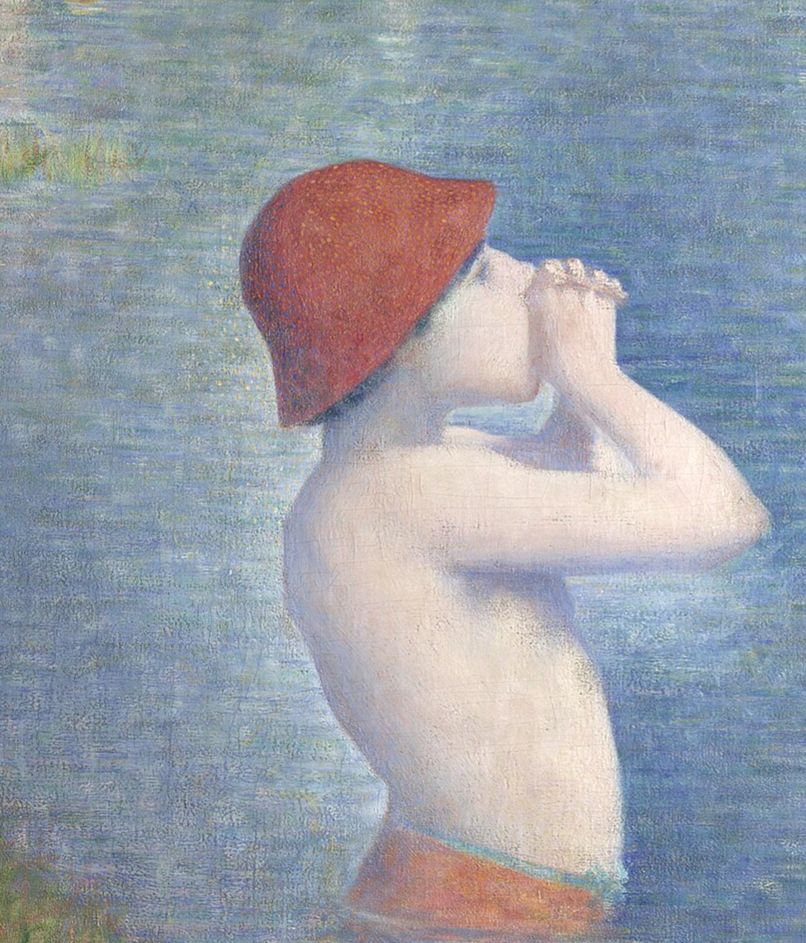
Once the method matured, Seurat returned to the canvas and reworked passages. The clearest example is the boy’s orange hat, redone in small touches of yellow and blue. Amid the smooth surface around it, the hat looks like a trial run of a new language.
Beyond the bridges smoke the chimneys of a gasworks and the factories of Clichy; the museum suggests some of the bathers may work there. Leisure here is as motionless as the bourgeois Sunday on La Grande Jatte: people side by side, each alone.
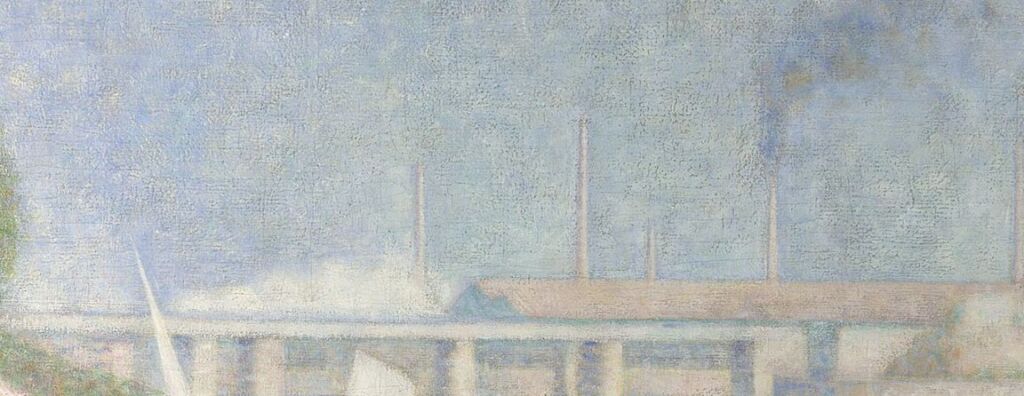
Seurat died at 31. At the Grafton Galleries he got little wall space: by scholars’ count, two works.
Red and green
Van Gogh (1853–1890) came to painting late and began with dark peasant scenes. He found bright color in Paris and pushed it to the limit in Arles: thick, fast, ringed with dark outlines. Later, in the asylum at Saint-Rémy, his lines would writhe and his perspective bend.
In early September 1888 he painted The Night Café, and on the 8th explained it to his brother Theo in a letter: “I have tried to express the terrible passions of humanity by means of red and green.”
That sentence is a manifesto. Color stops reporting how things looked and starts reporting how they felt. The room, in Van Gogh’s own words, is “blood red and dark yellow with a green billiard table in the middle,” and everywhere there is “a clash and contrast of the most alien reds and greens.”
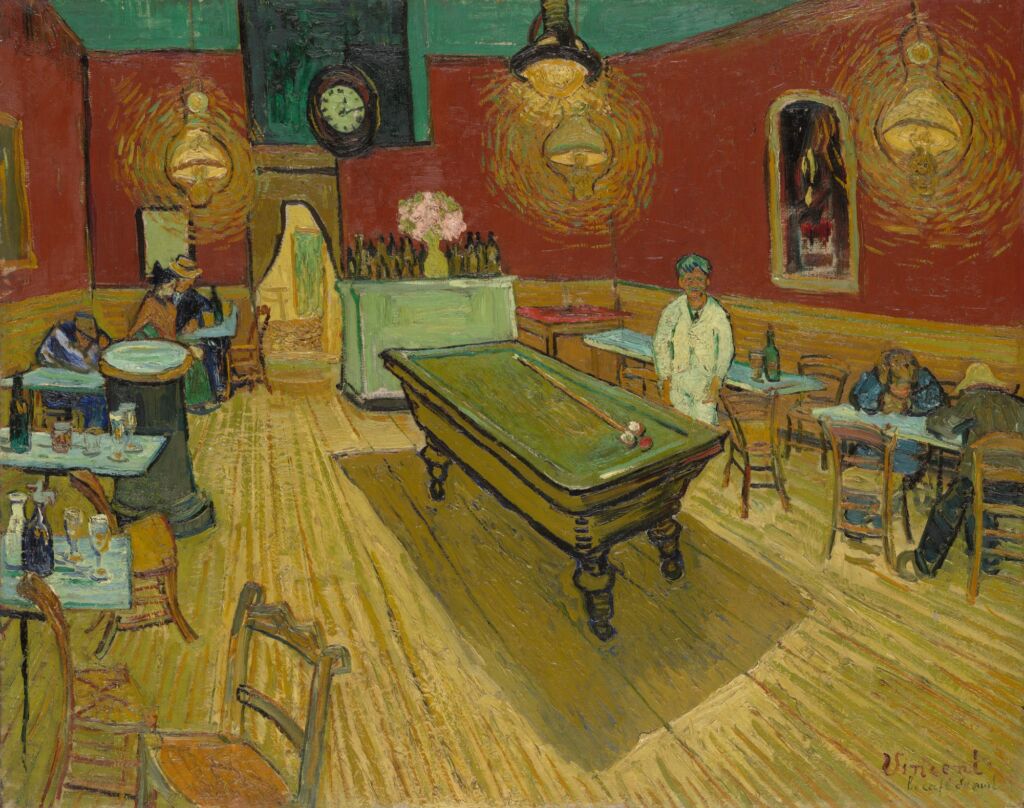
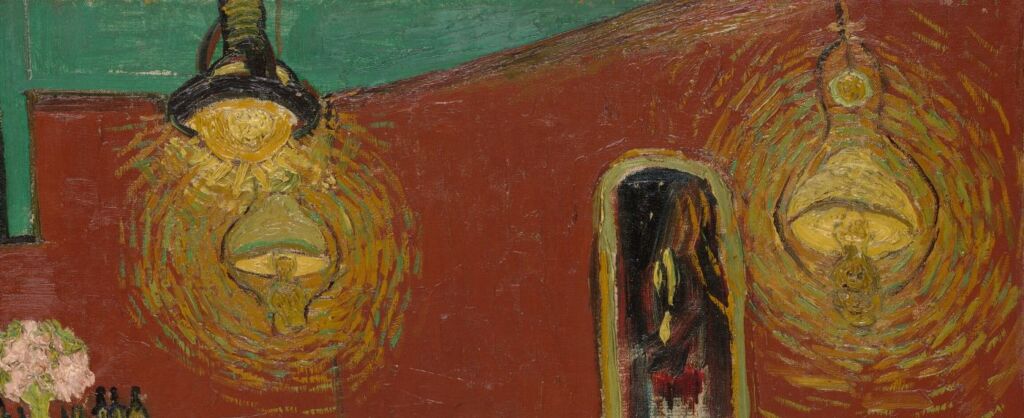
The light here does not illuminate; it presses down. Halos spread around the lamps, and less than a year later similar rings would swirl across the sky over Saint-Rémy in The Starry Night.
The Night Café traveled by way of Moscow. In 1908 Morozov bought it at the Golden Fleece exhibition there. After the revolution it went to the State Museum of New Western Art, and the Soviet state later sold it. Today it is at Yale, bequeathed by the American collector Stephen Carlton Clark.
Morozov’s great-grandson Pierre Konowaloff sued to recover it, arguing it had been taken from his family. Yale won: in 2016 the US Supreme Court declined to hear his appeal.
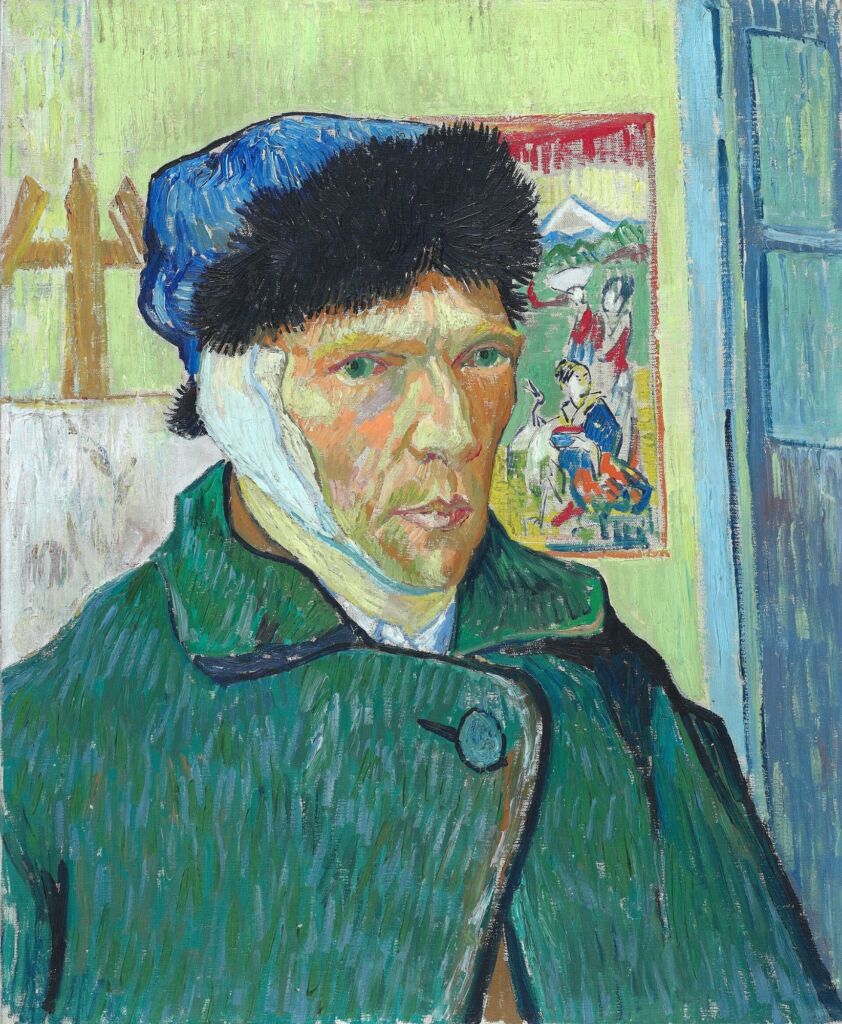
In October 1888, weeks after The Night Café, Gauguin arrived in Arles. Their partnership ended in December with Van Gogh’s breakdown and the cut ear, a story finally pinned down by a sketch from Dr. Félix Rey.
A fight on red grass
Gauguin (1848–1903) started beside the Impressionists, but in 1888, in the Breton village of Pont-Aven, he and Émile Bernard found another road: flat patches of color, hard outlines and a subject the painter cannot see. He renounced “the abominable error of naturalism” and looked for a simpler, more spiritual kind of painting.
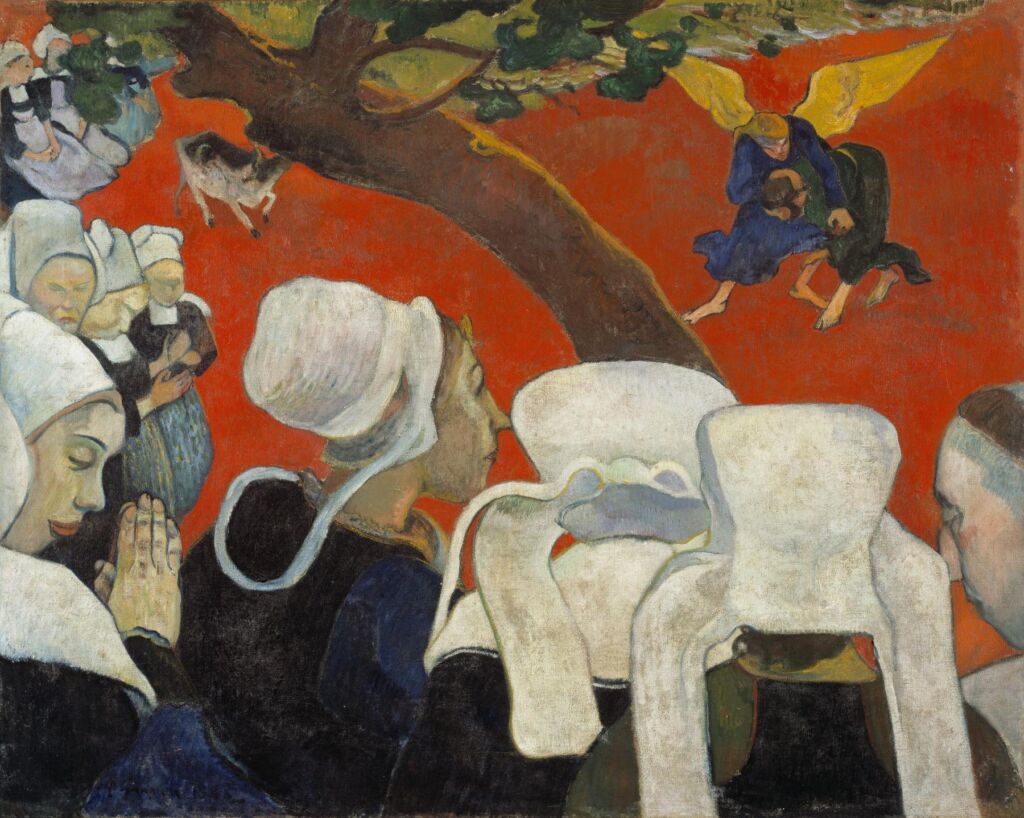
Breton women have just heard a sermon on Jacob wrestling with the angel. Gauguin wrote to Van Gogh: “For me the landscape and the fight only exist in the imagination of the people praying after the sermon.” Hence the red grass: it does not grow in Brittany, only in visions.
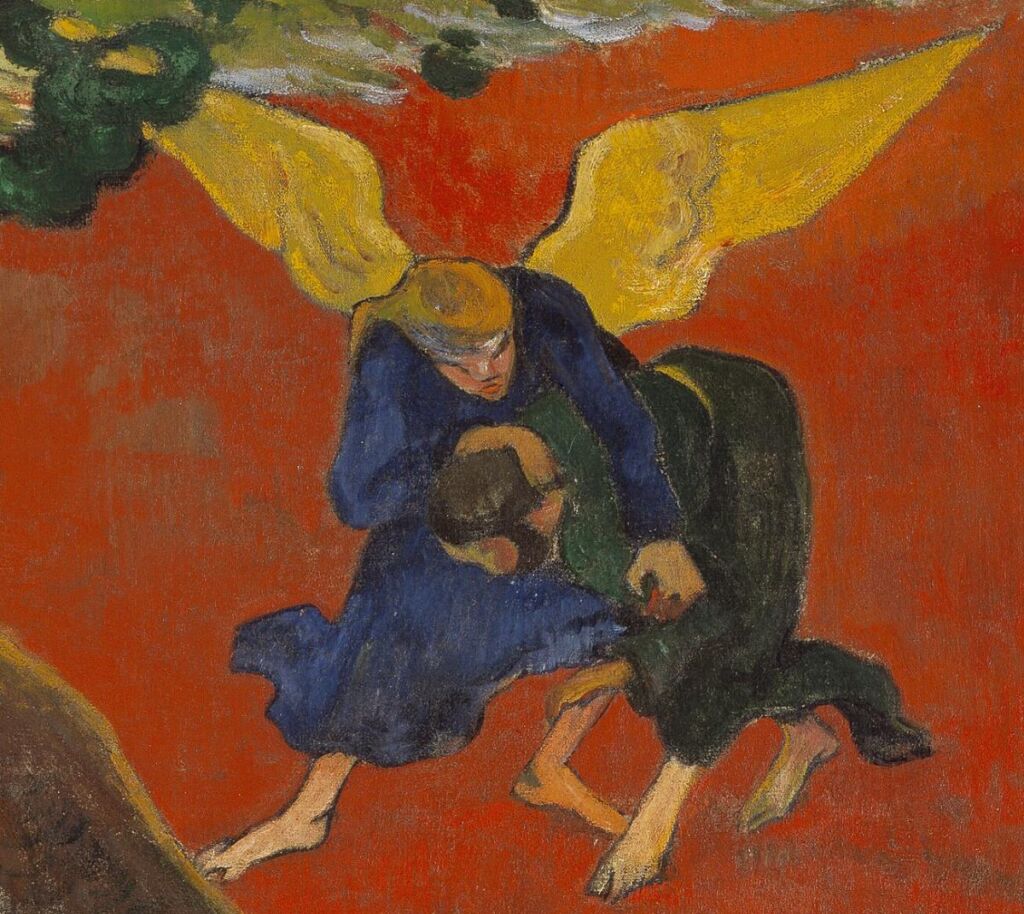
A canvas of about 72 by 91 centimeters (28 by 36 inches) holds both the women and the miracle. It is often called the starting point of Symbolism in painting. Only the women in white caps see the struggle; we watch not an event but someone else’s faith in it. Edinburgh bought the picture in 1925.
A green face at the edge of the canvas
Henri de Toulouse-Lautrec (1864–1901) does not always make the list, but Fry’s term usually stretches to include him. He took the Impressionists’ bright, contrasting color but laid it flat within a supple line, like a poster. His Paris is nighttime Montmartre, its cabarets and dance halls.
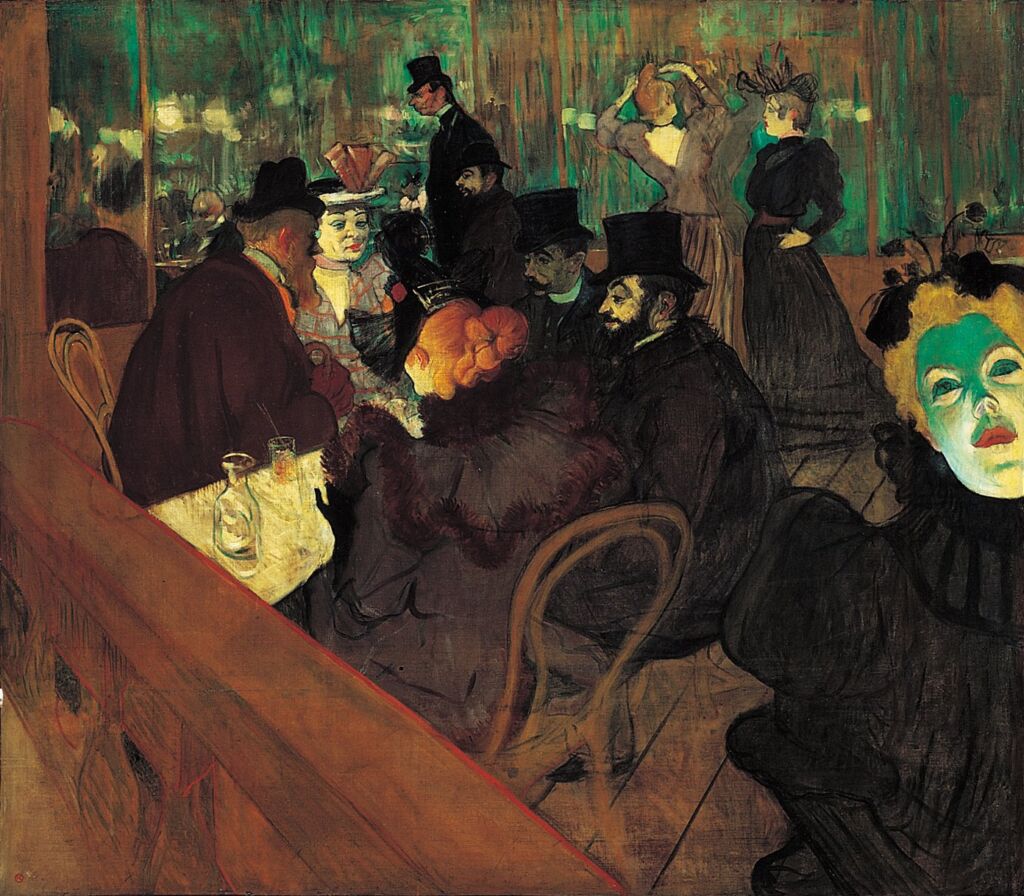
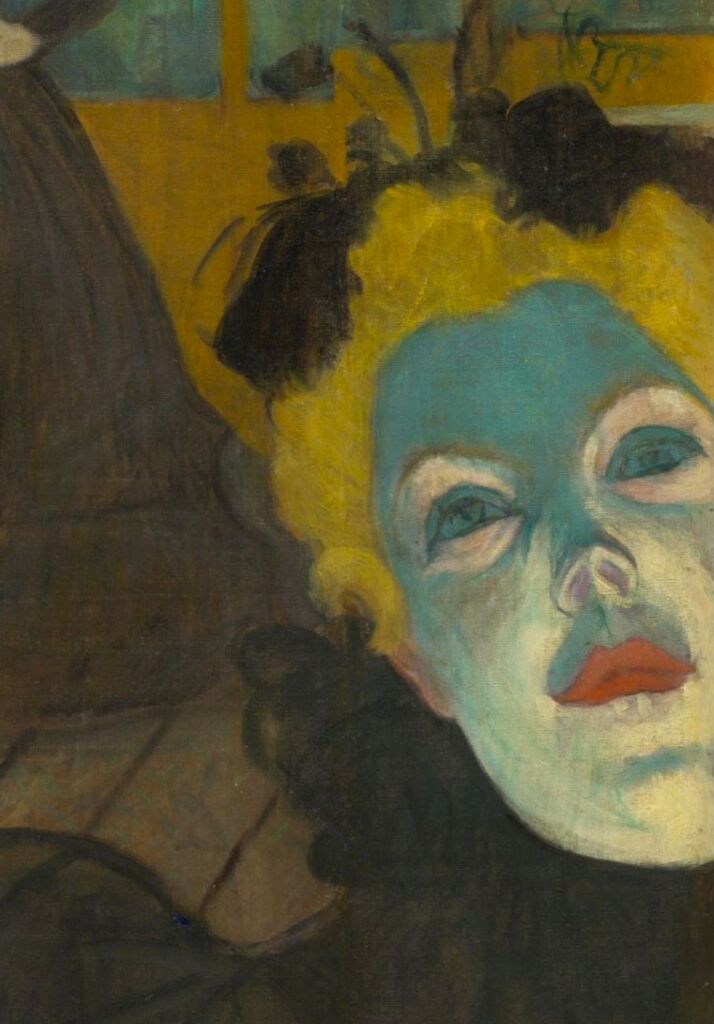
From the right edge the singer May Milton peers in, her face, in the museum’s words, “acid green.” At some point the strip of canvas bearing her was cut off, by the artist or his dealer, perhaps because such a face made the picture hard to sell. By 1914 it had been put back.
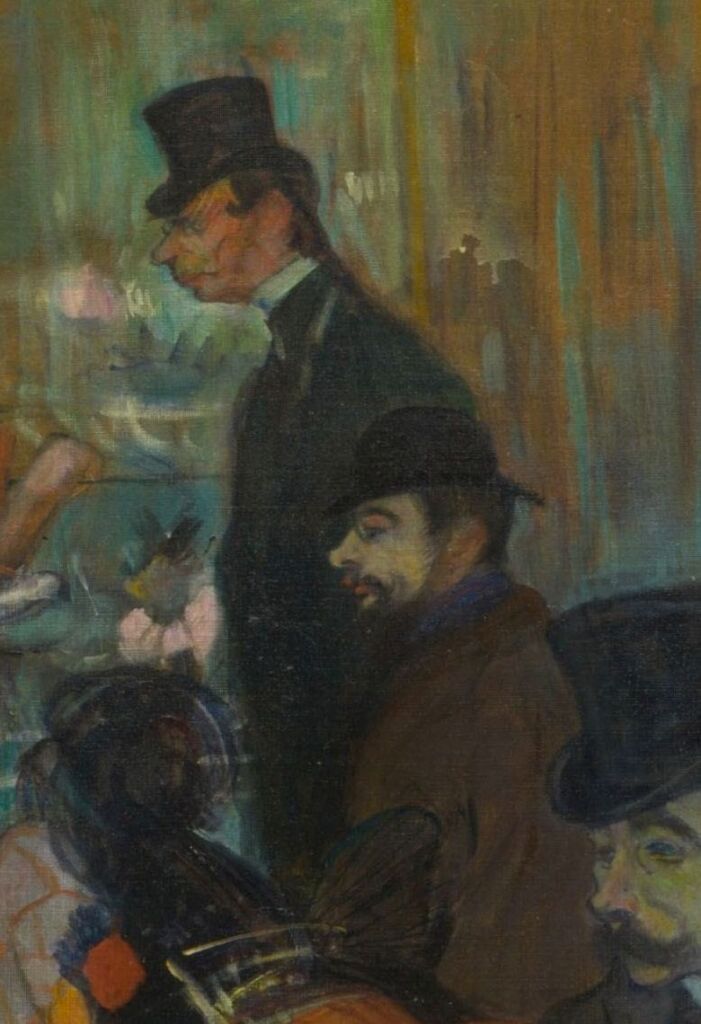
At the back Lautrec painted himself: a small figure beside his cousin, the doctor Gabriel Tapié de Céleyran. The artist watches this world from the inside, as a regular.
Tahiti, Moscow and a single word
In 1891 Gauguin sailed for Tahiti; he returned to Paris, then left again for good and died on Hiva Oa in the Marquesas Islands, some 1,500 kilometers (about 900 miles) from Tahiti.
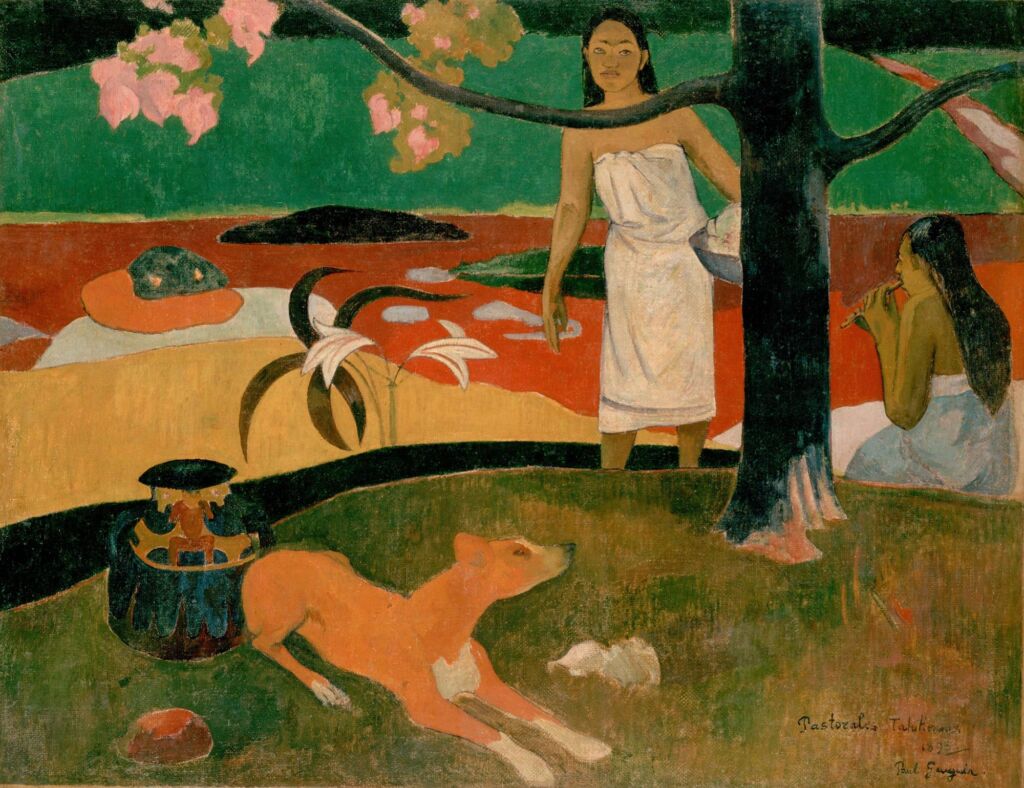
Tahitian Pastorals dates from that first stay. Ivan Morozov, who collected Gauguin on a grand scale, bought it, and today it is in the Hermitage.
Shchukin and Morozov were buying these painters while London laughed. In 1918 both collections were nationalized, later merged into one museum, and in spring 1948 that museum was closed as “formalist,” its holdings divided between the Pushkin Museum and the Hermitage. That is why their Gauguins are split between Moscow and St Petersburg.
Back in London, the scandal did not stop the show: part of it went on to Dublin and Liverpool in 1911. When a second Post-Impressionist exhibition opened at the Grafton Galleries in 1912, it had a Russian section, introduced by the mosaicist Boris Anrep.
They had one thing in common: all four came out of Impressionism, and none of them wanted to stay there.
The painters never used the word: by 1910 all four were dead. Coined after the fact, the term stays honest; it never promised a shared style.
One went to apples, another to dots, a third to color that shouts, and the fourth to the other side of the world.
Comments
For Hroniki readers
Comments are open to readers with an account. Signing up is free and takes a few seconds.
No comments yet. Start the conversation.