Cézanne’s Card Players: what Qatar paid for the last one in private hands
Cézanne painted five Card Players. Four have long been in museums; the fifth was sold to Qatar by a Greek shipping magnate's heirs. The price was never confirmed: all we have are press reports.
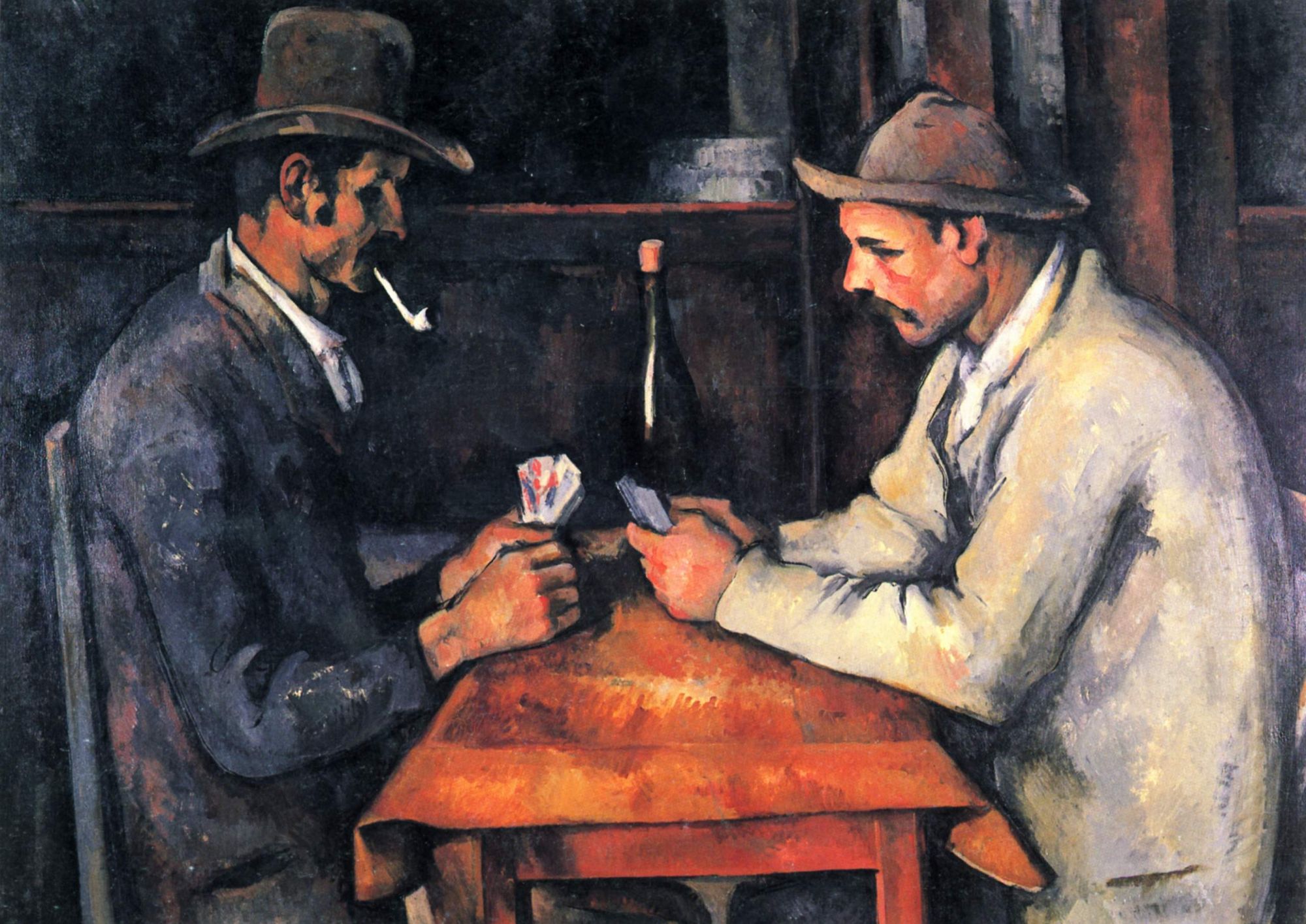
In February 2012, Vanity Fair revealed a deal kept quiet for about a year: the heirs of the Greek shipping magnate George Embiricos had sold Paul Cézanne’s The Card Players to the royal family of Qatar. The reported price: more than $250 million. No one has ever officially confirmed it.
The painting in that deal is one of five. Cézanne returned to the subject for several years in the 1890s, and four canvases have long been in museums. The fifth, the largest of the two-man versions, was until 2011 the only one still in private hands.
Five tables, four museums
The series falls into two groups. In two, three men play while onlookers stand by. In the other three, two players face each other across the table.
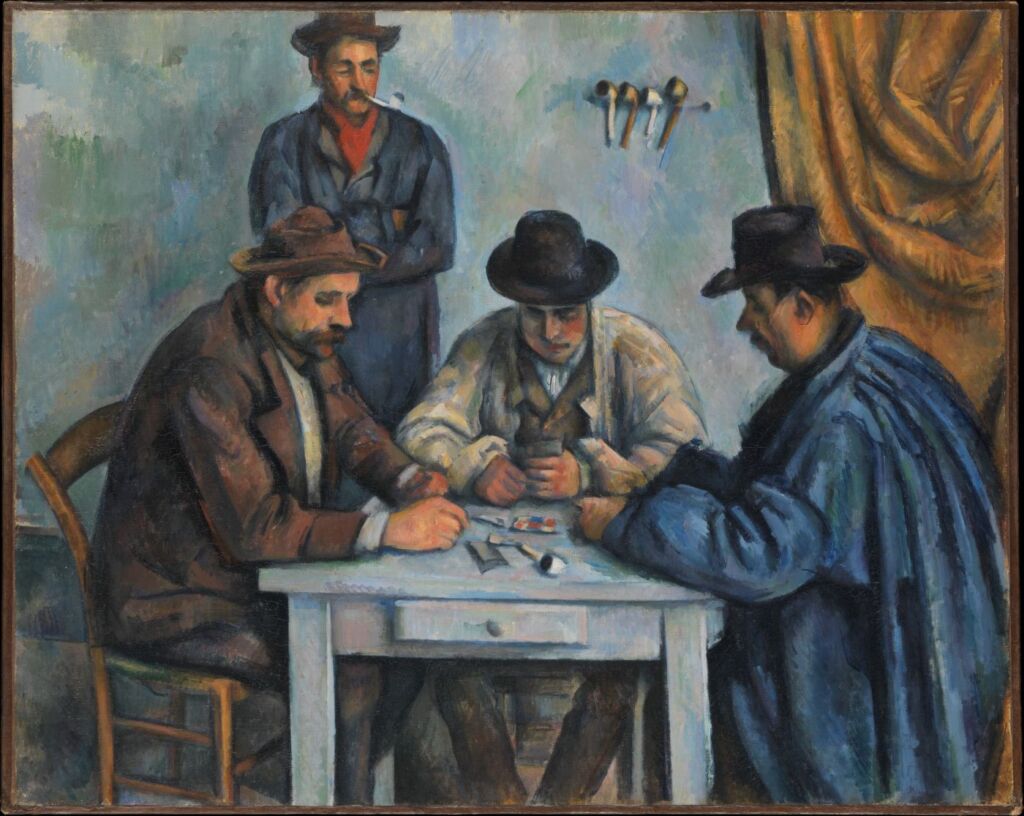
The Metropolitan Museum of Art describes its canvas as the first in the series: four men, three of them playing. Cézanne built the composition from figure studies of local farmhands. Stephen C. Clark bequeathed it to the museum in 1960.
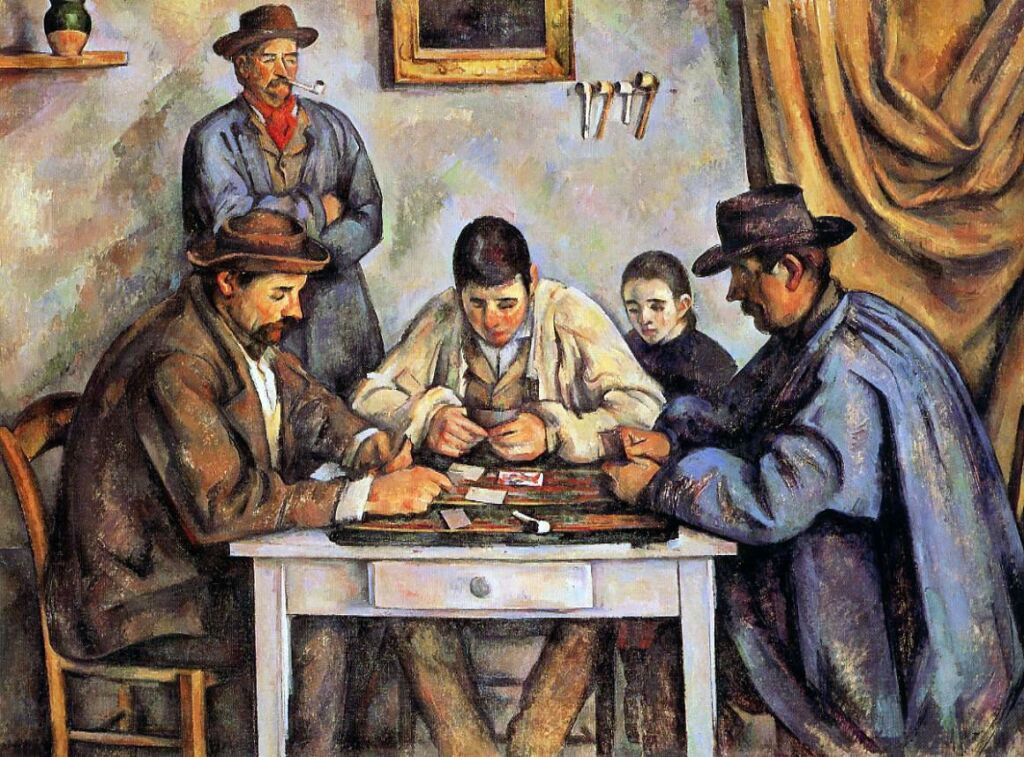
The largest version, about 135 × 181 cm (roughly 4½ by 6 feet), belongs to the Barnes Foundation in Philadelphia. The scene is nearly the same, but with five figures: a child appears behind the shoulder of the player on the right.
The London two-player version belongs to the Courtauld Gallery; Samuel Courtauld bought it in 1929. The gallery’s label puts the players in grand company: “They are the human equivalents of the painter’s views of Mount Saint Victoire: timeless, monumental and resolutely Provençal.” Two farmhands at a table, ranked with the great mountain of Provence.
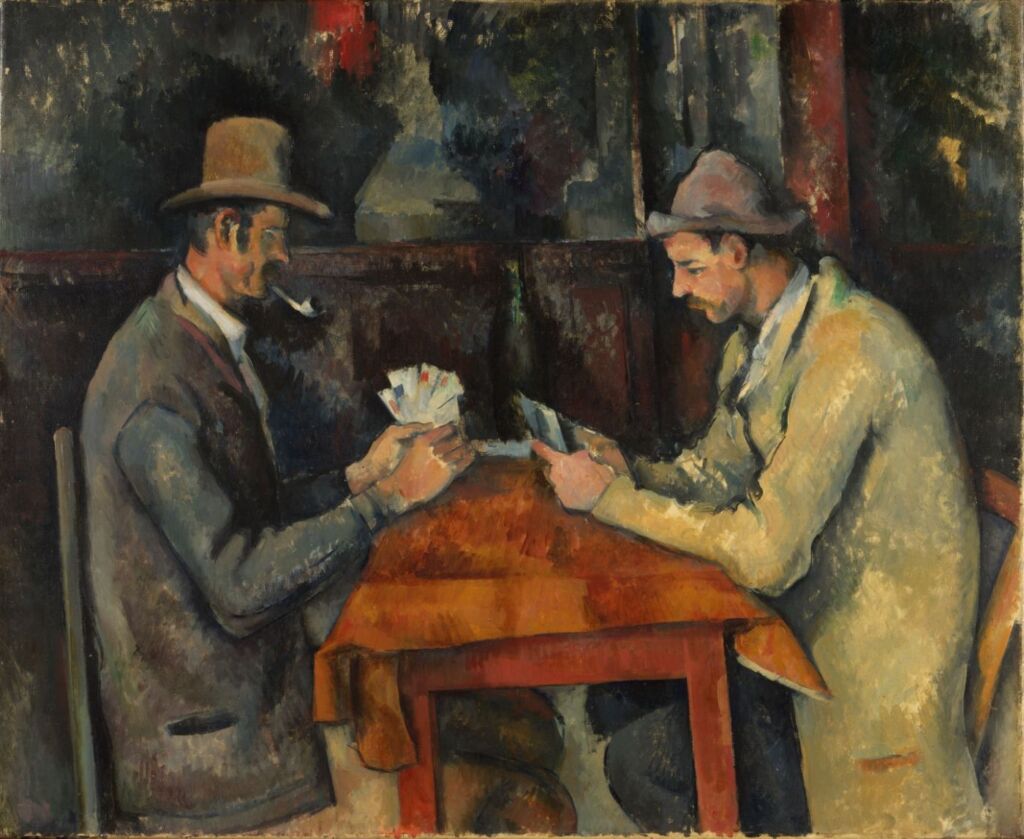
The smallest, 47.5 × 57 cm, is at the Musée d’Orsay. Count Isaac de Camondo left it to the Louvre in 1911. Technically it still belongs to the Louvre; it has hung at the Orsay since 1986.
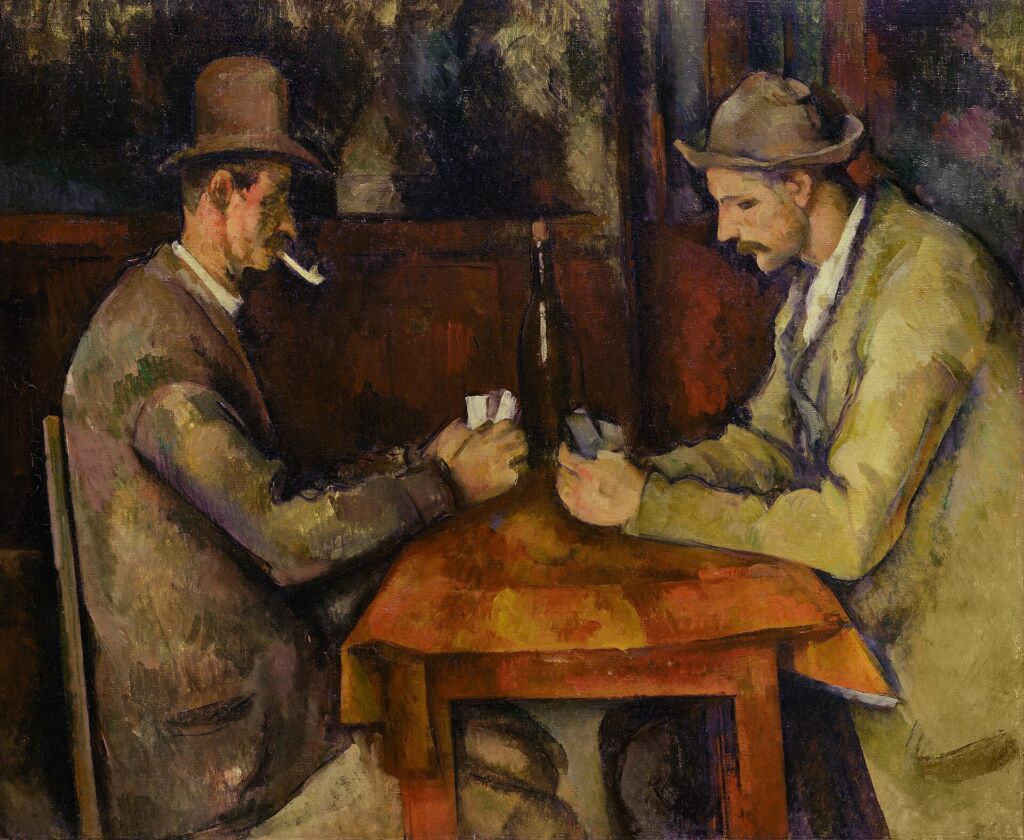
None of the five has a firm date, and within each group the order has long been disputed. Technical studies by the Met and the Courtauld found that, contrary to most scholarly opinion, the smaller canvases came first.
The models from Jas de Bouffan
In 1891 the writer Paul Alexis found Cézanne painting a local farmhand at the Jas de Bouffan, the family estate outside Aix-en-Provence. It is the first mention of the series. Estate workers posed, among them an old gardener, Père Alexandre. Paulin Paulet, who posed for three peasant portraits, was paid five francs, according to the Courtauld Gallery.
The workers often posed with clay pipes; Cézanne’s smokers from the same years hang in the Hermitage in St Petersburg and the Pushkin Museum in Moscow.
Cézanne probably knew the subject from his youth: the museum in Aix owned a Card Players attributed to the Le Nain brothers, as the Musée d’Orsay points out. Where that picture trades in glances and gestures, Cézanne paints bulky figures wholly absorbed in the game.
Fitting such figures around one table was not easy. On the New York canvas, Cézanne never finished the hand of the player on the right; it had defeated him in the drawings, too.
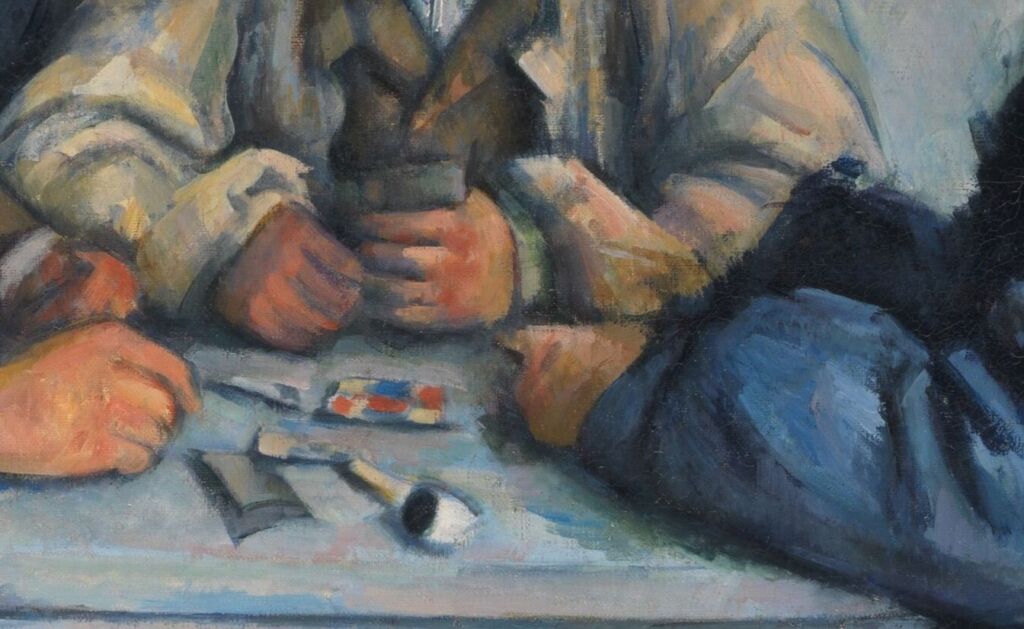
At first these canvases came cheap. The dealer Ambroise Vollard bought the picture now at the Met for 250 francs, according to Smarthistory, and sold it in early 1900 for 4,500.
A sale that surfaced a year later
George Embiricos (1920–2011) would not lend his painting to anyone, according to the Vanity Fair writer Alexandra Peers. The Courtauld and Met exhibition of 2010–2011 brought together the London, New York and Paris canvases. The private one was not among them.
Sale talks, according to Vanity Fair, began shortly before Embiricos died and were completed by his heirs. The dealers William Acquavella and, reportedly, Larry Gagosian offered upward of $220 million, but Qatar outbid them. Other outlets cited up to $300 million; neither buyer nor sellers confirmed any figure.
Even the lowest of those numbers was more than twice the auction record of the day: about $106 million for Picasso’s Nude, Green Leaves and Bust. The series’ arithmetic explains part of it: with four versions in museums, this was the only Card Players anyone could buy. In an interview with NPR, Peers said that “many people had been chasing this painting for years.” As for why it matters: “when everybody else was painting rich socialites and landscapes, Cezanne decided peasants were important.”
Qatar had bought big before. In the same interview Peers mentioned a Mark Rothko from the Rockefeller collection, which the royal family bought at Sotheby’s in 2007 for about $73 million. But she called the Card Players “the big jewel.”
Comparable sums have surfaced since: in 2015 Willem de Kooning’s Interchange reportedly changed hands privately for about $300 million. Since 2017 the auction record has belonged to Leonardo’s Salvator Mundi: $450.3 million. The Card Players sits outside such rankings, among private sales whose prices no one has officially confirmed.
Cézanne paid Paulin Paulet five francs. What the two peasants at the table finally cost, only the buyer and the Embiricos heirs know.
Comments
For Hroniki readers
Comments are open to readers with an account. Signing up is free and takes a few seconds.
No comments yet. Start the conversation.