Why did Turner put the masts back on the Fighting Temeraire?
The Temeraire reached the breakers' yard without masts, behind two tugs, hours before sunset. Turner, who may not even have been in England, painted something else.
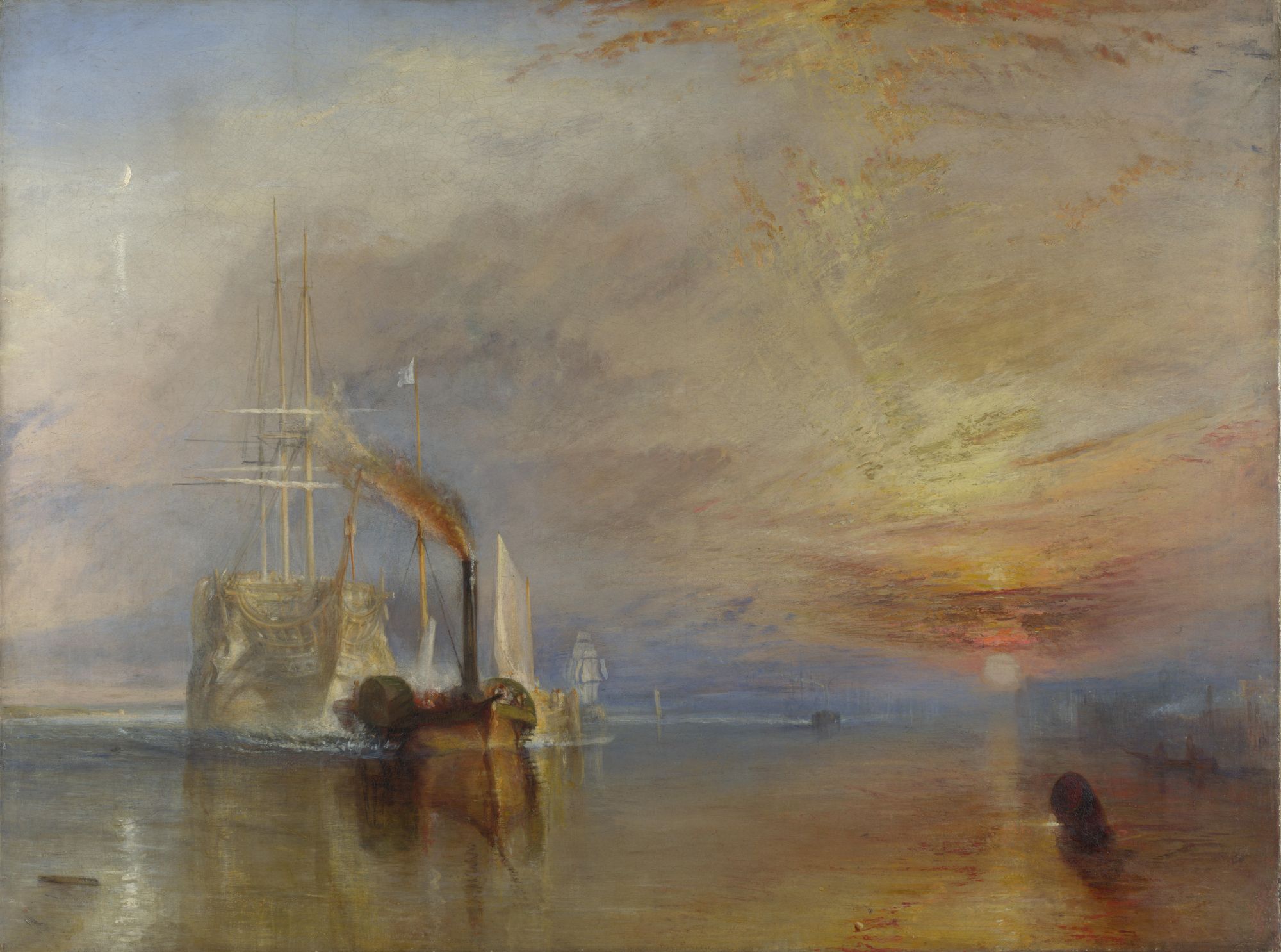
On September 6, 1838, the old warship Temeraire was towed up the Thames to a breakers’ yard at Rotherhithe. The Fighting Temeraire, which Turner showed at the Royal Academy the next spring, changes almost everything he could have read about that day. Most of the changes look deliberate.
A tow in the wrong light
The painting’s full title is The Fighting Temeraire tugged to her last berth to be broken up, 1838, and the adjective was earned. At Trafalgar in 1805 the 98-gun Temeraire sailed immediately astern of Nelson’s Victory. When the French Redoutable threatened to board the flagship, the Temeraire fired into her, then turned on the Fougueux and took both ships as prizes.
Thirty-three years later the Admiralty had no use for her. That August she was sold at auction to John Beatson, a Rotherhithe shipbreaker, for £5,530, little more than the worth of her wood. Her masts came down at Sheerness before the end of the month.
The tow from Sheerness to Beatson’s wharf took two days. He hired two steam tugs, the London and the Samson: one pulled, while the other probably worked astern as a brake. She was most likely moored at the wharf before three in the afternoon, hours before sunset.
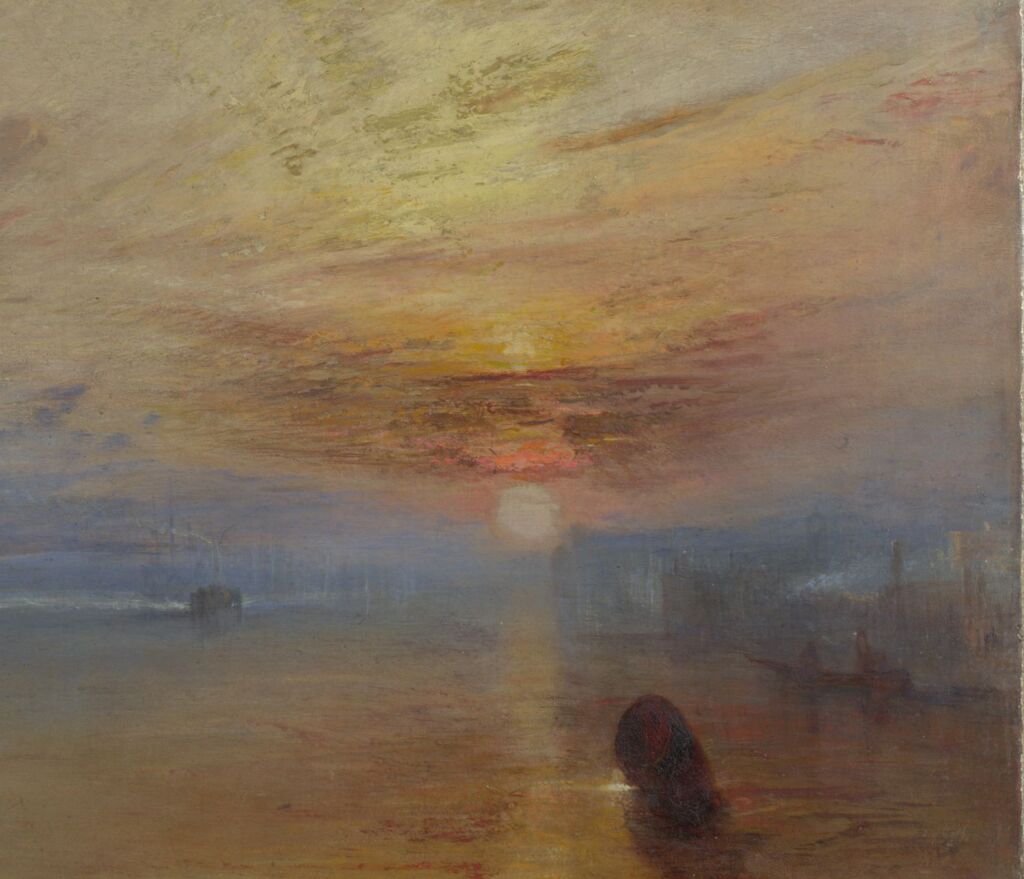
Turner’s blazing sunset is wrong in direction as well as in time. A ship coming upriver heads west; an evening sun could not sink behind her. In 1877 the critic James Dafforne noticed that Turner’s sun sets in the east, and then excused him: “the true points of the compass occupied no place in the artist’s mind.”
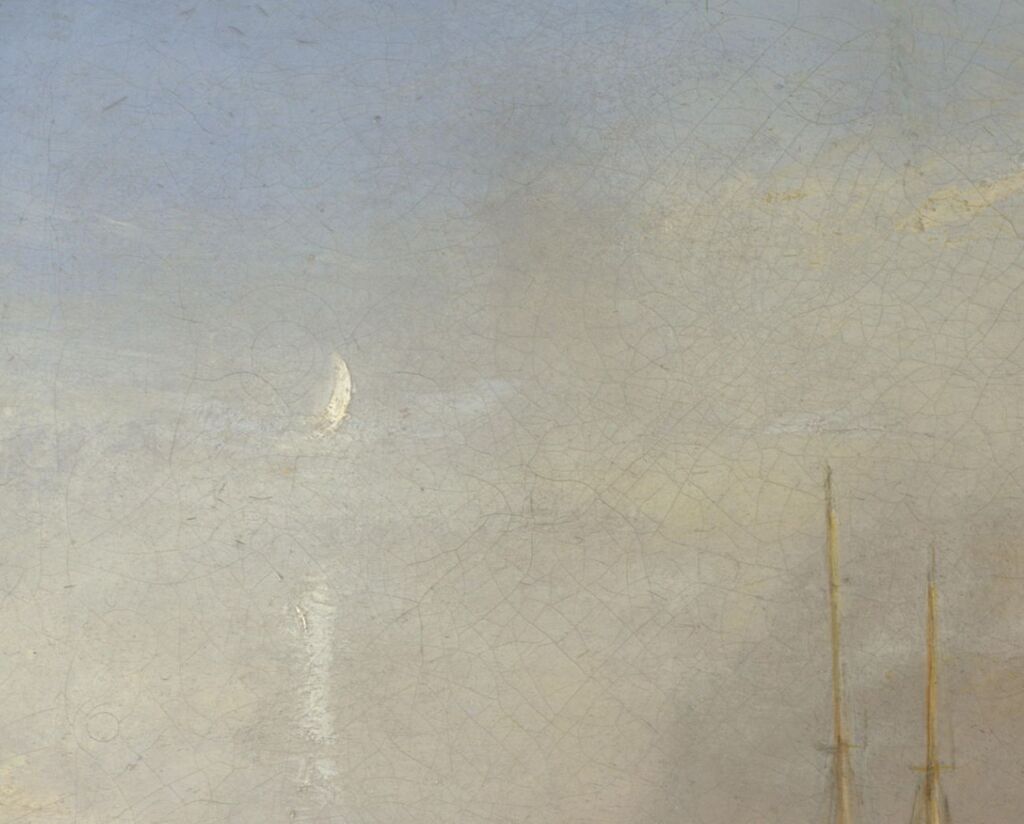
Even the sky above is edited. Beatson had waited for the full moon of September 4 and its spring tides, so the tow began the next day. Turner painted a thin crescent instead, a motif he used again in Modern Rome, shown at the same exhibition.
Turner worked from the newspapers
None of this required an eyewitness, and Turner probably was not one. Stories told after his death placed him at Greenwich with the painter Clarkson Stanfield, at Blackwall or on a Margate steamer. The National Gallery treats them as legends; Turner may not even have been in England that September.
The curator Ian Warrell, writing in Apollo, thinks Turner was probably far away on the Mediterranean coast. Géricault tracked down survivors for The Raft of the Medusa; Turner seems to have worked from newspaper reports in the Shipping and Mercantile Gazette and The Times.
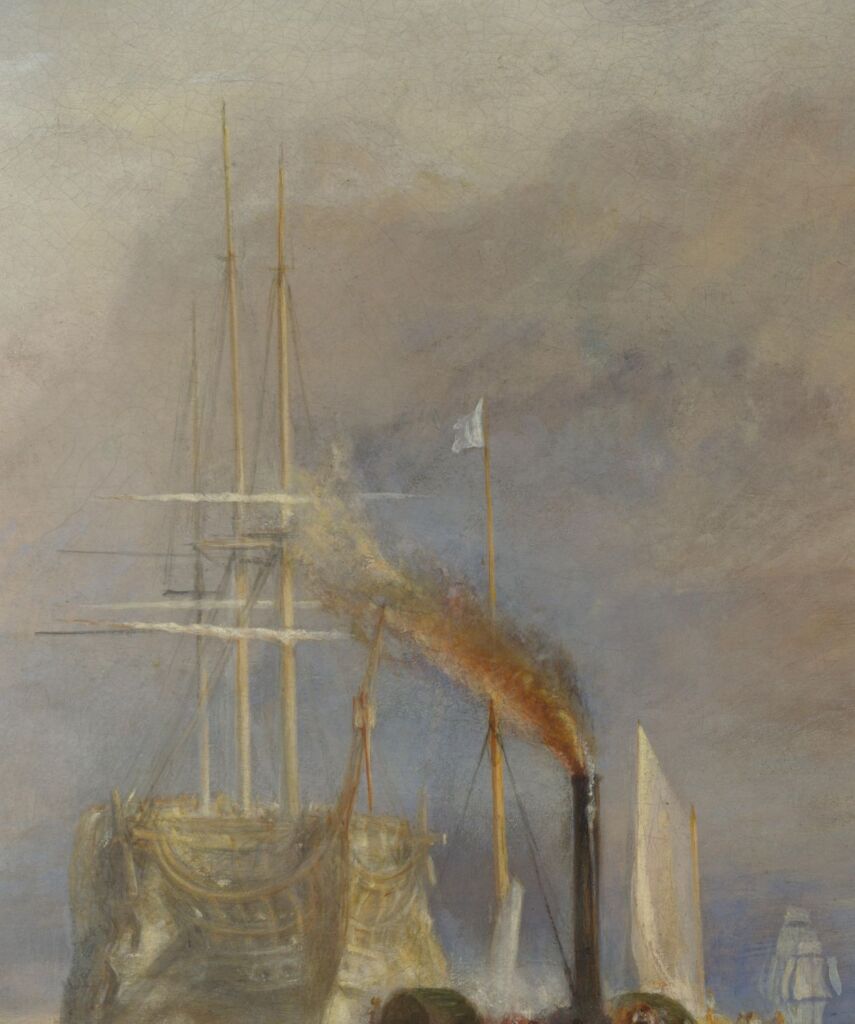
The boldest change is the rigging. Turner gave the Temeraire back her three lower masts, with sails furled, as if she might still put to sea. Some later writers claimed temporary masts had been rigged for the tow. The catalogue finds no evidence of it, and the Turner scholar Eric Shanes called the idea “risible.”
He also pushed the second tug into the distance, where it is barely visible. One small, dark steamer now does all the work, and the old warship looks even larger behind it. In the catalogue’s words, she “ceased to be a ship of the Royal Navy” the moment the gavel fell, so Turner left the flagpole at her bow empty.
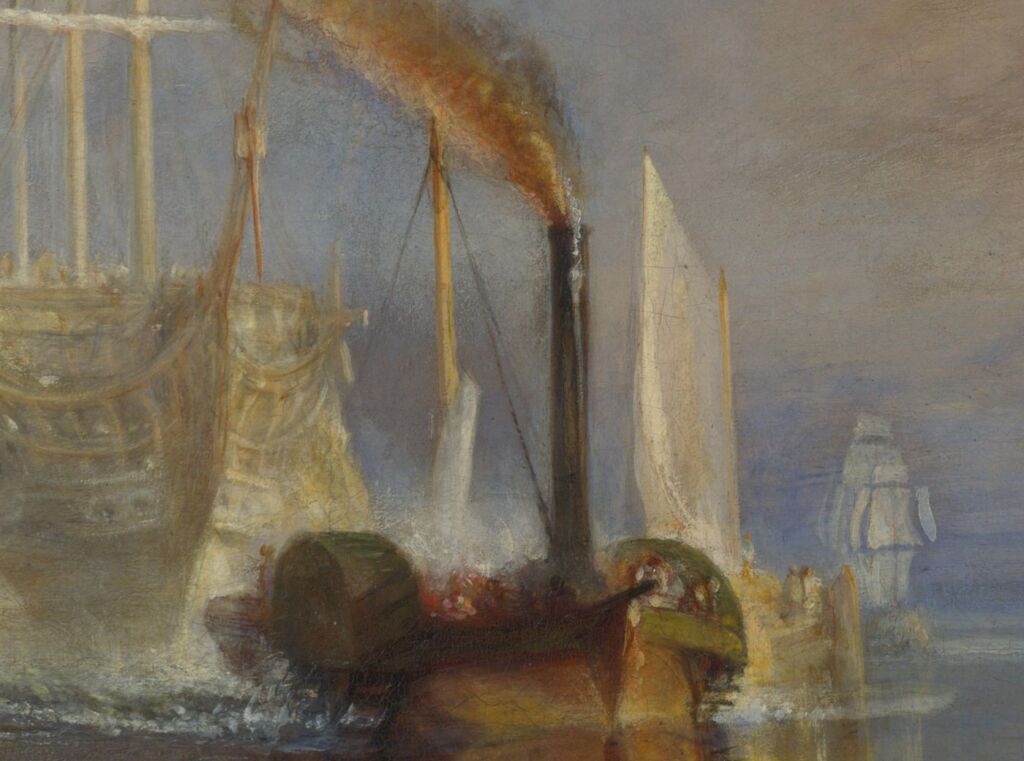
Then there is the funnel. Turner set it in front of the tug’s mast; Warrell notes that the mast is “positioned inaccurately (and dangerously)” behind it, so the smoke streams back toward the warship. Turner knew perfectly well how steamers were built.
He defended the choice. When J. T. Willmore’s engraving of 1845 shortened the funnel and moved it back, reducing the long plume to a short burst, Turner was reported to be in a “paroxysm of wrath.” By the 1851 reprint the plate had been changed back to Turner’s design.
Turner would not lend his darling again
The Royal Academy audience of 1839 read the picture at once. In the exhibition catalogue Turner paired it with lines adapted from Thomas Campbell’s “Ye Mariners of England”: “The flag which braved the battle and the breeze, / No longer owns her.” William Makepeace Thackeray, reviewing in Fraser’s Magazine, called the tug “a little, spiteful, diabolical steamer.”
Turner kept the canvas in his own gallery. Around 1845, drafting a reply to a loan request in pencil, he wrote that “no consid[eratio]ns of money or favour can induce me to lend my Darling again.”
Money was tried anyway. The American collector James Lenox reportedly offered £5,000, then a blank check. Turner refused; according to the painter C. R. Leslie, he intended to leave the picture to the nation.
He did. The Fighting Temeraire came to the National Gallery with the Turner Bequest after his death and was among the first of those pictures put on show. Today it hangs in Room 40, an oil on canvas measuring 90.7 by 121.6 centimeters.
In 2005 a poll run by BBC Radio 4’s Today program with the National Gallery named it the greatest painting in Britain, with more than a quarter of the votes; Constable’s The Hay Wain came second.
Since February 2020 the ship has also traveled in wallets, on the back of the polymer £20 note beside Turner’s youthful self-portrait: three masts, one tug and a sunset in the east.
Comments
For Hroniki readers
Comments are open to readers with an account. Signing up is free and takes a few seconds.
No comments yet. Start the conversation.