Under the yellow, gray: what restorers found on Liberty’s dress
Delacroix did not fight on the barricades of July 1830; he painted them. The French state bought the canvas for 3,000 francs, put it in storage a couple of years later, and let it into the Louvre only in 1874.
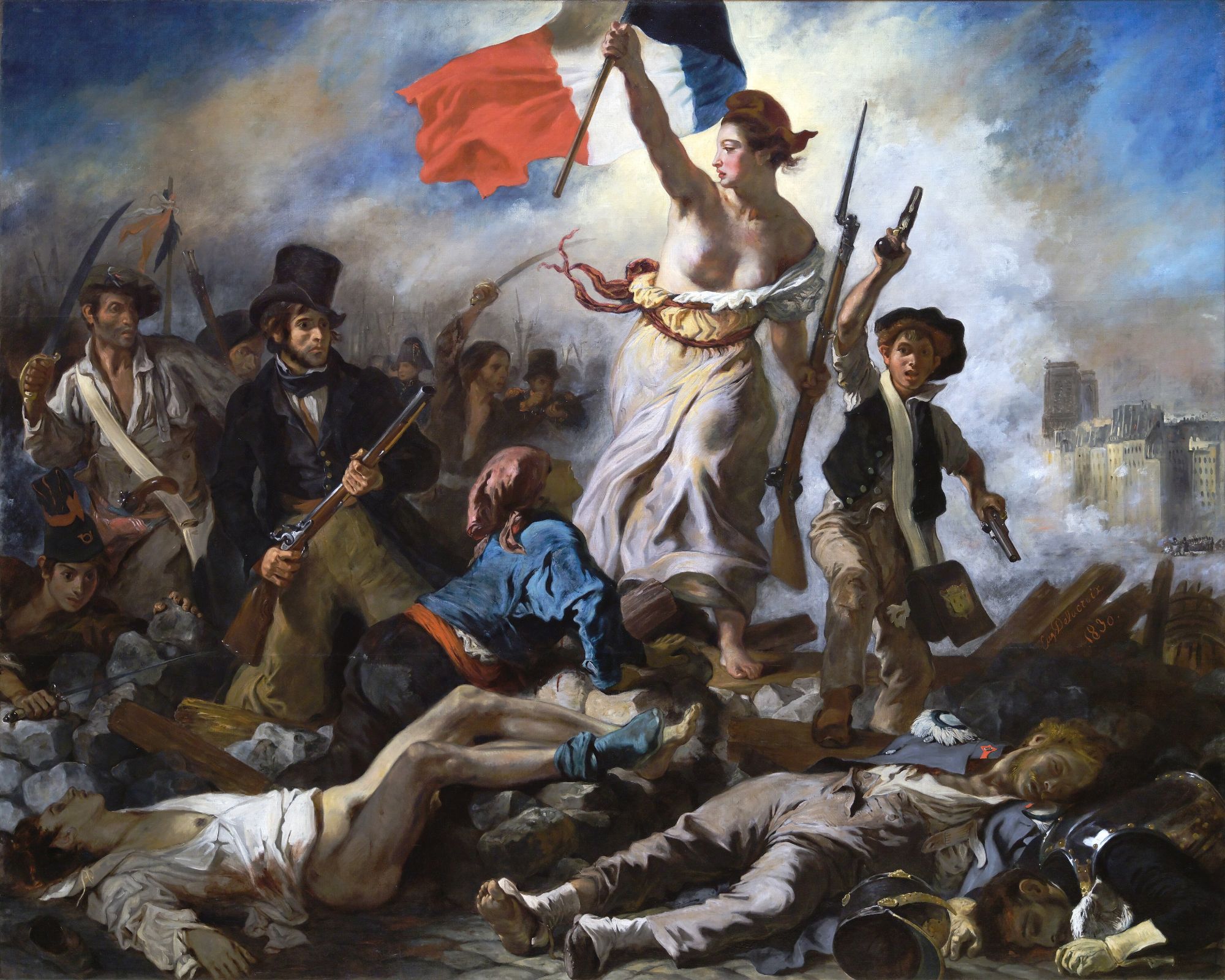
“I have undertaken a modern subject, a barricade, and if I have not won victories for my country, at least I will paint for her.” Eugène Delacroix wrote this to his elder brother, General Charles-Henri Delacroix, in the fall of 1830; the translation here is ours. His gloom was lifting, he added, and work was helping.
The Louvre quotes the line from his letter of October 28 (in French) in its dossier on the painting. It reads almost like an apology: judging by the letter, Delacroix saw the July uprising but did not fight on the barricades.
So began Liberty Leading the People. The new government would buy it and within a couple of years put it in storage. For thirty years it moved between storerooms, his aunt’s house outside Paris and the odd exhibition, reaching the Louvre for good only in 1874.
The second of three days
The July Revolution took three days, July 27 to 29, 1830: the Trois Glorieuses, or Three Glorious Days. Paris filled with barricades, Charles X fell, and Louis-Philippe of Orléans became King of the French.
For Delacroix, the revolution came at the right time. He was 32 and famous, but, as Louvre curator Côme Fabre writes (in French), he had hit a dead end. The Death of Sardanapalus had flopped at the Salon of 1828, where critics accused him of deliberately breaking every rule, moral and pictorial. Nobody bought the enormous canvas.
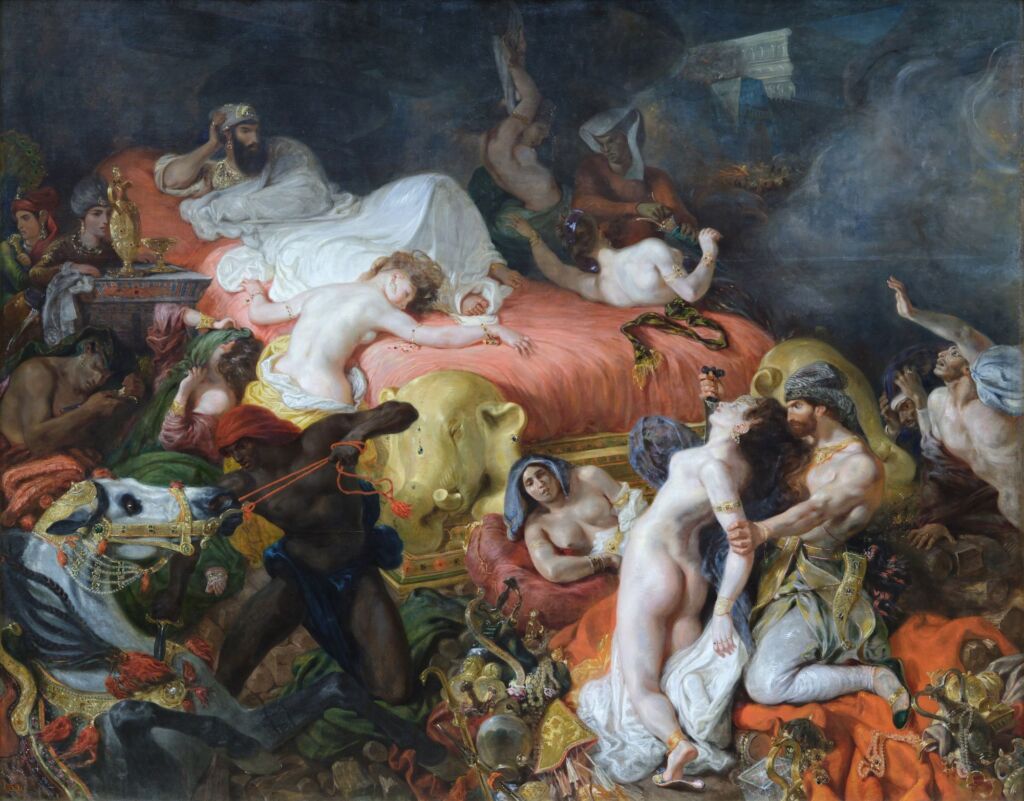
He was left painting portraits and genre scenes for collectors, his career as a history painter hanging by a thread. The revolution offered a way back. He worked on the canvas from September to December 1830, less than four months.
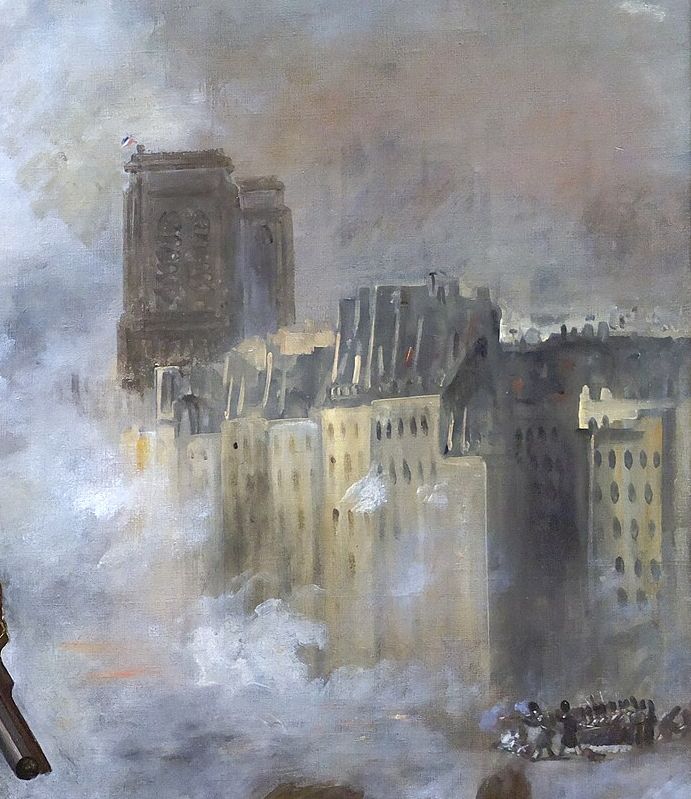
The full title includes a date: July 28, 1830. Delacroix pinned his allegory to the calendar: not to the victory but to the middle of the fight. The place is real too. On the right, the towers of Notre-Dame rise through the gunsmoke. According to Fabre, it is the only time Delacroix painted Paris.
Another, less quoted line: “It has put me back in a good mood.” The barricade was meant for the Salon, but it was also a way out of a slump.
The painting is huge, 260 cm (102 in) high and 325 cm (128 in) wide, on a canvas sewn from three horizontal strips.
Her face first turned to the viewer
Liberty is the only woman in the fight and the only figure who was never on the streets of Paris. The Louvre’s education dossier lists her allegorical attributes: the Phrygian cap, a sign of liberty since the first Revolution; the bare breasts; the bayoneted rifle; the classical profile.
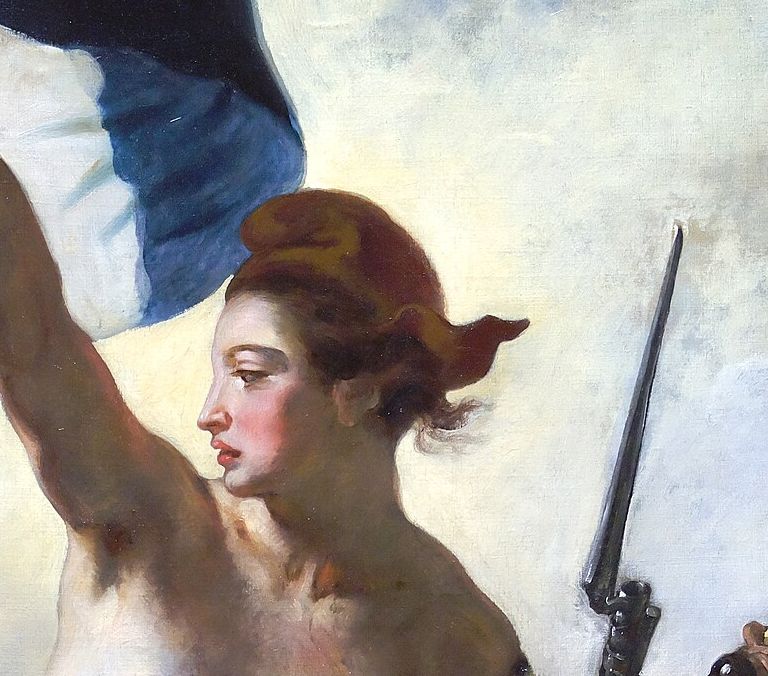
The profile came later. X-rays show that Delacroix first painted the face looking at the viewer, then turned it, so that Liberty now looks at those who follow her. Under the cap’s glazes (several translucent layers of beige-red, violet and two oranges) lies a bright red underlayer.
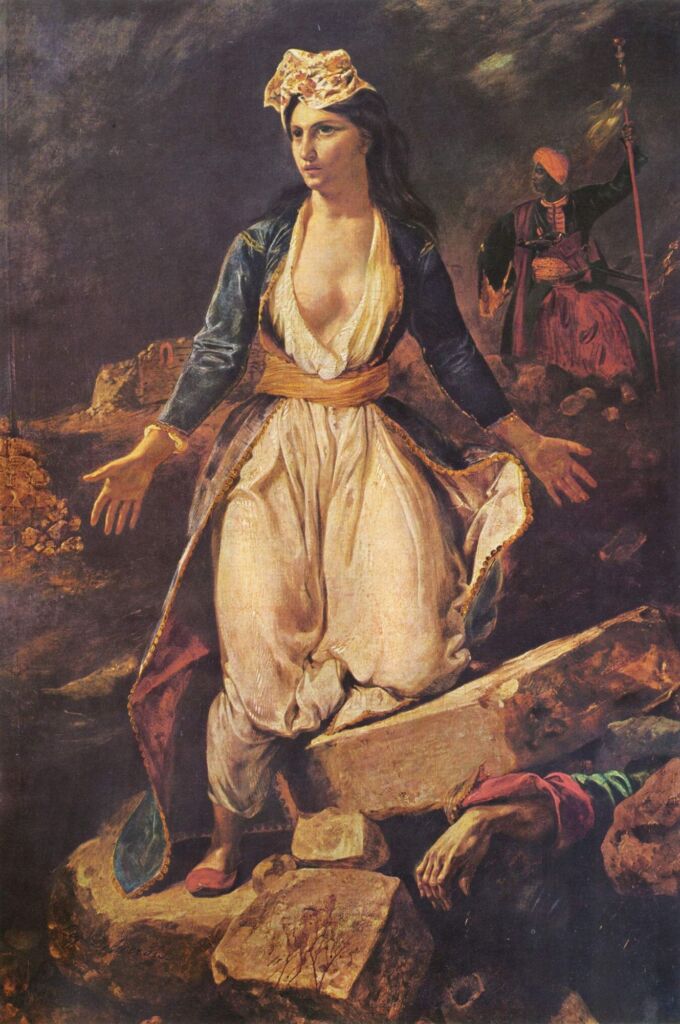
Delacroix had painted a woman as a nation before. In Greece on the Ruins of Missolonghi (1826), a female figure in a white dress and blue cloak kneels on the rubble of a fallen city. Four years later, the allegory got up and charged.
Fabre names a second source: the collective surge that drives Théodore Géricault’s The Raft of the Medusa. Delacroix had posed for his friend’s painting and knew it from the inside. The result is a pyramid, with the barricade as its base, Liberty as its center of gravity and the tricolor at its peak.
The man in the top hat
The most stubborn legend about the painting concerns the man left of Liberty, in a top hat, holding a double-barreled hunting gun. He was long taken for a self-portrait, as if the artist who never fought had written himself into the battle.
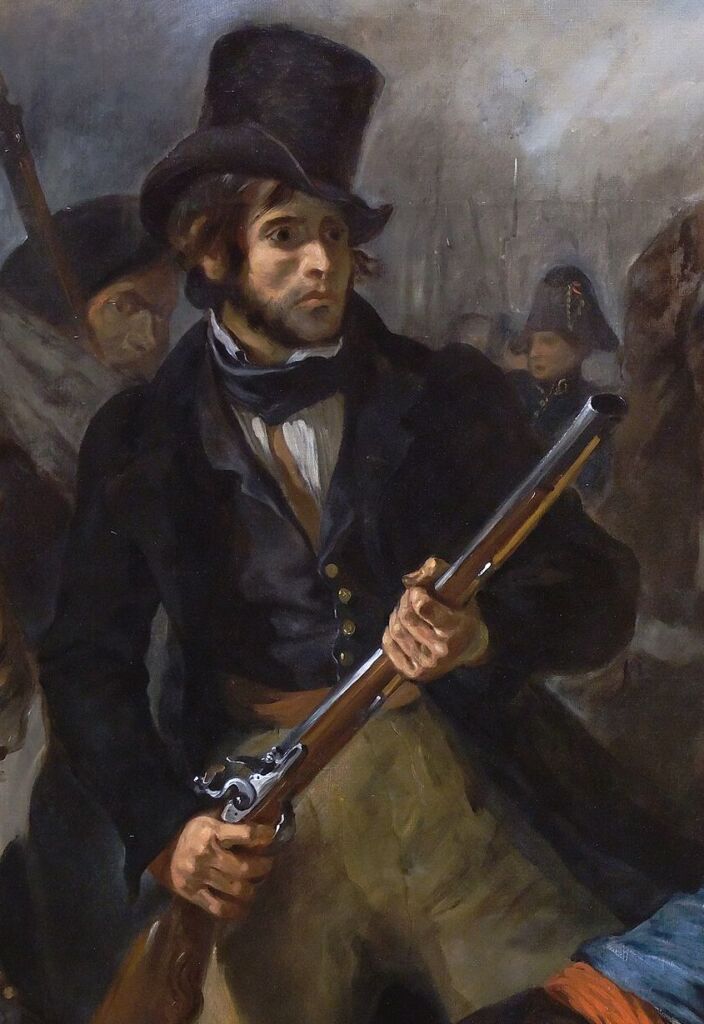
Art historians have long rejected the idea, among them Hélène Toussaint in a 1982 museum study. Late-19th-century candidates included Étienne Arago, a writer and theater director, and later Frédéric Villot, a future Louvre curator. There is no consensus.
The Louvre’s dossier offers another answer: the man is dressed like a “journeyman, craftsman or workshop foreman,” with wide work trousers and a red flannel belt under the frock coat. Delacroix merged the bourgeois and the worker in one figure, which may be why people so wanted to see the artist in him.
Even the museum gets tangled up. The man beside him, in a beret and with a saber, is a manufacturer in the text of the Louvre’s dossier and a worker in its table for schoolchildren. Perhaps that is the point: on a barricade, boss and hired hand look alike.
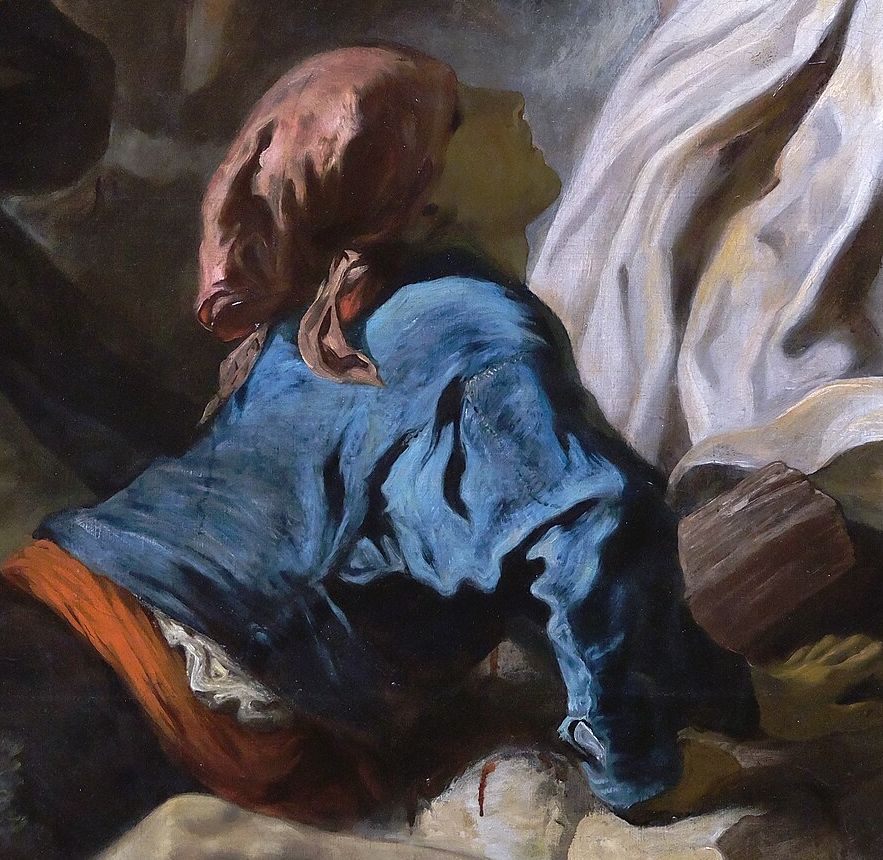
At Liberty’s feet, a wounded man in a smock and neckerchief raises his eyes to her. Everyone else is busy fighting.
The public expected marble
The Salon of 1831 was held in the Louvre, so the painting first hung in the building where it hangs today. Viewers fresh from the revolution did not find the revolution they wanted to remember. A reviewer for the Journal des artistes sneered: “Really, Monsieur Delacroix has painted our beautiful revolution in mud.” The line survives in Dominique Massonnaud’s anthology of Salon reviews.
Liberty herself was a problem. Bourgeois viewers, writes the art historian Nicos Hadjinicolaou, were put off by her underarm hair and the general “uncleanliness” of the figures. An allegory was supposed to be marble; this one had sweated and gotten dirty.
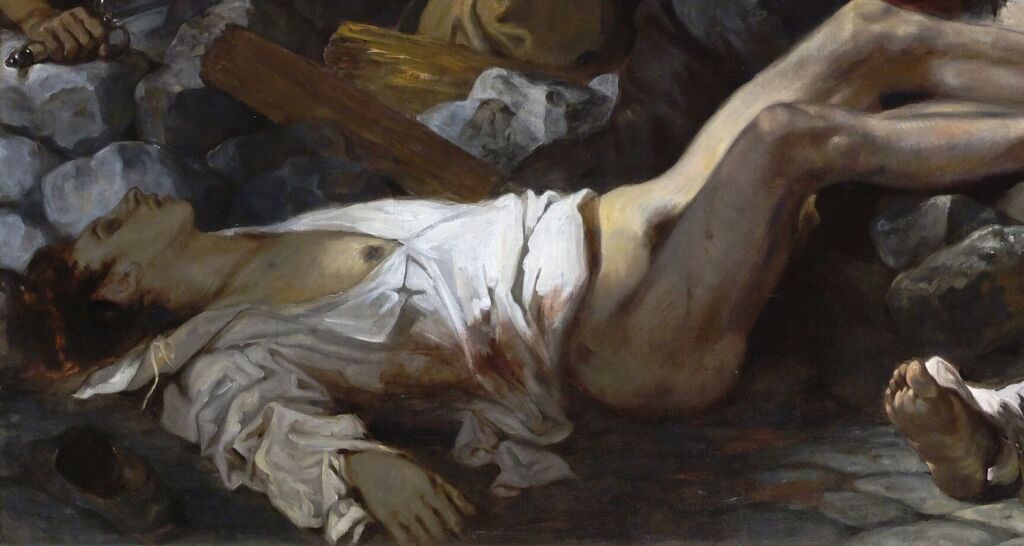
The dead lie against the frame, on torn-up paving stones, not a pedestal. Among them are government soldiers; the Louvre’s dossier identifies a cuirassier of the Royal Guard. Delacroix does not caricature the fallen enemy. At the foot of the barricade, all the bodies look alike.
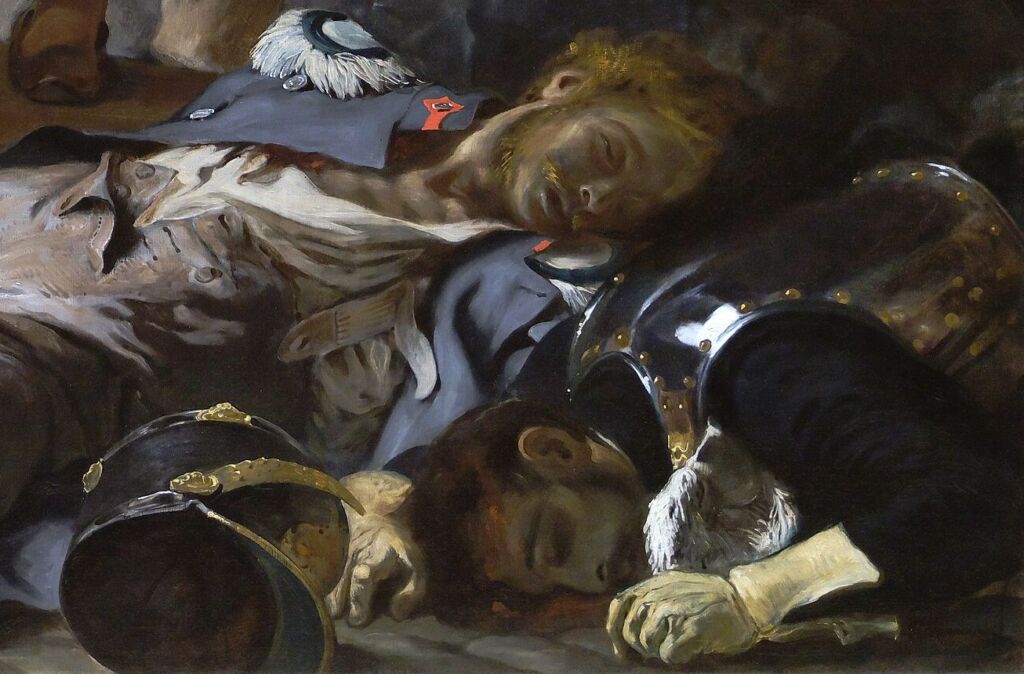
Heinrich Heine, reviewing the Salon for German readers, praised exactly that dust as the truth of the July days.
He also wrote, in Charles Godfrey Leland’s translation: “There is no picture in the Salon in which color is so sunk in as in the July Revolution of Delacroix.” Sunken color, gone matte, was a virtue to him, as was “this absence of varnish and sheen.” Almost two centuries later, conservators would have to thin the varnish built up on this very painting.
Three thousand francs
For all the grumbling, the painting sold. In the summer of 1831 there was talk of buying it for King Louis-Philippe’s private collection for 2,000 francs. In August the state bought it for 3,000 francs through the Ministry of Commerce and Public Works.
It was not on view for long. In 1832–33 Liberty hung in the Musée du Luxembourg; around 1833–34 it went into storage, as the authorities feared new riots. The republican uprising in Paris in June 1832 was still fresh.
A regime born on the barricades did not want a barricade on its own wall.
Around 1839 the canvas was returned to the artist, who took it to his aunt Félicité Riesener and his cousin Léon at Frépillon, outside Paris.
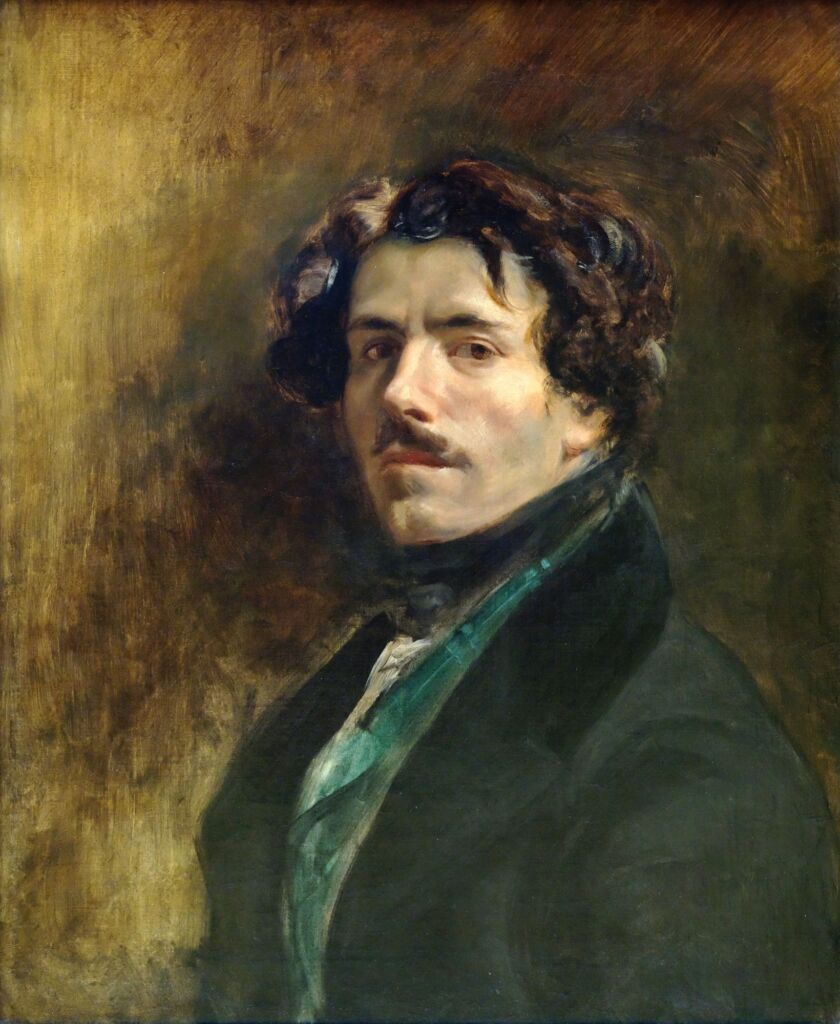
Delacroix in a self-portrait of around 1837, in the years his barricade spent out of public view.
After the revolution of 1848 the state demanded the painting back. Delacroix managed to lend it to Lyon for nearly a year before it returned to storage. In August 1848 the critic Champfleury claimed it was being hidden in an attic as too revolutionary.
The public saw it again only at the 1855 Exposition Universelle, the Paris world’s fair, which gave Delacroix a large retrospective. In 1863, the year he died, it was hung in the Musée du Luxembourg. In November 1874, under the Third Republic, it moved to the Louvre.
Gavroche did not exist yet
To Liberty’s right runs a teenage boy with two pistols, a student’s beret and an infantry cartridge pouch of the Royal Guard. He is almost always called Gavroche.
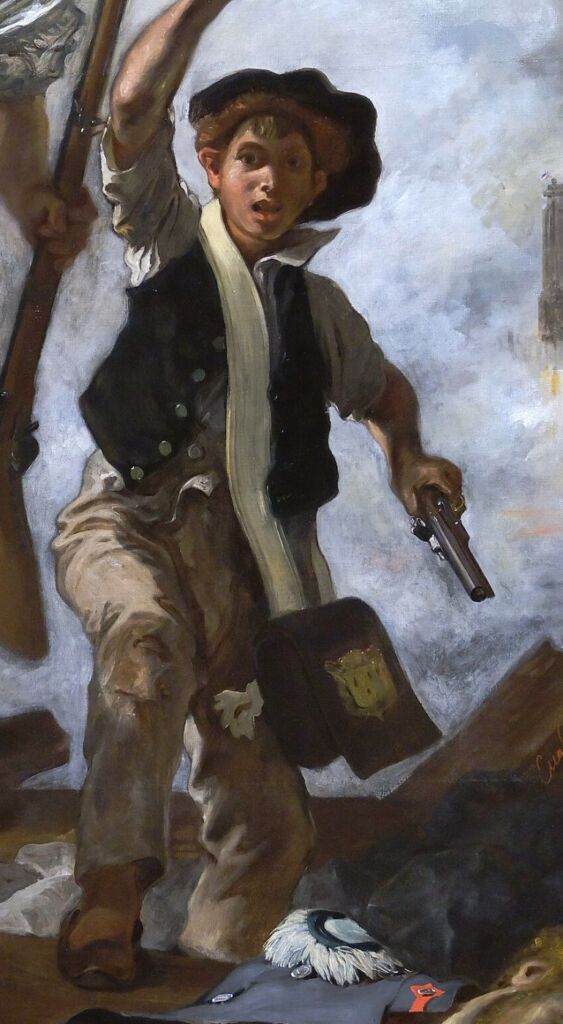
But Gavroche came thirty-odd years later, with Victor Hugo’s Les Misérables (1862). The Louvre writes that the boy “would become” Gavroche. English-language scholars say only that the painting may have influenced the novel. The link is persuasive, but it is a theory, not a document.
The dates hold an irony. Hugo’s Gavroche dies not in July 1830 but in the June uprising of 1832, the very one after which the authorities began to find Liberty dangerous. There are two boys, by the way: the second, at the left edge, clutches the paving stones, and nobody calls him Gavroche.
Eight coats of varnish
In September 2023 Liberty came off the wall again, this time for restoration. Ary Scheffer’s The Women of Souli took its place while the painting spent six months with conservators in the museum.
Bénédicte Trémolières and Laurence Mugniot worked with X-rays, ultraviolet and infrared imaging, and archival photographs. In 2020 the Arcanes studio had finished restoring The Massacre at Chios, another large Delacroix, for the Louvre.
The painting carried eight coats of varnish, Smithsonian magazine reported. It was thinned rather than removed, and that alone gave the colors back their resonance.
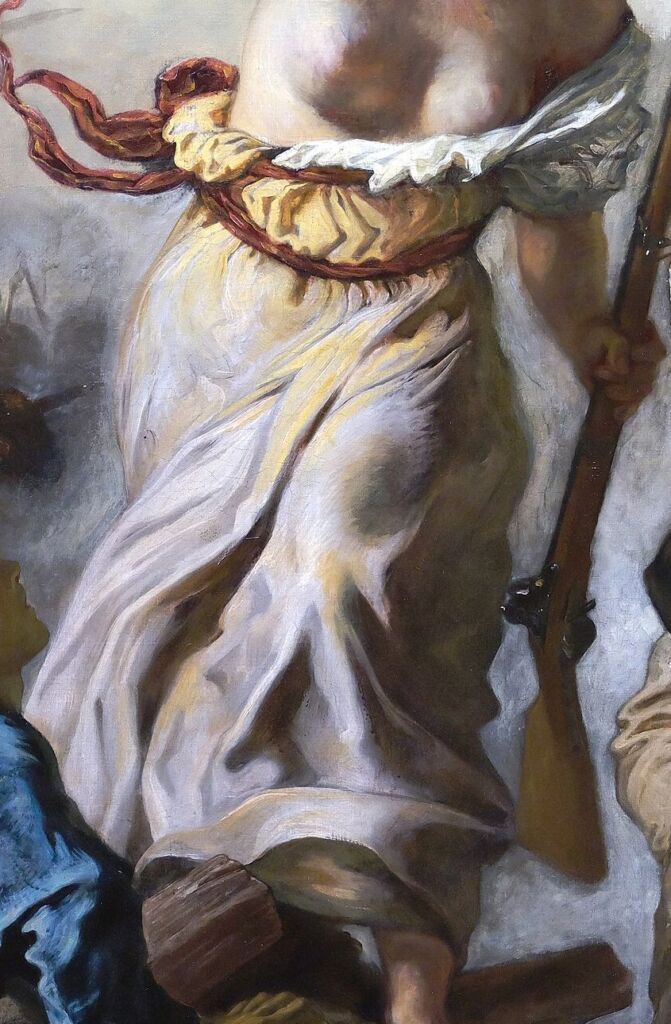
The main discovery is the dress. Everyone took it for yellow, but Delacroix first painted it entirely gray and only then laid yellow over it in varying density.
A restorer in 1949 had evened out the tone, painted over the dress and added orange highlights. That later paint dissolved easily, and the light gray with gold came through again. A brown stain on the dress, which Delacroix never painted, vanished, and the golden halo behind Liberty’s head separated from the white smoke again.
Small things came back. A worn leather shoe surfaced in the lower left corner. Tiny pink touches in the smoke turned out to be muzzle flashes from the windows.
The lighter smoke shows the boy with the pistols running slightly ahead of Liberty, not beside her. The painting returned to its gallery at the end of April 2024. “We’re the first generation to rediscover the color,” said Sébastien Allard, the Louvre’s director of paintings.
The flag at the top
Liberty became Marianne, the female face of the French Republic, later. The Phrygian cap suited the Third Republic, which turned the painting into a republican symbol. The figure appeared on the engraver Pierre Gandon’s “Liberté” series of everyday French stamps: from 1982 to 1990 her profile went out on ordinary letters.
The image spread to posters, cartoons and protest marches; even people who have never been to the Louvre know it.
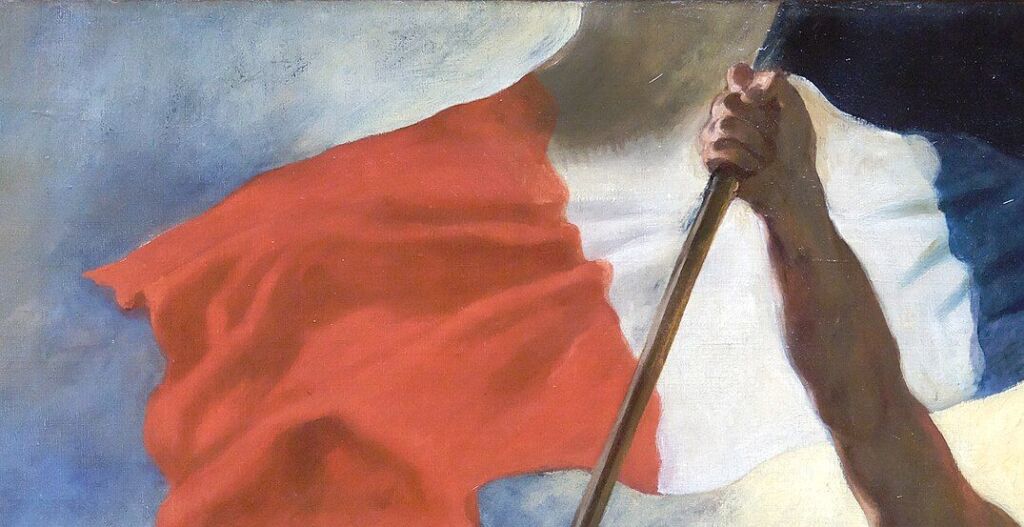
Delacroix put the flag at the top and scattered its blue, white and red across the clothes of the living and the dead; the eye gathers them without noticing. It was personal, too. The return of the tricolor after fifteen years of prohibition reminded him of his father, a minister and envoy of the French Republic, and of his brothers, officers in Napoleon’s army.
The painting has been both rebel and official icon without ever becoming comfortable. In February 2013, at the Louvre-Lens, a woman visiting the museum wrote “AE911” on it in marker; the writing stayed on the varnish, and a conservator quickly removed it. Famous canvases attract vandals: Ilya Repin’s Ivan the Terrible and His Son Ivan has been attacked twice.
Today Liberty Leading the People hangs in the Salle Mollien of the Louvre’s Denon Wing, among the large French Romantic canvases, Géricault’s The Raft of the Medusa included. It belongs on even the shortest route through the museum.
Delacroix promised his brother he would paint for his country, and he did. It was his country that, for thirty years, could not bring itself to hang the painting on a wall.
Comments
For Hroniki readers
Comments are open to readers with an account. Signing up is free and takes a few seconds.
No comments yet. Start the conversation.