Delacroix face down: who else posed for The Raft of the Medusa
Of the 150 people on the raft of the French frigate Medusa, fifteen were still alive when help came. How Géricault turned the disaster into a painting of more than 35 square meters, with survivors as models, studies from a morgue and Delacroix lying face down.
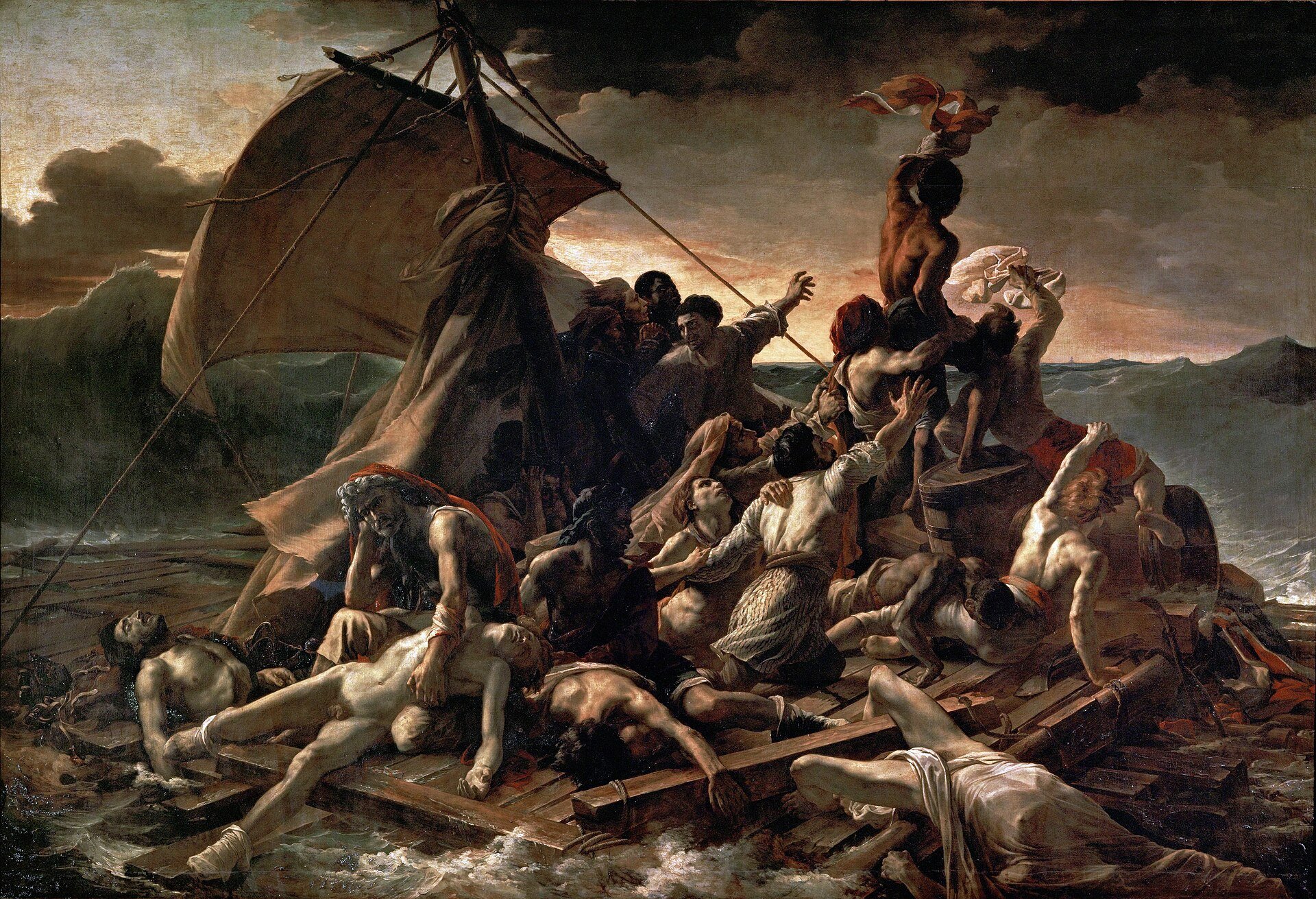
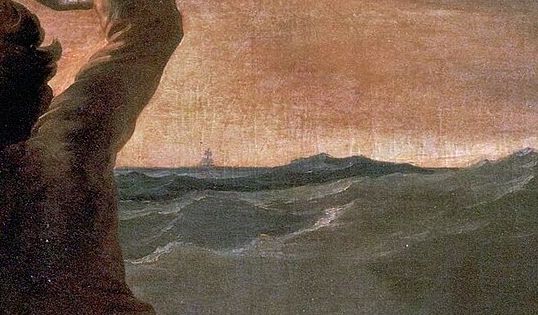
On a canvas of over 35 square meters (380 square feet), the main event is a speck on the horizon: the brig Argus. The people on the raft have just spotted it and do not know it is about to drop out of sight.
Théodore Géricault painted The Raft of the Medusa in 1818–19, at twenty-seven: oil on canvas, 491 × 716 cm (193 × 282 in), now in the Louvre. In about a year and a half he tracked down survivors, built a model of the raft and turned his studio into a kind of anatomy theater.
The towlines are cut
The frigate Medusa was bound for Senegal, a colony France was reclaiming, carrying the new governor, his family and officials. On July 2, 1816, she ran aground off the coast of West Africa. Her captain owed his post to royal patronage, not to experience.
There were too few boats. A raft about twenty meters (65 feet) long was lashed together from masts and planks, and roughly 150 soldiers, sailors and settlers crowded onto it. Counts range from 146 to 150; one of them was a woman.
Among them was Alexandre Corréard, an engineer-geographer who would later tell all of France about it. The raft was towed by the boats, but it slowed them, and their well-born passengers cut the lines. The boats with the captain and the governor reached shore.
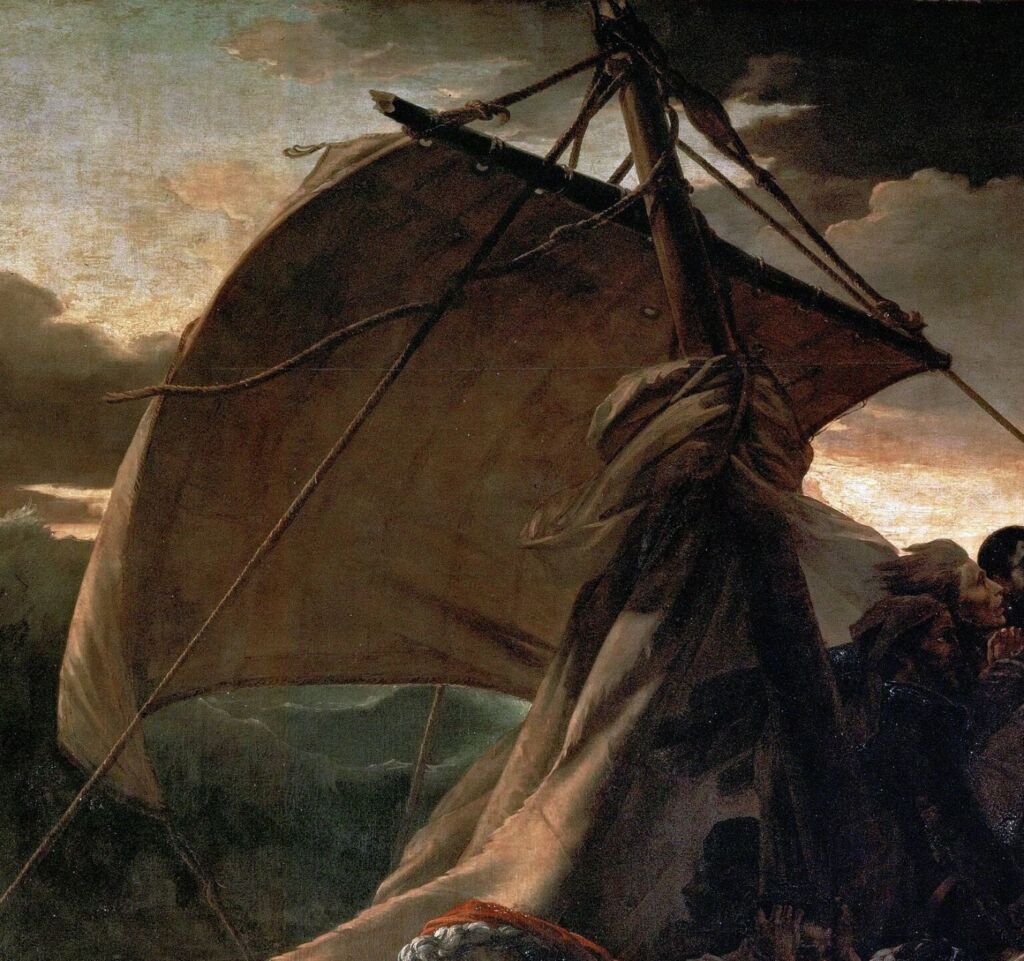
Thirteen days followed. About twenty died the first night; by the fourth day, around sixty-seven were left. Then came murder, then cannibalism. On the eighth day, those still holding on threw about a dozen of the weak and wounded overboard.
When the Argus picked up the raft, fifteen were alive. Four or five died aboard the brig, so about ten reached land. Of the seventeen left on the frigate, three were found alive almost two months later.
A book by two survivors
By 1818 Géricault was known for The Charging Chasseur, a cavalry officer on a rearing horse, his Salon debut of 1812. He could paint movement but had yet to paint a large history picture. He read of the disaster in the Paris papers.
The details came from two survivors, the ship’s surgeon Henri Savigny and Corréard. Their 1817 book on the wreck was reissued in 1818 with a plan of the raft (in French). Its subtitle promised events “on the raft, in the Sahara desert, at Saint-Louis”: for many, the wreck did not end at sea.
It read as an indictment of officers who owed their posts to the restored monarchy. Early in 1818 Géricault sought out both authors. With them and another survivor, Lavillette, he built a scale model of the raft and arranged wax figures on it.
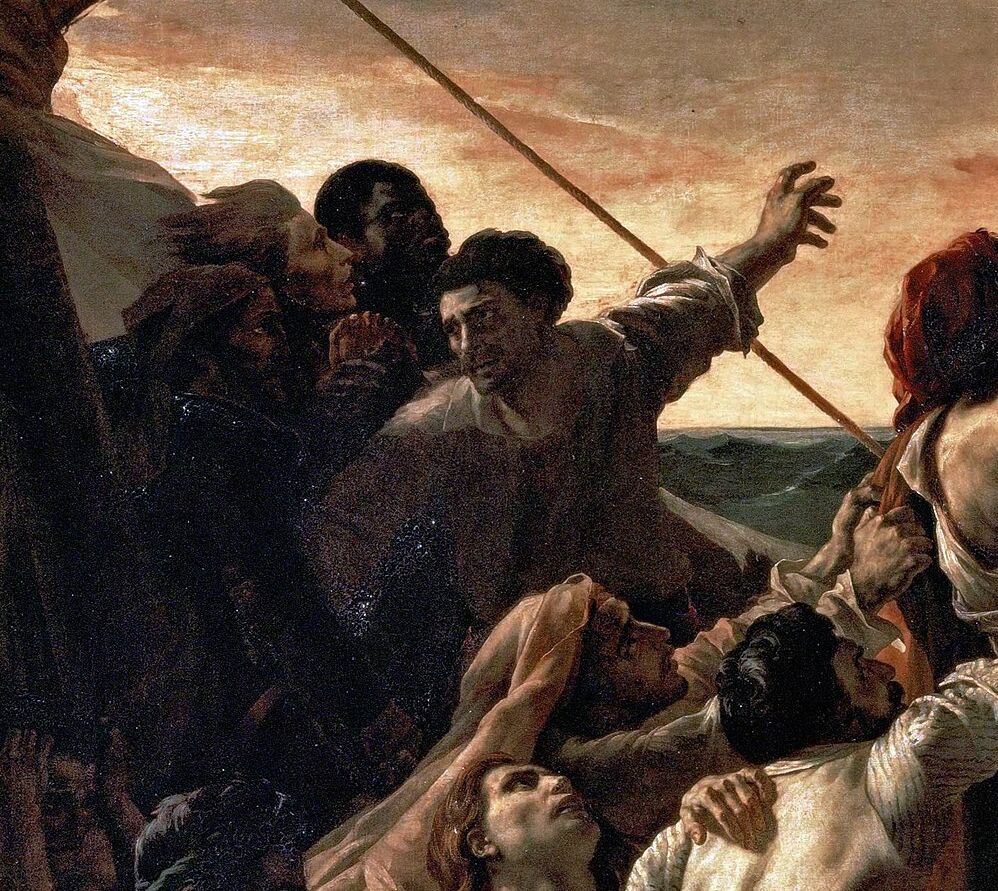
Savigny, Corréard and Lavillette also made it onto the canvas, painted from life. Two more survivors posed for figures by the mast. Two years after those thirteen days, the survivors were building a raft again, a small one, with wax figures for people.
A studio across from the hospital
From November 1818 Géricault worked at 80 rue du Faubourg-du-Roule, opposite the Beaujon hospital. He shaved his head and saw almost no one. A canvas that size cost him 440 francs.
In the Beaujon morgue he drew the dead and studied the faces of the dying. He brought severed limbs to the studio to watch them decompose. A severed head from an asylum sat on the studio roof for about two weeks.
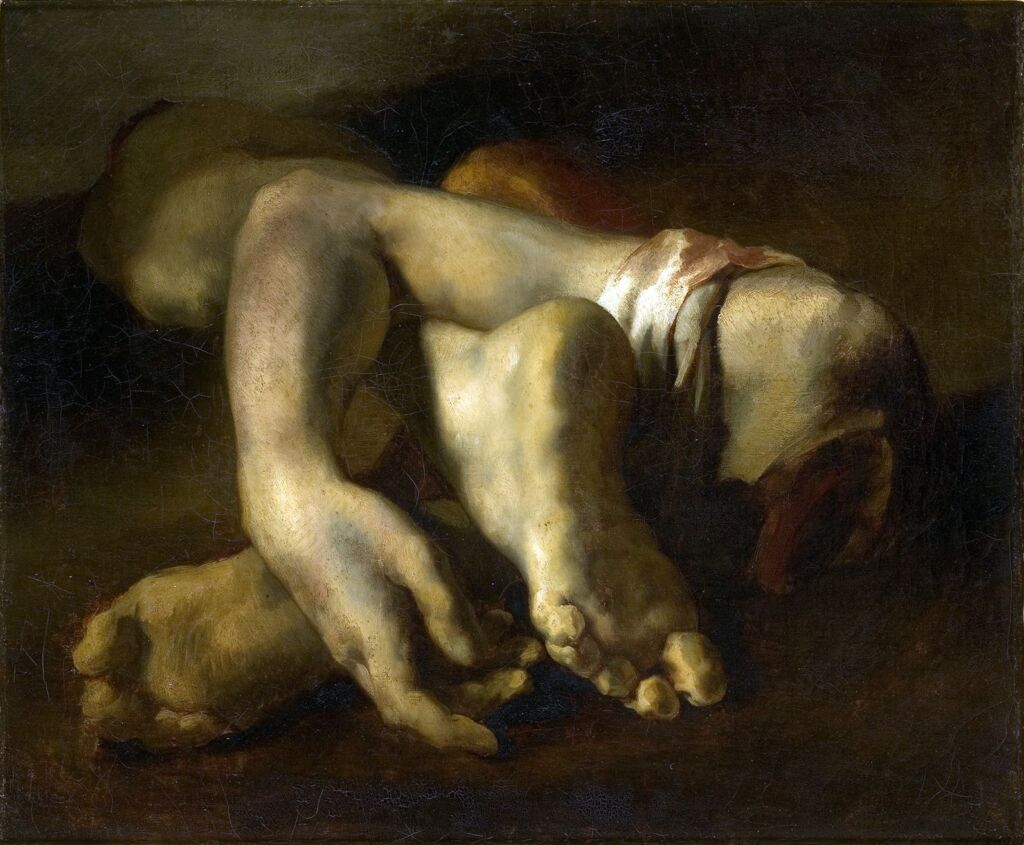
The sessions also yielded paintings of severed limbs: still lifes, technically, with morgue specimens in place of fruit and tableware.
There were living models too. Louis-Alexis Jamar, his eighteen-year-old assistant, slept in a room next to the studio and posed nude for the dead youth in the foreground and two other figures.
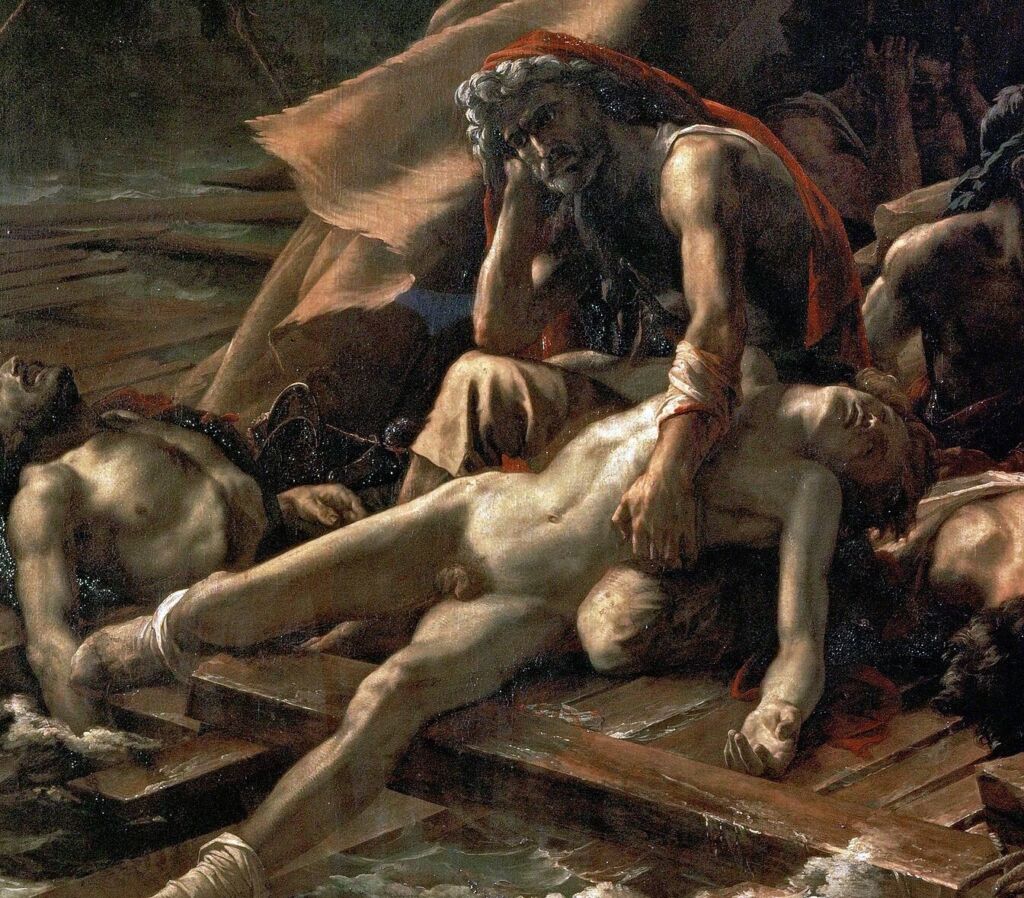
The old man in the lower left turns his back on the Argus. Scholars see in the pair Ugolino from Dante’s Divine Comedy, the count who was locked in a tower with his sons and starved to death; Dante darkly hints that before the end he ate his children. The allusion says more about the cannibalism than a direct scene could.
The brig on the horizon
Géricault had plenty to choose from: he sketched the mutiny, the cannibalism, the rescue; studies, drawings and oil sketches came to more than a hundred. He went to Le Havre to study the sea and sky.
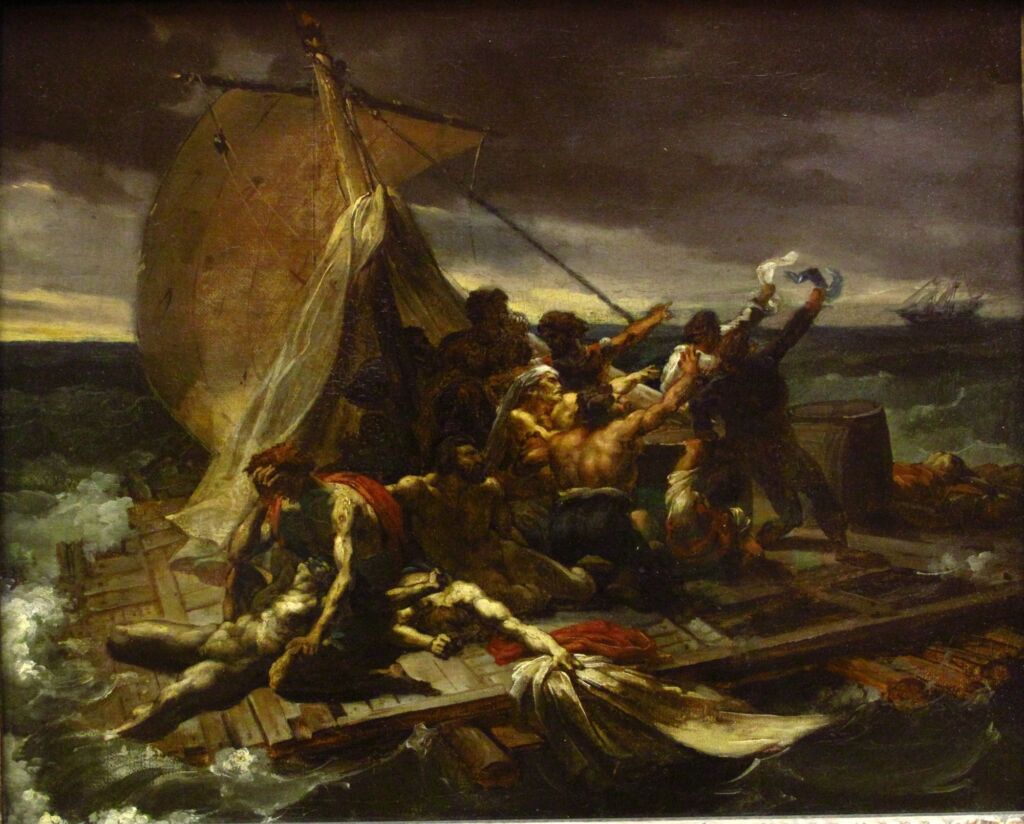
He chose neither rescue nor horror but the gap between them. The people have just seen the brig. Survivors said the Argus then vanished and returned only two hours later. We see a hope that will slip below the horizon in a moment, for two long hours.
The rejected ideas survive. A watercolor of a man biting into the arm of a headless body is now in the Louvre. On the big canvas, all that remains of that scene is the old man and the dead youth in the lower left.
The composition rests on two pyramids: the mast and its stays, and the bodies rising to the right toward the man on the barrel. The sail pulls the raft left, away from the brig; the people strain right.
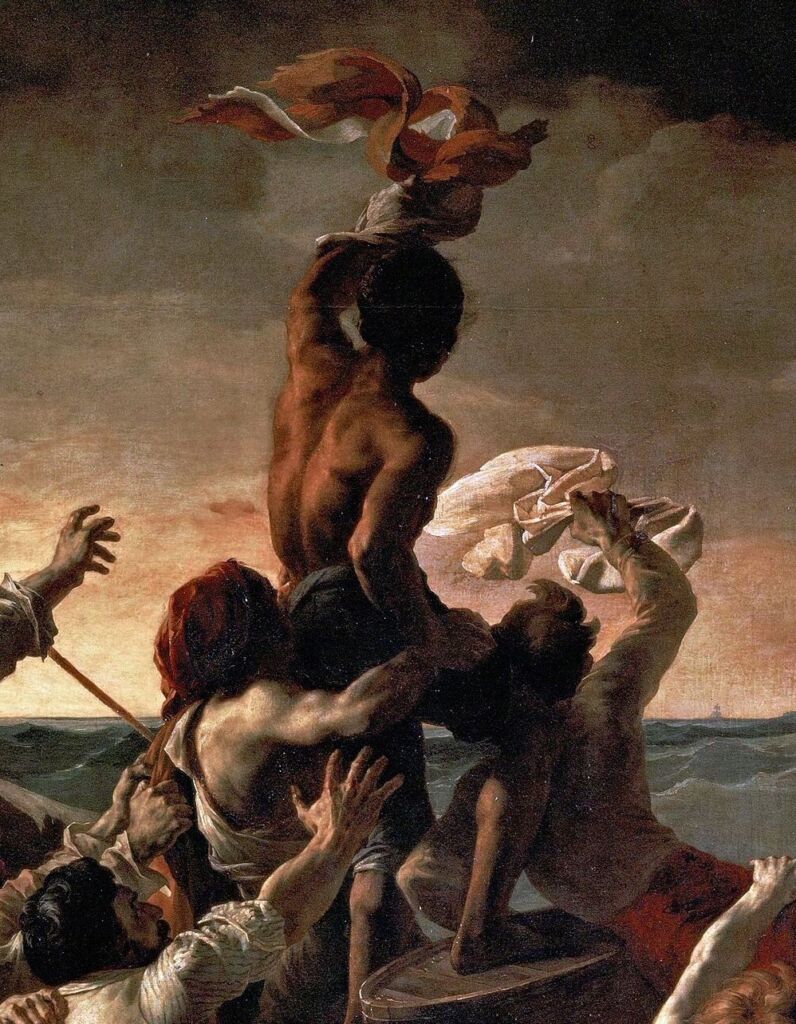
For this figure Géricault used Joseph, a Haitian model well known in the Paris studios, and painted at least two of the Black men on the raft from him. The back repeats the Belvedere Torso, the ancient fragment in the Vatican that generations of artists learned from.
Géricault gave the top of the painting to a Black man. The expedition itself was also tied to the covert slave trade, which France had already officially banned.
Delacroix, face down
Of that year and a half, the big canvas itself took eight months. Studio visitors recalled him painting straight onto the white canvas, with no underpainting. He finished in a hall of the Théâtre-Italien in July 1819. In August it went to the Louvre for the opening of the Salon.
The young Eugène Delacroix posed for his friend as the youth lying face down in the foreground. The future painter of Liberty Leading the People entered art history first as a model, and a faceless one.
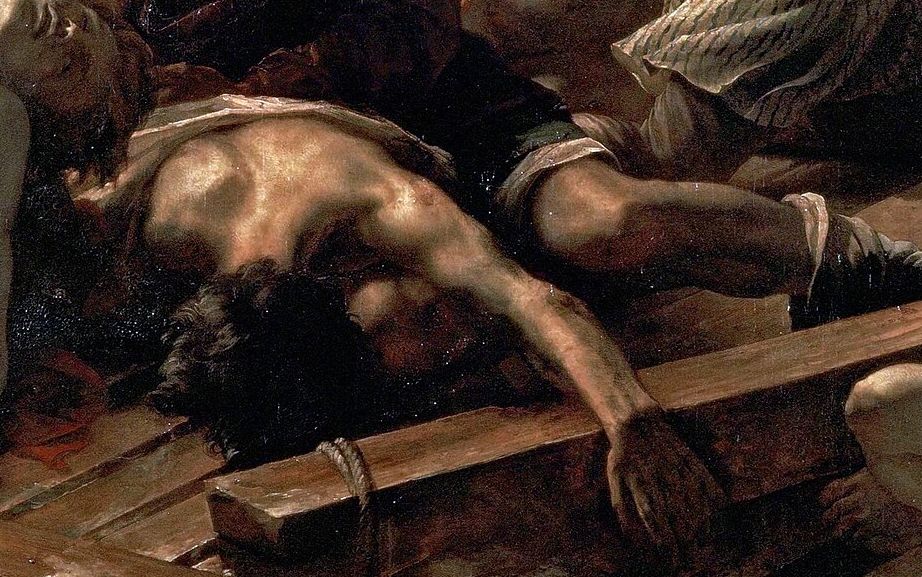
Delacroix saw it unfinished. Years later he recalled (Achille Piron wrote it down) leaving the studio so shaken that he ran “like a madman” all the way to his room.
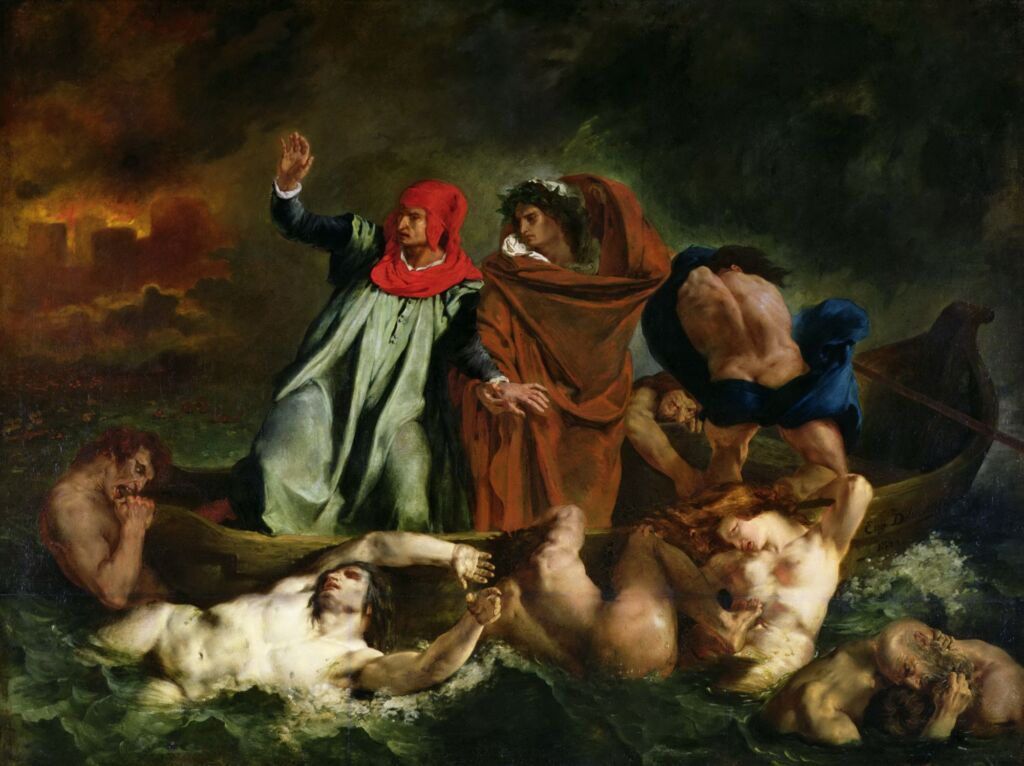
At the Salon of 1822 he showed The Barque of Dante: another boat, more bodies in the water. In 1824, the year Géricault died, came The Massacre at Chios, and the quarrel between the new painting and the heirs of Jacques-Louis David passed to the next generation.
Scene of a shipwreck
At the Salon of 1819 the painting hung under the neutral title Scene of a Shipwreck; the real one was kept out of the catalog. But the public had read Savigny and Corréard, and the bland label hid nothing.
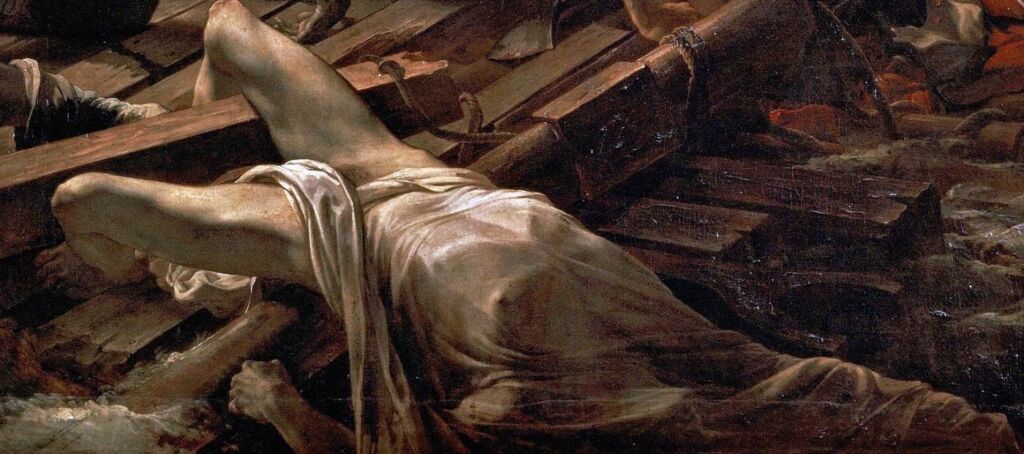
To the government it recalled a scandal it wanted forgotten, and the pro-government press was hostile. Yet it was the Salon’s great draw. French history painting still followed David: clear drawing, the heroic gesture, the classical model. Here the classical model was present, lying on wet planks among the dead.
Géricault gave the viewer neither hero nor villain. The captain who abandoned the raft is nowhere on the canvas: his absence is the accusation.
Louis XVIII toured the Salon three days before it opened. The painter François Gérard recorded his words, translated here by Hroniki: “Monsieur, you have made a shipwreck that is no shipwreck for you.” He praised the artist and kept silent on the subject.
The critics split. The Journal de Paris wrote that the painting “strikes and attracts all eyes.” Coupin de la Couperie objected that painting should speak to the soul and the eye, not repel. Opponents called it “a pile of corpses.”
Géricault won a gold medal, but the state did not buy the painting, which was rolled up and stored in a friend’s studio. Later the historian Jules Michelet would say that the whole of society was aboard the raft of the Medusa.
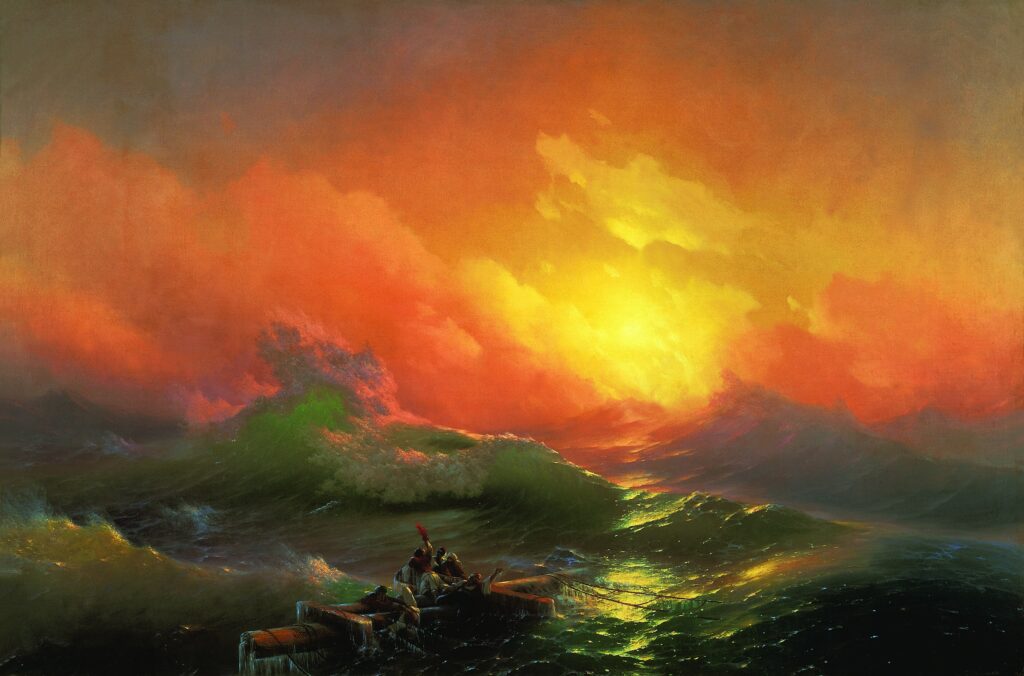
A Louvre label once made the same point: the only hero of this story is humanity. Thirty years later, in The Ninth Wave, the Russian painter Ivan Aivazovsky would also leave survivors on a broken mast at sea, but give them a sunrise. Géricault gave none.
Forty thousand visitors in Piccadilly
In 1820 the painting went to London, where about 40,000 people saw it at the Egyptian Hall in Piccadilly between June and the end of the year. It hung almost at floor level, so visitors stood at the edge of the raft, as if they could step onto it.
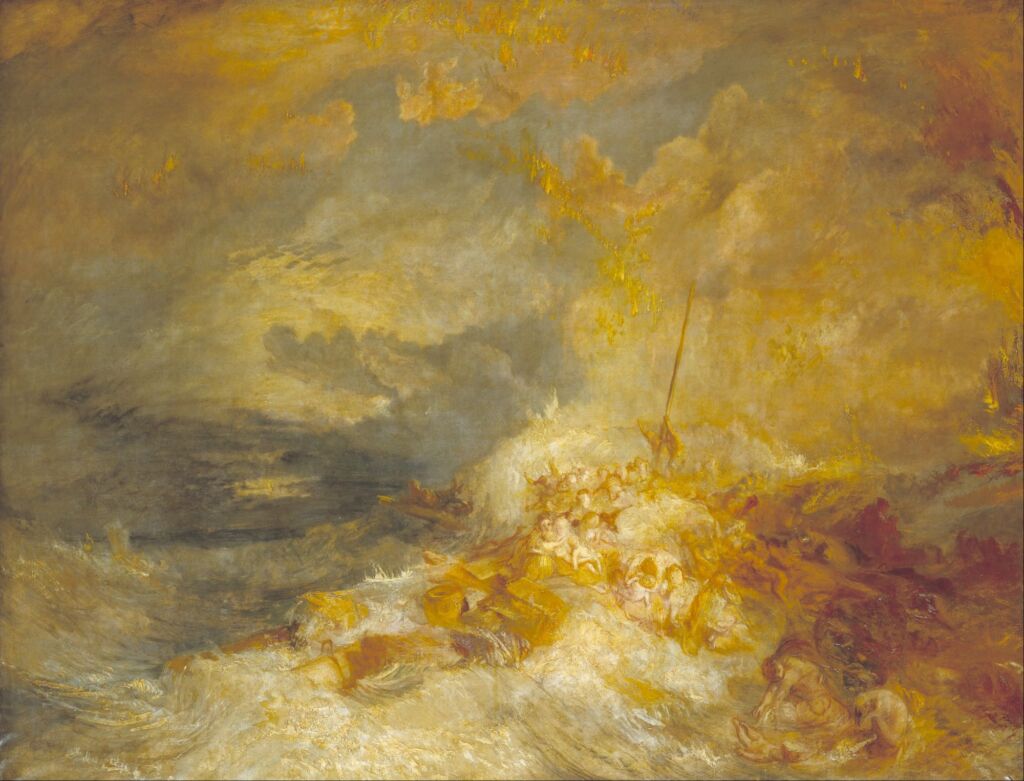
Géricault earned about 20,000 francs; France had given him only a medal. In Dublin, in 1821, it drew no such crowds. The English remembered it: among the works thought to bear its mark is J.M.W. Turner’s A Disaster at Sea, painted around 1835.
Back in Paris, Géricault was often ill, and riding falls wrecked his health. In 1822 the comte de Forbin, who ran the Louvre as director general of the royal museums, offered 6,000 francs for the Raft on the state’s behalf, but the deal fell through. Géricault died in Paris in January 1824, at thirty-two.
On November 2, 1824, it was sold as the first lot of his estate auction. Pierre-Joseph Dedreux-Dorcy, the artist’s closest friend, bought it for 6,005 francs on behalf of that same Forbin. So the Louvre got the Raft after all, for five francs more than it had offered the living painter.
It has hung in the Louvre since 1826, apart from the world wars: in the first it went to Toulouse, in the second into hiding in the provinces. Today it is in the Salle Mollien, worth a stop even on a three-hour visit to the Louvre.
The painting is darkening
Londoners in 1820 saw a different Raft. For the shadows Géricault used bitumen, an asphalt pitch that at first gives a velvety, glossy black. Scholars trace the harsh light on the bodies and the deep shadow to Caravaggio’s dramatic chiaroscuro, known as tenebrism.
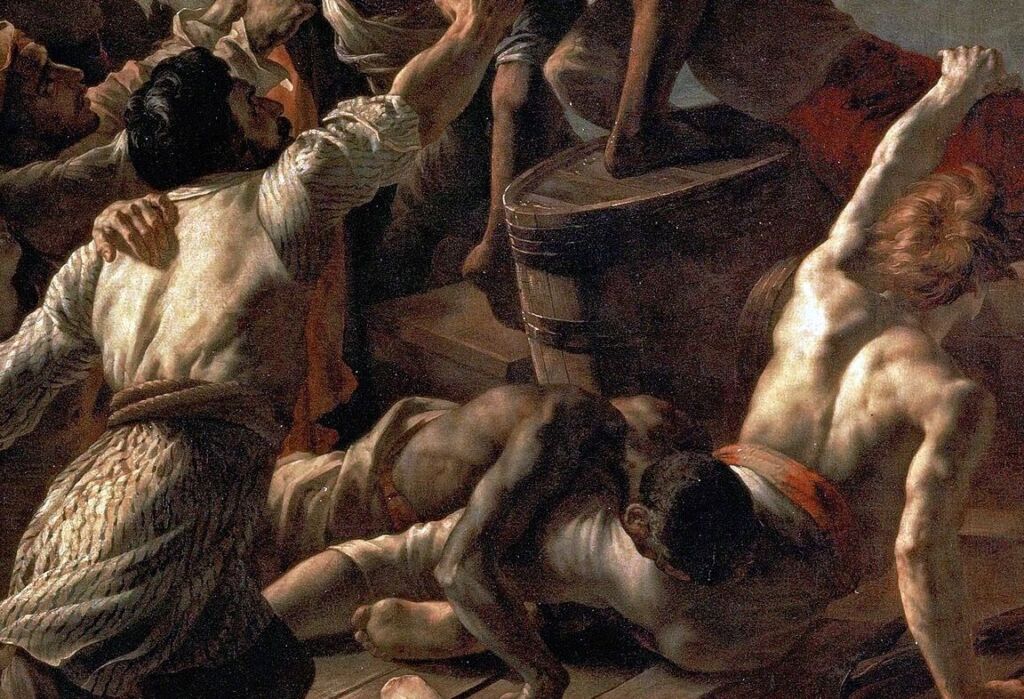
Over time bitumen blackens, wrinkles and drags the paint layer with it. The oil, cooked with lead and wax, darkened too. It cannot be undone: conservators have treated the canvas repeatedly, most recently in 2018, but in the large dark areas the detail is gone.
In 1859–60 Eugène Ronjat and Pierre-Désiré Guillemet painted a copy of the Raft, now in Amiens.
The shadows that were velvet in 1819 have gone dead, and the bodies in them must be guessed at. The light still holds on the backs, the raised arms and the small silhouette on the horizon: the reason Géricault chose this moment.
Comments
For Hroniki readers
Comments are open to readers with an account. Signing up is free and takes a few seconds.
No comments yet. Start the conversation.