School of painting
Barbizon school
1830s–1870s · France
About the movement
The name "Barbizon school" was coined after the fact. It came into general use in 1890, when the Scottish art dealer David Croal Thomson published The Barbizon School of Painters. The artists never called themselves that. From the 1830s on they simply came to the village of Barbizon on the edge of the Forest of Fontainebleau, about 50 kilometers from Paris, took rooms at the Auberge Ganne and set off into the woods with their sketching easels.
The Barbizon painters rejected historical landscape, in which nature served as a backdrop to myth. Their models were the 17th-century Dutch and the Englishman John Constable, whose The Hay Wain made an impression at the Paris Salon of 1824. They wanted to paint not an ideal Arcadia but a particular oak, a marsh, the sky before a storm, and they made their studies outdoors, though they still finished their large pictures in the studio.
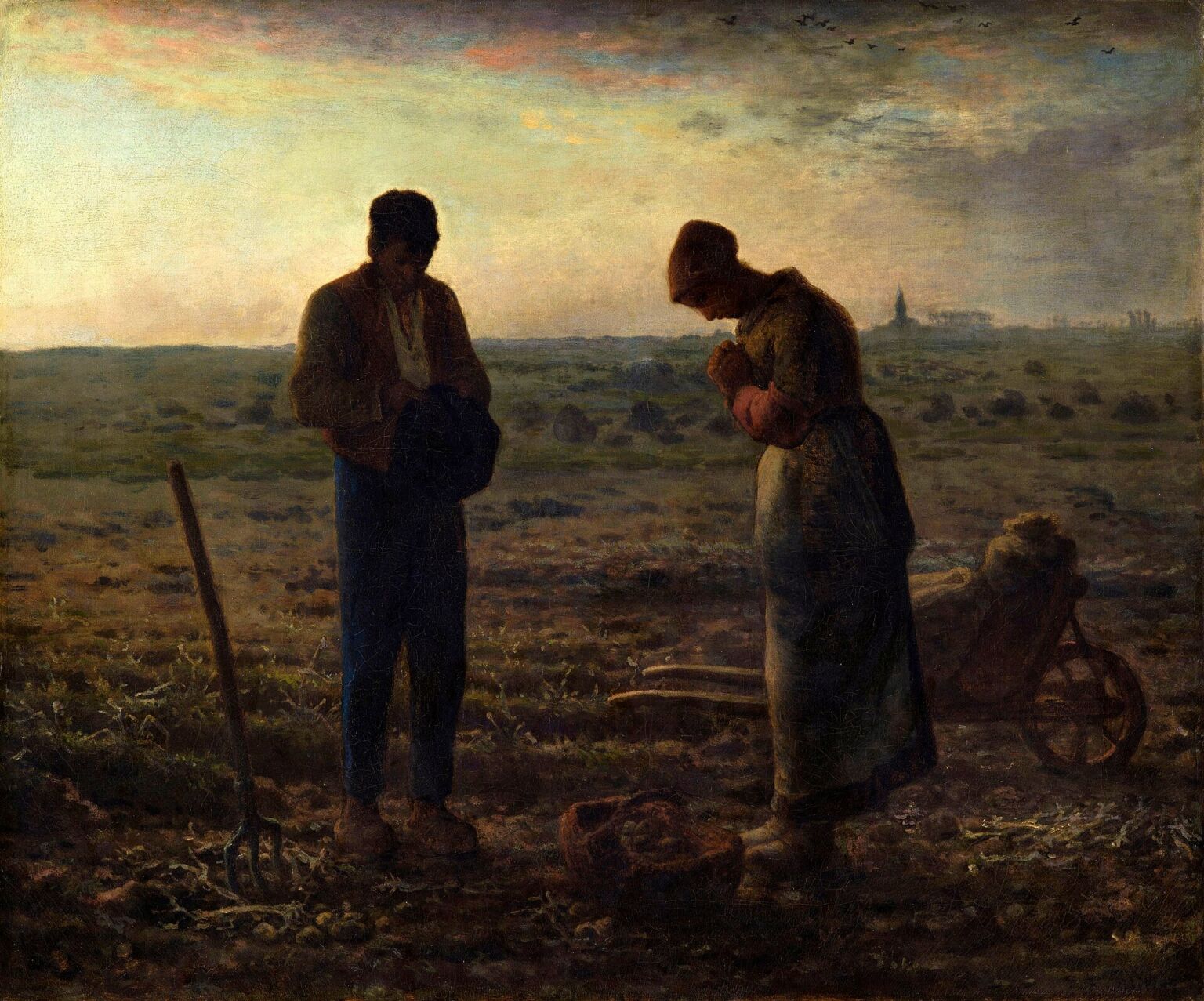
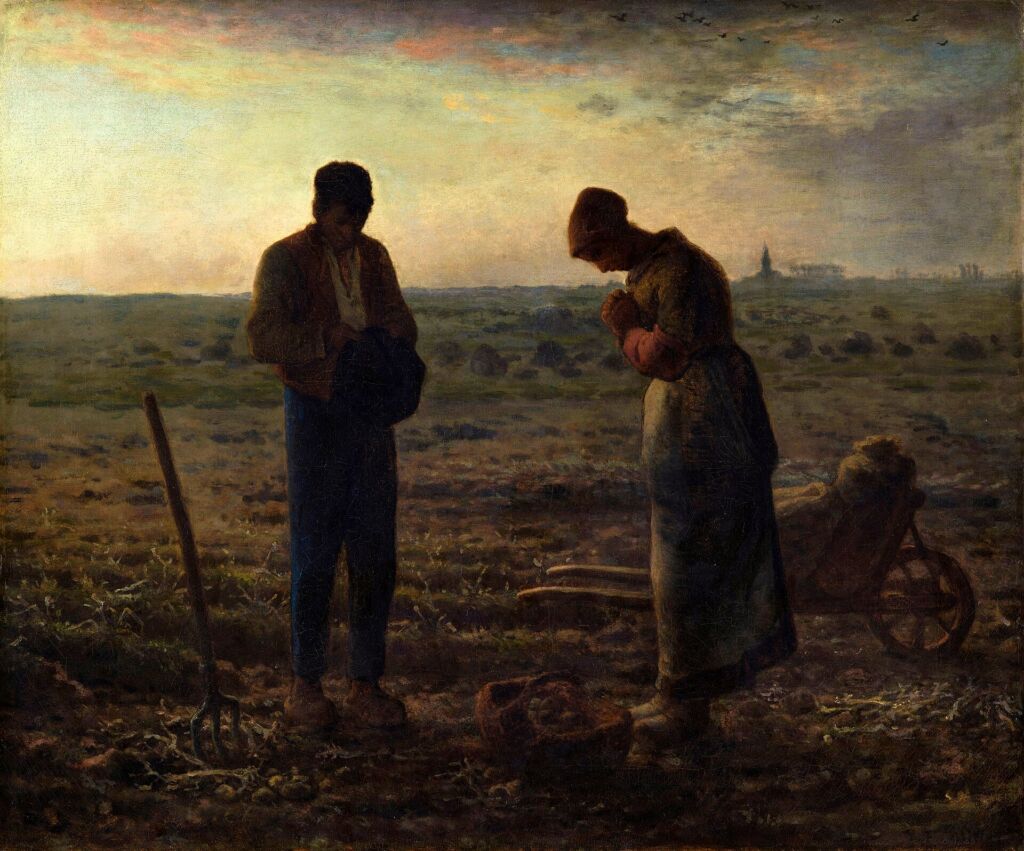
Their acknowledged leader was Théodore Rousseau, whom the Salon jury rejected so often that he was nicknamed "le grand refusé," the great rejected one. Working alongside him were Narcisse Díaz de la Peña, Jules Dupré, Constant Troyon and Charles Jacque. Charles-François Daubigny painted from a studio boat, drifting along the Oise. Camille Corot, older and more independent, was close to the group; his Souvenir of Mortefontaine (1864, Louvre) combined the study from nature with a poetic haze. Jean-François Millet, who settled in Barbizon in 1849, brought peasant labor into the landscape: The Gleaners (1857, Musée d'Orsay) and The Angelus (1857–1859, also in the Orsay).
It was Millet who provoked the fiercest arguments. When The Gleaners was shown at the Salon of 1857, some critics saw in its three stooping figures of poor women not an idyll but a reproach to society, only nine years after the Revolution of 1848. Attitudes later changed, and as early as 1890 the painting entered the Louvre as a gift. The story of The Angelus made even more noise: in 1889 French and American bidders fought over it at auction, the picture went across the Atlantic, and only a year later did the collector Alfred Chauchard buy it back. Rousseau, meanwhile, was fighting for the forest itself. Together with Alfred Sensier, a government official and critic who was a friend and biographer of Millet and Rousseau, he persuaded the authorities in 1853 to declare 624 hectares of Fontainebleau an "artistic reserve," and a decree of August 13, 1861, enlarged it to more than a thousand hectares. It was one of the first protected natural areas in the world, more than a decade before Yellowstone in the United States. Rousseau did not live to see the end of the struggle: he died in Barbizon in December 1867.
The Barbizon painters have a real Russian connection, too, one you can see in museums. Count Nikolai Kushelev-Bezborodko collected Rousseau, Dupré, Millet, Troyon and Corot; after his death in 1862 the collection went to the museum of the Imperial Academy of Arts in St Petersburg, and in 1922–1923 almost all of it passed to the State Hermitage Museum, with some pictures later sent on to the Pushkin State Museum of Fine Arts in Moscow. And so French landscape painting found a home inside Russia's leading art school, where future landscape painters were trained.
The Barbizon painters paved the way for the Impressionists. In the early 1860s Claude Monet and his friends also came to work in Fontainebleau, and paint in tubes, patented in 1841, finally sent the artist out into the open field. Vincent van Gogh copied Millet more than twenty times and considered him his chief teacher. Daubigny, himself a member of the Salon jury, stood up for the young, and the Forest of Fontainebleau became the first open-air studio for an entire generation.
Stories