Bauhaus
1919–1933 · Germany
About the movement
The manifesto of April 1919 looked not to the machine but to the Middle Ages. "Let us create a new guild of craftsmen," wrote Walter Gropius, and the cover carried Lyonel Feininger's woodcut Cathedral, a Gothic church pierced by the rays of stars. So in Weimar, a few months after Germany's defeat in the war, the State Bauhaus was born from the merger of the Academy of Fine Arts and the School of Arts and Crafts. The name inverted the German Bauhütte, the lodge of the medieval cathedral builders.
The central idea was simple and radical: there was no longer any division between "high" art and craft, and the goal of all the arts was building. Students began with a preliminary course, taught until 1923 by Johannes Itten, in which they learned to see texture, contrast, rhythm and color. Then they moved on to the workshops (carpentry, metal, weaving, ceramics), each run by a master of form and a master of craft. By 1923 the slogan had changed. The major exhibition that year was held under Gropius's new motto, "Art and Technology: A New Unity," and the school turned from handwork to design for industry.
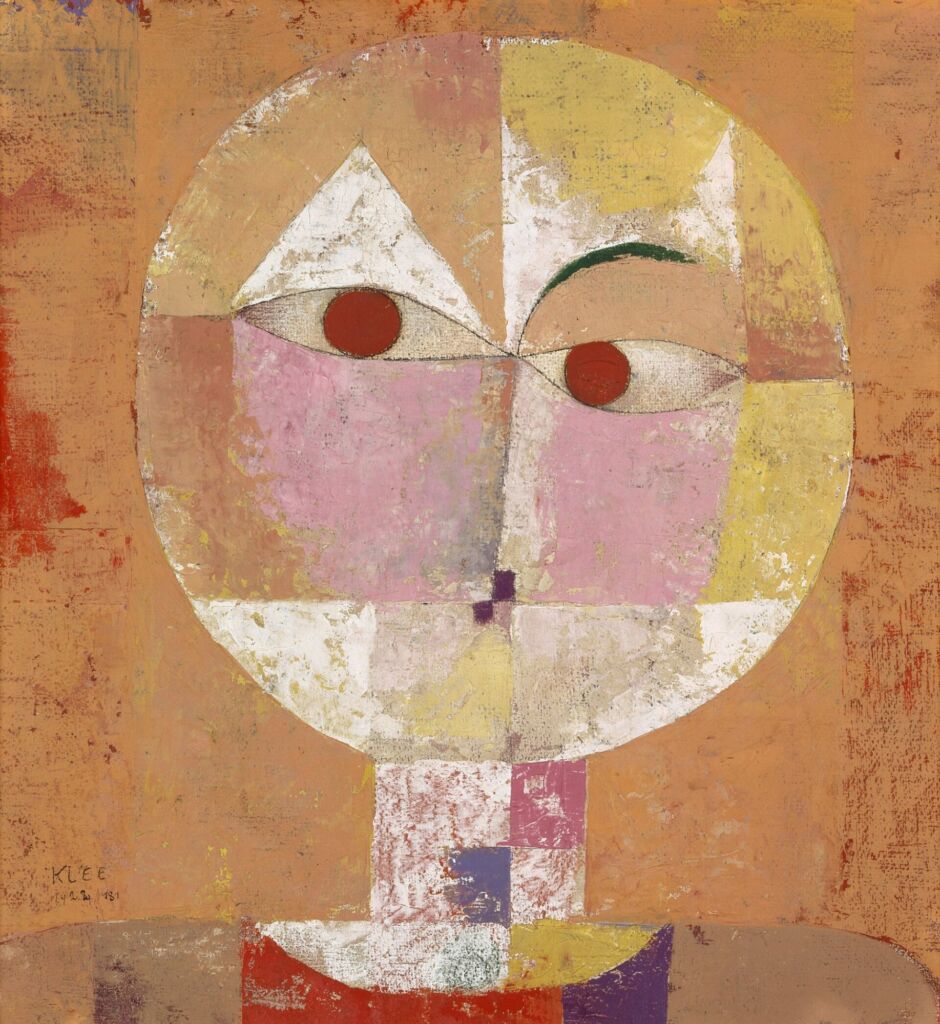
The most surprising thing about the history of this design school is its painters. Paul Klee taught there from 1921 to 1931, and Wassily Kandinsky from 1922 until the very end. In 1924, together with Feininger and Alexej von Jawlensky, they formed the Blue Four in order to exhibit in America. In Weimar Klee painted Senecio (1922, Kunstmuseum Basel) and Kandinsky Composition VIII (1923, Solomon R. Guggenheim Museum). Their lectures appeared in the Bauhaus Books series: Klee's Pedagogical Sketchbook (1925) and Kandinsky's Point and Line to Plane (1926). Oskar Schlemmer staged the Triadic Ballet and painted Bauhaus Stairway (1932, MoMA), and László Moholy-Nagy, who succeeded Itten, brought in photography and experiments with light. Former students grew into the school's next generation of masters, among them Marcel Breuer, Josef Albers and Herbert Bayer.
The school was under constant pressure. The conservative government of Thuringia cut its budget, and in 1925 the Bauhaus moved to Dessau, where its glass building, designed by Gropius, opened in December 1926. In 1928 the Swiss Marxist architect Hannes Meyer became director under the slogan "the people's needs instead of luxury"; in 1930 he was dismissed for his politics, and Ludwig Mies van der Rohe was brought in. In 1932 the Nazi majority on the Dessau council closed the school, and Mies moved it to Berlin, into a former telephone factory. In April 1933 the police searched the building, and in July the faculty themselves announced its dissolution.
The Russian connection runs through Kandinsky. He came to Weimar from Moscow, where after the revolution he had helped found the Institute of Artistic Culture and the Academy of Artistic Sciences, and his Bauhaus course grew out of his Moscow experiments. Moscow also had a parallel school of its own: VKhUTEMAS, the Higher Art and Technical Studios, founded in 1920, tackled the same problems, and the two schools followed each other closely.
The closure marked the start of the Bauhaus's worldwide spread. In 1937 Moholy-Nagy opened the New Bauhaus in Chicago; Gropius taught at Harvard and Mies in Chicago; from 1933 Josef and Anni Albers taught at Black Mountain College in North Carolina. Bauhaus graduates were among the architects who filled Tel Aviv with thousands of white buildings, and in 2003 the "White City" was added to the UNESCO World Heritage List. The tubular steel chair, the sans-serif typeface, the kitchen as a machine: much of everyday life in the 20th century was invented at this school.