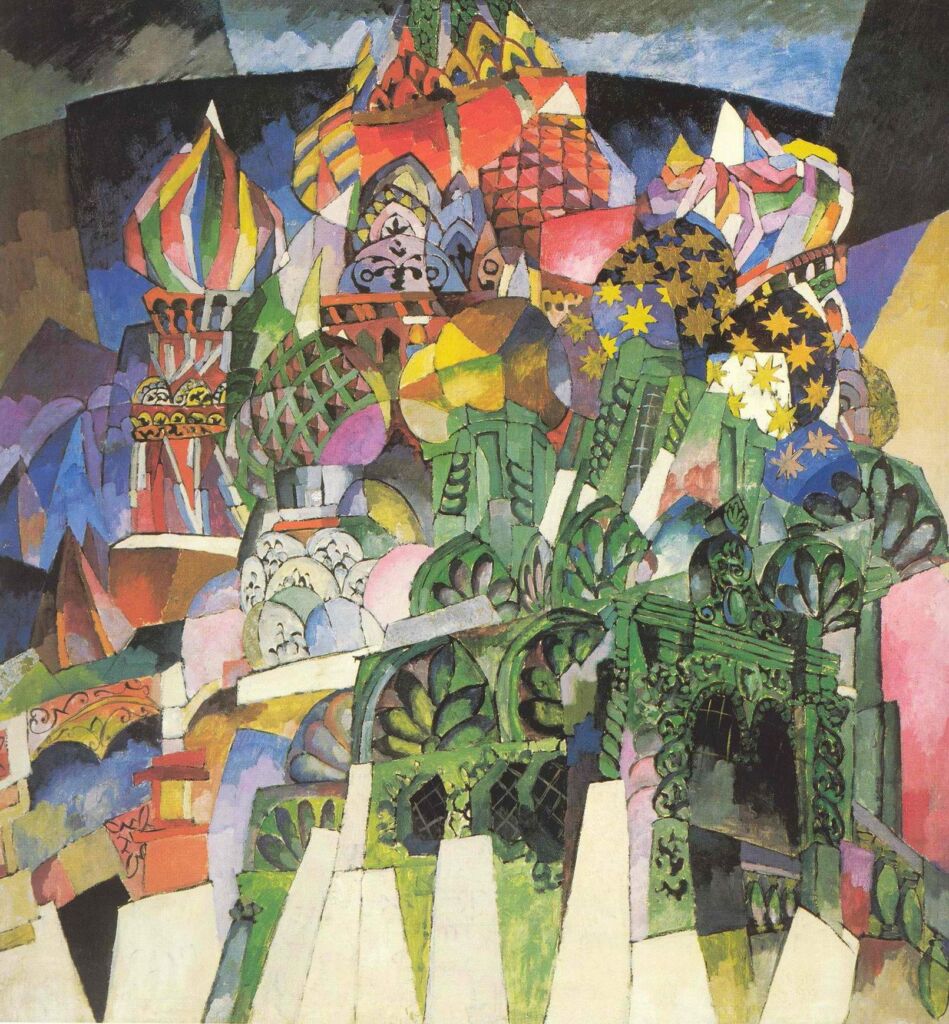
Aristarkh Lentulov, St Basil’s Cathedral, 1913
Jack of Diamonds
1910–1917 · Moscow
About the movement
The name was Mikhail Larionov's idea, and by his account he simply liked the sound of it. The public took it differently: in Russian card-playing slang a "jack of diamonds" was a cardsharp, convicts had a patch called the "ace of diamonds" sewn on the backs of their uniforms, and the exhibition's title seemed to promise a gambling den rather than art. The show opened on December 10, 1910, in the Levisson house on Bolshaya Dmitrovka Street in Moscow and ran until January 16, 1911. Thirty-eight artists took part, from Pyotr Konchalovsky, Ilya Mashkov, Aristarkh Lentulov and Alexander Kuprin to Larionov himself and Natalia Goncharova.
The "Jacks" set out to topple two authorities at once: academic training and the hazy, half-toned painting of the Symbolists of the Blue Rose group. Their chief teacher was Paul Cézanne, whose work could be seen in the original in Moscow, in the collections of Sergei Shchukin and Ivan Morozov. Alongside him came the Fauves and early Cubism. But they valued shop signs, painted trays, lubok prints (Russian popular woodcuts) and folk toys just as highly, for their dense, ringing color, weighty form and rough directness. Hence their banquet-like still lifes, in which bread, fruit and crockery carry more weight than the figures in an academic genre scene.
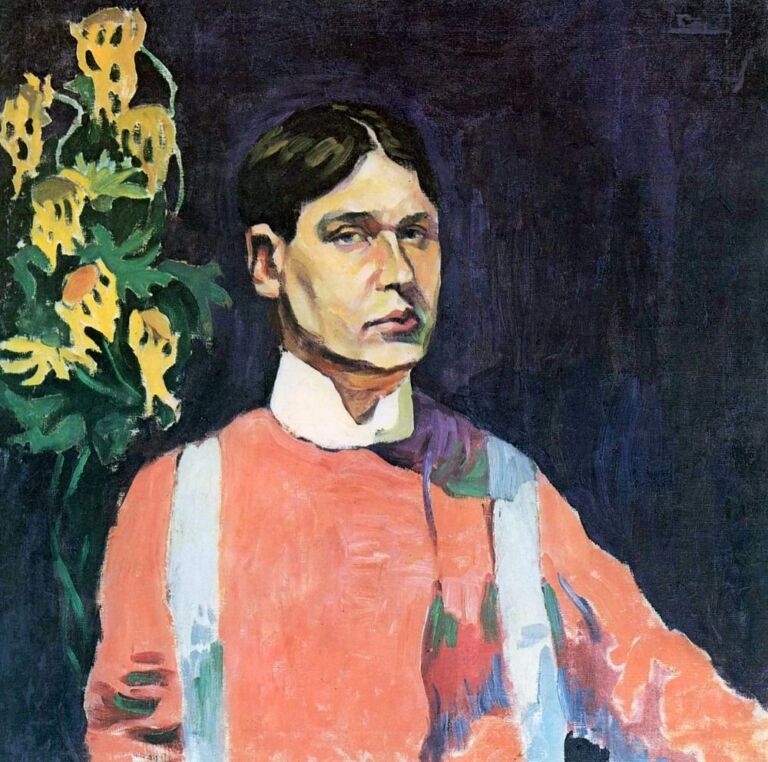
Key works of the period include Mashkov's Self-Portrait and Portrait of Pyotr Konchalovsky (1910), in which the two painters pose like circus wrestlers; Konchalovsky's Portrait of the Artist Georgy Yakulov (1910, State Tretyakov Gallery); and Lentulov's Saint Basil's Cathedral (1913, State Tretyakov Gallery), the Moscow landmark shattered into colored fragments, a trace of his study with the Cubists at the Académie de La Palette in Paris. Robert Falk also belonged to the core of the group. A late echo of the Jack of Diamonds still life is Mashkov's Moscow Food: Breads (1924, State Tretyakov Gallery), painted seven years after the society had broken up.
The first exhibition should not be seen as a purely Moscow affair. Through the French writer Alexandre Mercereau came paintings by Albert Gleizes, Henri Le Fauconnier, André Lhote and Jean Metzinger, and from Munich works by Wassily Kandinsky, Alexej von Jawlensky, Marianne von Werefkin and Gabriele Münter. There were Germans too, among them Alexander Kanoldt and Adolf Erbslöh, so Muscovites saw Parisian Cubism and German Expressionism side by side. It was this mixture, and not only the provocative name, that made the show the event of the season: young Russian artists exhibited on equal terms with the European avant-garde, not as its pupils.
The unity did not last. In 1911 the Jack of Diamonds society was formally constituted, with Konchalovsky as chairman, Mashkov as secretary and Kuprin as treasurer. Larionov and Goncharova, who found their former allies too "Parisian" and too complacent, walked out and in March 1912 opened the Donkey's Tail exhibition. The Jack of Diamonds went on exhibiting in 1912, 1913, 1914 and 1916; in 1912 Picasso, Matisse, Léger and Delaunay hung alongside the Muscovites. A common simplification needs correcting: not all the founders were outcasts from the art school. Mashkov was expelled from the Moscow School of Painting, Sculpture and Architecture in 1909, but Konchalovsky had studied at the Imperial Academy of Arts in St Petersburg and in Paris.
In 1916 Konchalovsky and Mashkov left the society and Kuprin became chairman; in October 1917 Kazimir Malevich was elected to the post. The last exhibition closed in the Levisson house in December 1917, and the society ceased to exist with it. But the painterly, Cézannist line did not disappear. Mashkov, Konchalovsky and Falk taught at Vkhutemas, the Moscow art and design school of the 1920s, and passed on to their students a culture of color and solid form that outlived both the avant-garde and Socialist Realism.
Artists
Major works
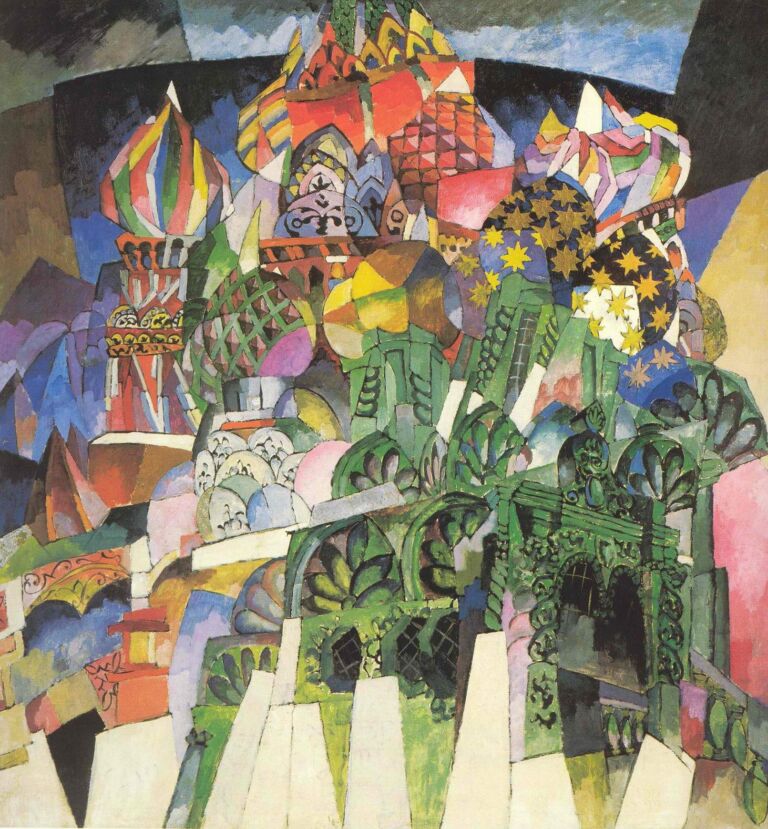 St Basil’s CathedralAristarkh Lentulov · 1913