Aristarkh Lentulov
Aristarkh Vasilyevich Lentulov · 1882, Nizhny Lomov district — 1943, Moscow
Biography
“My passion for the sun and bright light has stayed with me…” This was how Aristarkh Lentulov explained why his canvases ring so loudly. It all began far from the capitals, in the Nizhny Lomov district of Penza Governorate. His father, the village priest Vasily Lentulov, died in 1884, and his mother raised the boy alone, hoping he too would enter the church. Even his date of birth comes in two versions: reference books give January 16, 1882 (January 4, Old Style), while the parish register records March 26.
His road to painting was a winding one. After church school Lentulov entered the Penza Art School, headed by Konstantin Savitsky; in 1900 he left together with several classmates and went to Kyiv to study under Mykola Pymonenko. He was expelled in 1905 and received his diploma back in Penza in 1906. He failed the entrance exams for the Academy of Arts and joined Dmitry Kardovsky’s studio in St Petersburg. In 1908 he moved to Moscow and married Maria Rukina, a graduate of the Bestuzhev Courses, the women’s university courses in St Petersburg.
The breakthrough came in 1910–1911. In December 1910 Lentulov, together with Mikhail Larionov, Pyotr Konchalovsky, Alexander Kuprin and others, organized the Jack of Diamonds exhibition, and he then joined the board of the society of the same name. In 1911 he and his wife went to Paris, where he studied at the Académie de La Palette; sources disagree about his teachers there, naming either Jean Metzinger and Henri Le Fauconnier or Metzinger and Albert Gleizes. He brought Cubism back to Moscow but recast it in his own way.
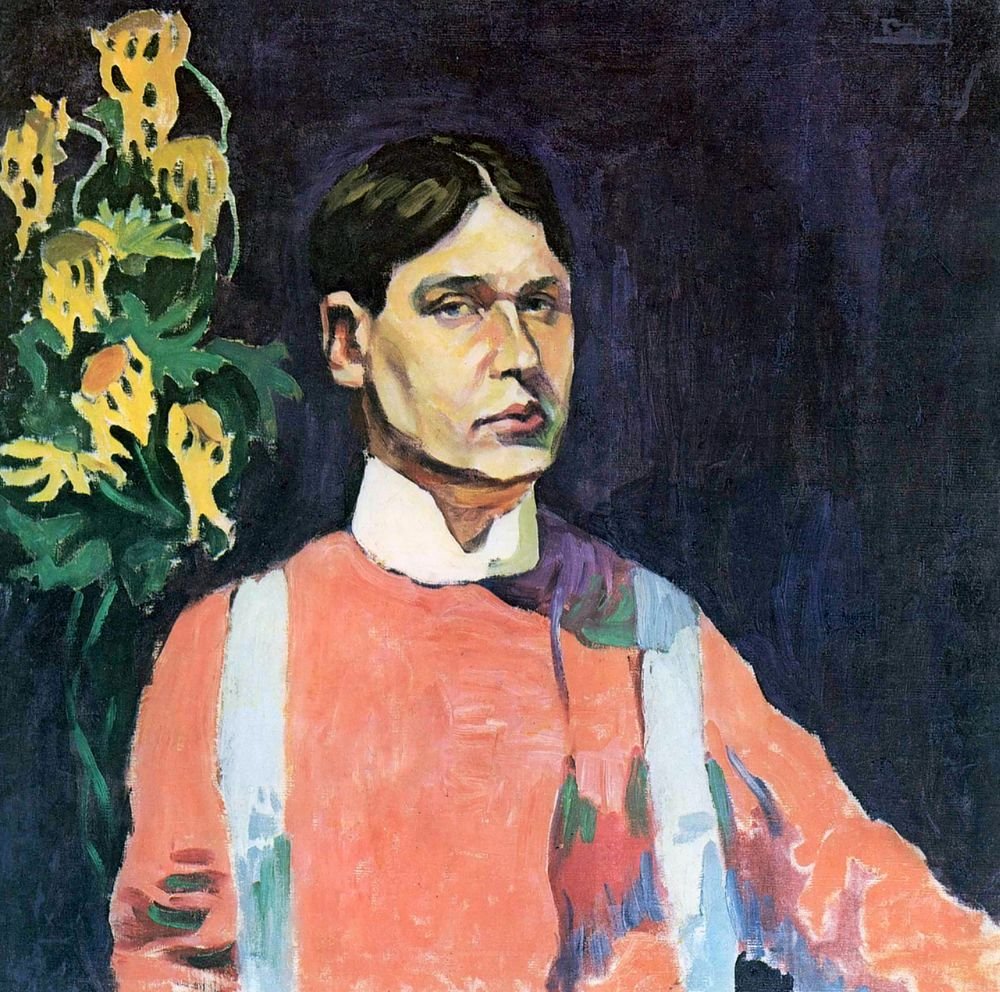
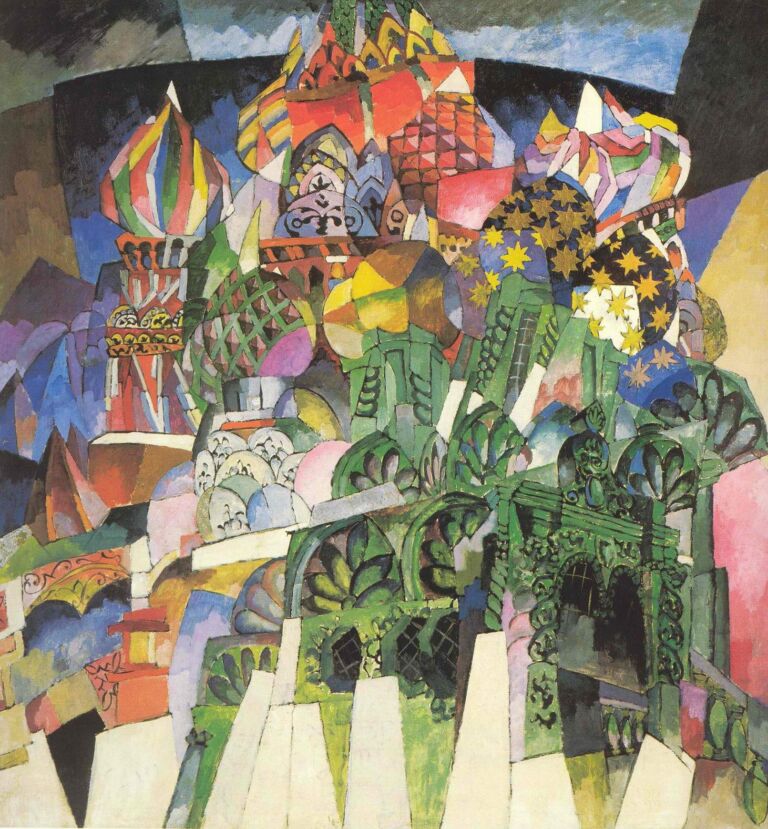
His major canvases date from 1913–1917, and nearly all of them are now in the State Tretyakov Gallery. St Basil’s Cathedral and Moscow were painted in 1913, Ringing. The Bell Tower of Ivan the Great and the manifesto self-portrait Le Grand Peintre (The Great Painter) in 1915, and At the Iverskaya Chapel in 1916. Decorative still lifes such as Asters also date from 1913. The early Self-Portrait in a Red Shirt, shown at the Stephanos and Wreath exhibitions, is in the St Petersburg State Museum of Theatre and Music.
How does he differ from the French Cubists? They broke a violin or a bottle into facets; Lentulov did the same with the churches of Moscow. He split domes and bell towers into planes of color and reassembled them into a festive, almost audible image of the city. The subject is not taken apart so much as set swinging, like a bell. The poet Maximilian Voloshin noted that Lentulov had none of the “cocky juggling of talent,” and Alexandre Benois wrote that his pictures “sing and gladden the soul.”
Lentulov also did a great deal of stage work: before the revolution, The Merry Wives of Windsor at Alexander Tairov’s Chamber Theatre (1916), then Scriabin’s Prometheus at the Bolshoi Theatre (1919) and later The Demon, which won a diploma at the Paris exhibition of 1925. From 1919 he taught at the State Free Art Studios, then at Vkhutemas and its successor Vkhutein, and from 1937 at the Moscow Art Institute. He left the Jack of Diamonds in 1916, and in 1928, with Ilya Mashkov and Vasily Rozhdestvensky, he founded the Society of Moscow Artists.
His later work is calmer. Night at Patriarch’s Ponds and Sunset on the Volga (both 1928) still carry his earlier energy, but in the 1930s he traveled around the Soviet republics, painted industrial landscapes and drew closer to official realism. In 1933 a solo exhibition in Moscow marked twenty-five years of his work. After a serious operation in 1942 he painted little, and he died on April 15, 1943; he was buried in the Vagankovo Cemetery.
Lentulov is best represented in the State Tretyakov Gallery. His work is also in the State Russian Museum; in the Savitsky Art Gallery in Penza, which holds Moscow Artists (1927) and his last self-portrait, from 1943; in the Perm Art Gallery; and in the Ryazan Art Museum.
Major works
Click a painting to see the details.
-
 01
St Basil’s Cathedral
1913 · State Tretyakov Gallery, Moscow
Related artists
 Konstantin Savitsky
1890s · head of the art school
 Mikhail Larionov
1910 · Jack of Diamonds
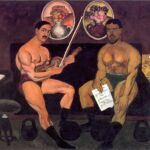 Ilya Mashkov
1910–1928 · Jack of Diamonds, Society of Moscow Artists