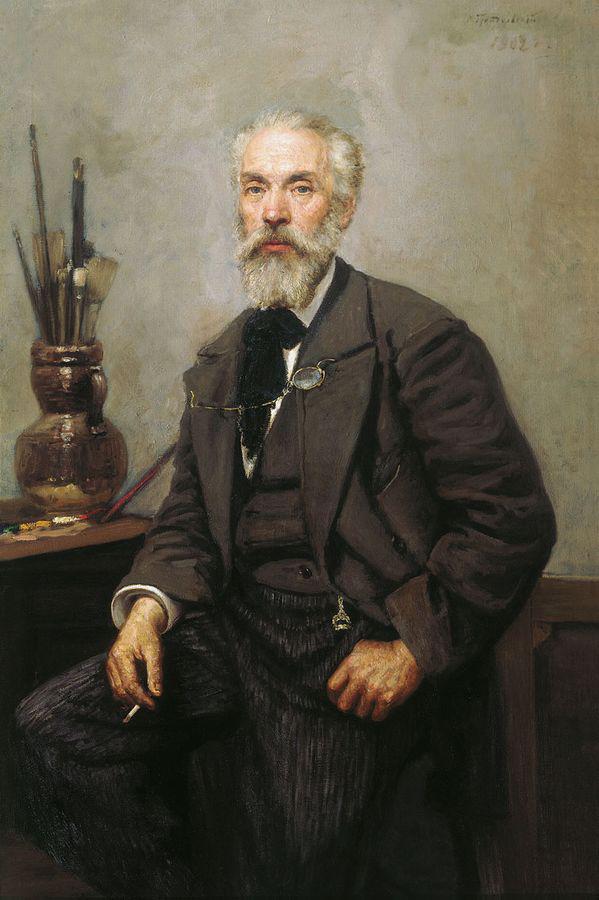
Konstantin Savitsky
Konstantin Apollonovich Savitsky · 1844, Taganrog — 1905, Penza
Biography
The most famous painting Konstantin Savitsky worked on does not bear his signature. He signed Morning in a Pine Forest (1889) next to Ivan Shishkin, but the signature later disappeared. According to a widespread version, Pavel Tretyakov removed it after buying the picture, saying that everything in it spoke of Shishkin's manner; according to the notes of the artist's wife, Savitsky painted over the signature himself. What is known is that it was Savitsky who suggested the idea to his friend and painted the bears. The story also sums up his career: a major genre painter of the Peredvizhniki whom the wider public knows through another man's fame.
He was born on June 6, 1844 (May 25, Old Style), in Taganrog, the son of an army doctor. His parents died early, and he was raised by relatives. In 1862 Savitsky entered the history painting class of the Academy of Arts, where he studied under Fyodor Bruni, Alexei Markov and Pavel Chistyakov. Medals followed one after another, from small silver medals for The Organ Grinder in 1868 to the small gold medal for Cain and Abel in 1871. Then came a scholarship abroad: Dresden, Düsseldorf, Paris. He was also drawn to etching.
From 1872 Savitsky exhibited with the Peredvizhniki, and in 1878 he became a member of their society. His first success was Repair Work on the Railway (1874), shown at the third traveling exhibition. Tretyakov offered a thousand rubles, and the artist accepted on condition that the picture first tour other cities; in 1878 it was sent to the World's Fair in Paris. Savitsky painted Welcoming the Icon (1878) in Dinaburg (now Daugavpils, Latvia), where his sister's family lived, and Tretyakov bought it straight from the exhibition for two thousand. To War, dated to either 1880 or 1888 (the artist later cut up the first version), is in the Russian Museum; his other major works are in the Tretyakov Gallery.
Savitsky built a genre painting as a crowded scene in which the crowd itself is the protagonist. He was interested not in anecdote or individual character but in mass movement: a gang of navvies, a religious procession, recruits being seen off to the army. Hence his wide formats: Welcoming the Icon is 228 centimeters across.
Critics received him sympathetically. Ivan Kramskoy wrote that Savitsky had “stood out very favorably” at the exhibition, and Vladimir Stasov called Welcoming the Icon the most important work of the sixth traveling exhibition. The newspaper Moskovskie Vedomosti, by contrast, saw the priest in it as a “pathological type.” The gallery's keeper, Nikolai Mudrogel, recalled how the artist, while Tretyakov was away, touched up the cracked clouds in Welcoming the Icon; Tretyakov asked for turpentine and washed the retouching off.
From 1883 to 1889 Savitsky taught at the Stieglitz Central School of Technical Drawing in St Petersburg, and in 1891 he moved to the Moscow School of Painting, Sculpture and Architecture, where from 1894 he ran the life class. In 1895 he became a full member of the Academy of Arts, and in 1897 he was named academician of painting “for renown in the artistic field.” He spent his last years in Penza as the first director of the N. D. Seliverstov art gallery and art school. He died there, in his official apartment at the school, on February 13, 1905 (January 31, Old Style). His second marriage, to Valeria Dumoulin, produced seven children; his son Georgy also became a painter.
His major paintings are in the State Tretyakov Gallery and the State Russian Museum. The Penza art gallery he once headed now bears his name. In the history of the Peredvizhniki, Savitsky remains the artist who put the Russian crowd on canvas; for everyone else, he is the man who painted Shishkin's bears.
Major works
Click a painting to see the details.
-
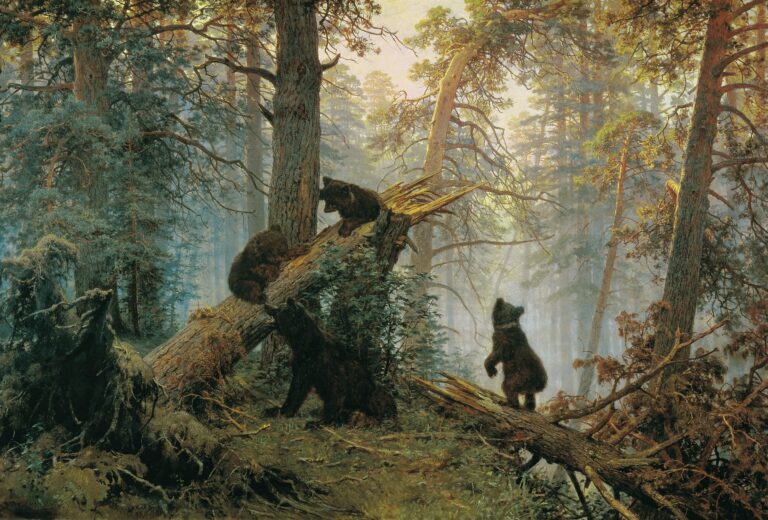 01
Morning in a Pine Forest
1889 · State Tretyakov Gallery, Moscow
Related artists
 Ivan Shishkin
1889 · co-author of Morning in a Pine Forest
 Ivan Kramskoy
1870s · fellow Peredvizhnik, critic